

"Flood Prevention First" turns "victims" into "water managers" through the principle of "knowing first – preparing first – preventing first," advancing toward a Water Economy approach that values water as an economic resource rather than a risk.
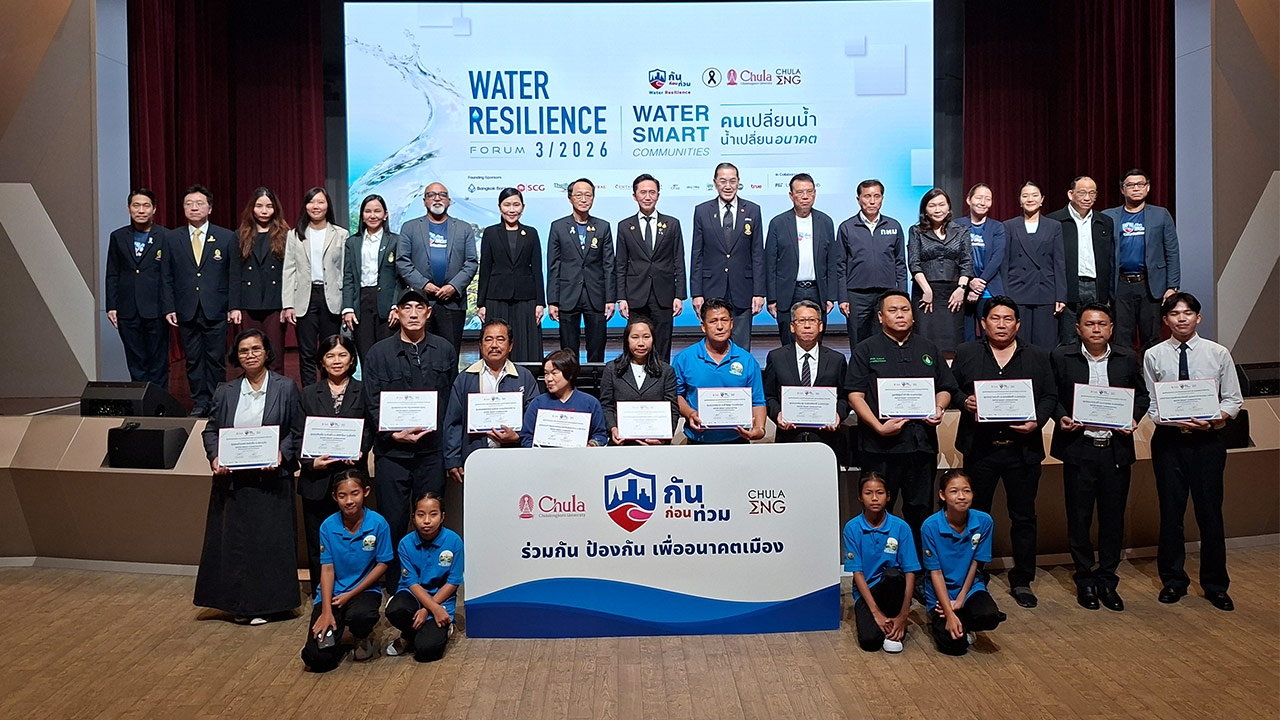
The Flood Prevention Center joined forces with partner networks to hold the 3rd Water Resilience Forum titled "WATER SMART COMMUNITIES – People Change Water, Water Changes the Future." The event gathered leaders from government, academia, and communities to extract lessons from model communities, highlighting that Thailand possesses the knowledge, science, technology, and practical models to promote preventive water management across all provinces. The focus is shifting from reactive disaster response to early knowledge, preparedness, and proactive water management that transforms water from a hazard into a resource for quality of life and economic value.
On 4 September 2026, the Flood Prevention Center at Chulalongkorn University's Faculty of Engineering collaborated with partner networks to host the 3rd Water Resilience Forum "WATER SMART COMMUNITIES – People Change Water, Water Changes the Future" at Chulalongkorn University's Faculty of Engineering auditorium. The event aimed to build cooperation to shift Thailand’s water management from reactive responses toward sustainable preparedness and prevention.
Professor Emeritus Dr. Surakiat Sathirathai, Chairman of Chulalongkorn University Council, opened the event by emphasizing the importance of water. He described water as the lifeblood of the Thai people, whose lives have been intertwined with rivers and waterways from the past to the present.
Drawing from his experience assisting communities in numerous areas as Vice Chairman of the Advisory Board of the Volunteers Foundation of the Thai Red Cross Society, Dr. Surakiat highlighted that the impact of water-related disasters goes far beyond economic losses. It causes profound losses of life, homes, farmland, property, livelihoods, and income. Many families lose everything they have built over a lifetime in less than a night.
The 2011 mega-flood caused economic damages estimated at about 1.43 trillion baht, equivalent to 70% of the national budget. The 2025 southern floods, especially in Hat Yai, caused damages exceeding 25 billion baht. Severe flooding in Nan, Kanchanaburi, and other provinces, along with major floods in Nepal, serve as warnings that water-related risks and natural disasters are becoming increasingly severe and complex.

The true cost of water disasters is not measured only by lost property value but also by impacts on quality of life, job security, and the continuity of the national economy. These costly lessons teach us that the expense of waiting for floods before responding far exceeds the investment needed for preparedness and preventive measures.
Moreover, the World Bank has estimated that if Thailand faces flooding similar in scale to the 2011 mega-flood again by 2030, the country could lose nearly 10% of its gross domestic product (GDP).
Therefore, Thailand's crucial challenge today is not only how to better respond to floods after they occur but fundamentally to enable each area to "know its own water"—to assess and understand risks and to manage and prepare systematically before natural disasters arrive.
Professor Dr. Yossanan Wongwatsawat, Deputy Prime Minister and Minister of Higher Education, Science, Research and Innovation, shared his vision on "Science, Innovation, and the Future of Water Smart Communities," stating that
to address flooding, the government has clearly assigned oversight by region. He oversees the entire Northern region and acts on-site when situations escalate, applying a Single Command system for speed and unity. This supports rather than overrides provincial governors, who best understand their areas. The government's role is to coordinate assistance beyond provincial capacity—mobilizing military, machinery, heavy equipment, and personnel from various ministries promptly to fill gaps.
Before flooding crises, preparatory meetings with key agencies such as the Office of the National Water Resources, the National Science and Technology Development Agency, the Meteorological Department, and the Royal Irrigation Department consolidated data centers. However, during actual events, especially with heavy localized rainfalls known as "Rain Bombs" in highland areas like Nan, flash floods rush down waterways and roads with high speed. A key lesson is that precise telemetry systems at headwater points, issuing warnings at water levels above 50-60 millimeters, can alert residents in time. While telemetry downstream allows district centers to prepare, residents in hillside or elevated communities still worry. Therefore, installing additional telemetry upstream on mountains is urgently underway in cooperation with the National Science and Technology Development Agency.
At disaster sites, the most critical needs on day one are food and transportation. Past experiences show that traditional bureaucratic systems may be too slow in crises, so flexible work models are needed. Agencies can temporarily cross-function, such as having irrigation units procure food for relief first, coordinating volunteers to assist with cooking, or mobilizing boats from various agencies to reach isolated areas. Another successful example is the Ministry of Transport's rapid construction of Bailey Bridges, connecting isolated mountain villages within 2–3 days, facilitating patient transport and timely delivery of supplies. Behind the scenes, medical personnel, community hospitals, and emergency medical teams work tirelessly; these groups are vital to helping disaster victims through crises.
For relief efforts, the government accelerated approval of central budget and contingency funds under provincial governors’ authority to urgently distribute survival kits, cost-of-living allowances, and home repair funds, especially for homes completely destroyed beyond normal compensation limits. Additional budgets were allocated for comprehensive care. However, lessons show that even expedited state compensation processes may lag behind people’s urgent needs. Future plans include implementing a disaster insurance system, enabling private sectors to assess and pay compensation immediately after events.
Another critical issue during crises is communication. The government opted for a One Stop Service press briefing twice daily, morning and evening, due to continuously changing information. Transparent, consistent communication reduces public panic. Occasionally, bringing media to monitor water levels on-site or live streaming real-time nighttime situations helps build public confidence.

Professor Dr. Yossanan added that long-term solutions must return to the "First Principles" of nature: "Water knows no administrative boundaries and always flows from higher to lower ground." The words of King Rama IX remind us that obstructing water leads to flooding. Therefore, overlay maps showing actual water flow should guide planning rather than just administrative lines. Integrating modern technology with local wisdom is essential because local people know their water best. This approach leads to sustainable self-managed communities or Water Smart Communities.
Ultimately, the greatest lesson in water management is shifting from reactive disaster response to creating a "Water Economy" and sustainability. Inspired by Japan’s urban design, water management becomes a seamless part of daily life through the dual-use concept, such as public parks designed as retention basins that serve as recreational spaces during normal times but absorb floodwaters when needed; park equipment that converts into kitchens and rescue tools during evacuation; rooftop ponds as emergency water reserves; and stairways designed as evacuation routes to rescue centers.
All these lessons show that sustainable flood solutions require more than engineering—they demand integration across science, social sciences, urban planning, and information technology to transform cities and communities into places that safely coexist with water and ensure a sustainable future.
Beyond national policy strategies, grassroots momentum is reflected in model communities across regions that effectively manage their own water resources.
Chiang Dao, Chiang Mai Province: "Upstream People Building a Shared Future"
Kasara Jaidee, secretary of the Thung Chao Water User Group Fund in the Chiang Dao area, explained that Doi Luang Chiang Dao is the source of water for their community. When water volume exceeds capacity, they rely on the traditional Lanna-style irrigation dam system passed down over generations. The community appoints a 'Kaew Fai' or dam head to control, oversee, and allocate water so the dam distributes water fairly.
Kasara described challenges faced by Thung Chao dam from drought, water shortages, and flooding that damage crops, as well as issues with the dam itself. The dam, built from many logs blocking water flow to slow water entering the community, uses bamboo stakes for reinforcement. Later, the government constructed concrete dams, but these deteriorated over time, while water flow continues unabated.
Sufficiency Economy 9D Learning Center, Buriram Province: "Water Management Builds Security and Income"
Kunengnit Chanamo, founder of the Sufficiency Economy 9D Learning Center in Buriram, said that previously villagers farmed rice once a year (about four months) and lacked alternative livelihoods during the rest of the year, causing income insecurity. The village has a central reservoir holding about 1.3 million cubic meters of water, formerly used only during the rice season. They transformed this into an organic agriculture center using solar-powered irrigation and constructed retention basins for drought periods, generating about one million baht annually.
Kunengnit added that the center has extended this model to neighboring communities by identifying local water sources to start water-retentive agriculture and experimenting with new rice varieties, which evolved into products generating community income.
Songwat, Bangkok: "Living with Water, Building an Economy"
Kiatwat Srichanwanphen, president of the Made in Songwat Association, said that about 30 years ago, Songwat area suffered from tidal floods, stagnant water, and seawater intrusion. About 10 years ago, the construction of a giant tunnel helped mitigate these issues. In the past four years, floodwalls have been built throughout low-lying Bangkok, lessening severe impacts.
From September to November, local agencies place sandbags at key points. When water levels rise, officials block water flow to direct it through pipes into the giant tunnel.
Phraek Nam Daeng, Samut Songkhram Province: "Water Creates Friendship"
Panya Tokthong, from the Mae Klong Lover Community Network, explained that water gates built by government agencies separate fresh and saltwater. Opening one side causes flooding on the opposite side, affecting farmers differently despite being in the same river basin. Therefore, they innovated water gates based on the Ban Mub model—"Mub" means close, "Pey" means open—where at night, wooden braces open one gate, alternating with the other gate during the day.