

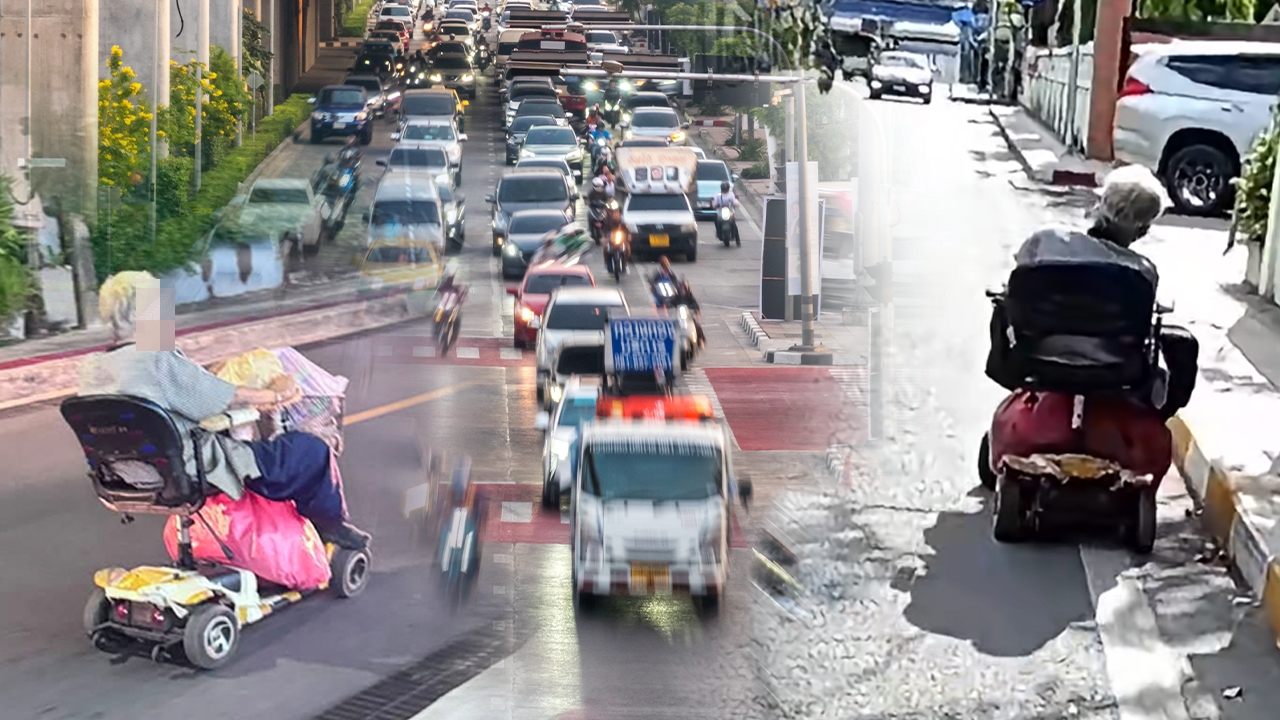
Lessons from the 'Inheritance Accelerators'—elderly riding electric tricycles on main roads—The Accident Reduction Network suggests a three-level approach starting from family, community, and society to jointly enforce regulations before losses occur.
Regarding the case 'Inheritance Accelerators' or small electric tricycles used by elderly people to travel within private areas or secondary roads in communities, but problems have increased after these vehicles were driven on main roads, risking fatal accidents. These vehicles have low speed, fragile structures, and lack safety features such as clear signal lights. Such vehicles cannot be registered for public road use.
Bringing unregistered small electric tricycles onto highways may violate several laws: under the Motor Vehicle Act 1979, Section 6 prohibits using unregistered vehicles on roads, punishable by a fine up to 10,000 baht.
Under the Land Traffic Act 1979, Section 43, slow vehicles mixing with regular traffic may obstruct traffic and pose accident risks, punishable by a fine of 400 to 1,000 baht. Driving on sidewalks violates the Cleanliness Act with fines up to 5,000 baht.
A well-known case is 'Grandma Speedster' in Setthakit Village, Bang Khae district, Bangkok, who drove onto a main road against traffic, hitting a police cone. Witnesses saw this behavior multiple times and feared accidents could happen.
Thairath Online's special team visited and found the elderly woman lives alone with a bent back and uses a wheelchair, making public transport inconvenient. Taxi drivers often refuse her, so she bought an electric tricycle for errands like shopping. She has been sideswiped before but received no motor vehicle insurance compensation because her vehicle is unregistered.
This case reflects that 'small electric tricycles' may be necessary for some people, but responsible agencies must ensure these vehicles are safer for both drivers and other road users.

Mr. Prommin Kanthiya, Director of the Accident Reduction Network Office (ARN), commented on the case 'Inheritance Accelerators' that it must be divided into two parts: first, 'the vehicle' which is an electric tricycle with limited torque, designed for small areas or community use to help elderly avoid walking effort. It is unsuitable for main roads due to high accident risk from low speed, risk of being rear-ended, difficulty making U-turns, and fragile structure that could tip over even on small speed bumps.
The second part is 'the user' Even young people find such vehicles hard to use; for elderly with declining physical, hearing, and vision abilities, it is especially inappropriate to drive on main roads.
"These vehicles are challenging to ride even in communities when encountering speed bumps or oncoming vehicles. Using them on main roads greatly increases risk, leading to frequent accidents among elderly over 60 who use these tricycles, earning the nickname 'Inheritance Accelerators.'"
Legally, these vehicles cannot be registered because their motor power is under 250 watts, while the law requires a minimum of 4,000 watts. Their top speed is only 25 km/h, below the minimum 45 km/h standard.
Regarding sales control, it is difficult because when used properly as intended, they provide benefits by helping elderly reduce effort and maintain local mobility, avoiding isolation at home.
"Regarding sales, the intent is for local, community use. The problem lies in misuse. Therefore, no matter how many laws are made, enforcement is difficult unless sales are banned outright. However, banning sales could backfire, causing elderly to switch to motorcycles, increasing danger."

Mr. Prommin emphasized that enforcement should focus on preventing these vehicles from being used on main roads, proposing a three-level enforcement approach.
family members should communicate clearly to elderly that these vehicles are for home or community use only, giving clear reasons rather than simply forbidding use, which may provoke resistance. If elderly must travel outside for essential errands such as hospital visits, family members could take turns accompanying them.
Driving electric tricycles on main roads also raises family financial risks because accidents lack motor vehicle insurance protection or compensation.
community leaders like village heads, local officials, and staff must discuss and implement clear community measures, such as public announcements or signs warning against using electric tricycles outside the community or on main roads, and regularly inform about dangers.
Communities play a crucial role, especially for elderly living alone without constant family care who need these vehicles for essential trips like buying food or hospital visits. Communities could survey how many elderly need transport assistance, then design supportive measures such as volunteer caregivers or arranging shuttle services for errands and hospital visits.
"Good examples exist in many subdistricts, especially rural areas, such as organized shuttle vehicles for mutual care, inviting doctors to provide services within communities, and assigning village health volunteers to assist households, reducing elderly travel alone."
law enforcement officers like police and volunteer police must inspect and prevent electric tricycles from being driven outside permitted areas. Police currently warn and enforce when they spot violations, but some cases slip through, so prevention must begin at the family level.