

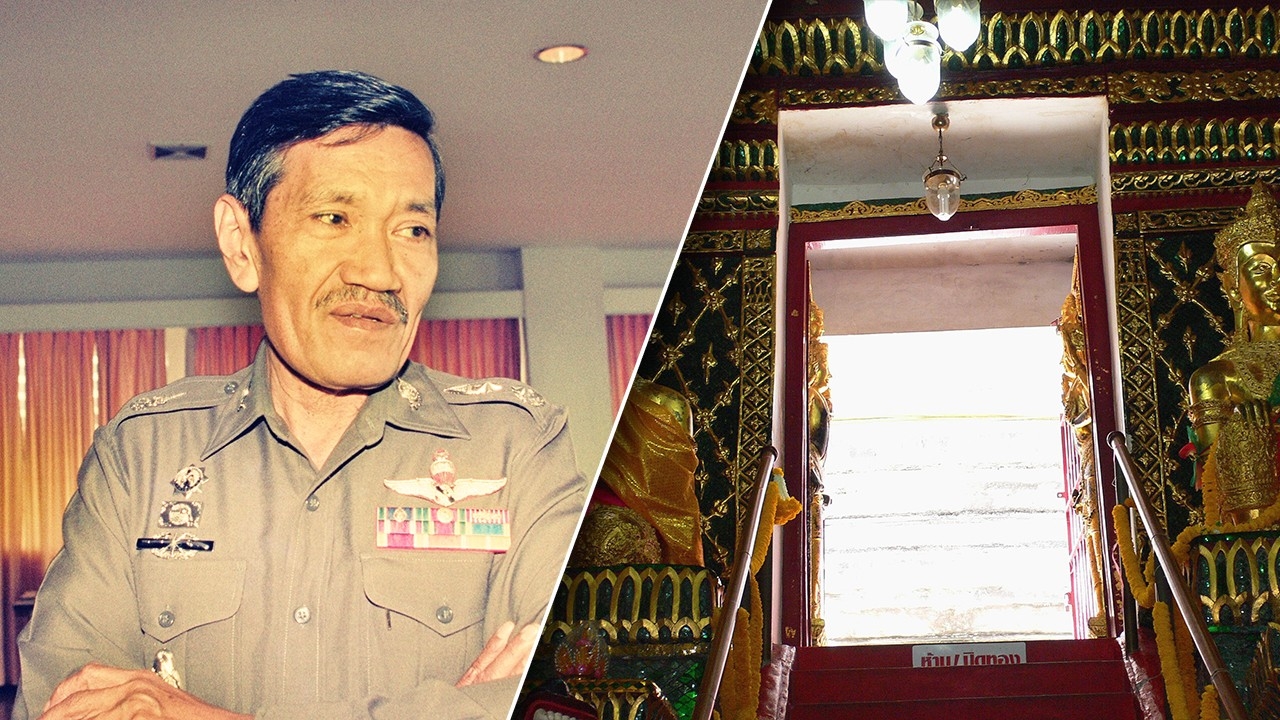
At the height of the rising faith in 'Jatukam Ramathep,' the phenomenon of round amulets caused a widespread stir. Yet, behind the commercial Buddhist scene and mass believers, only a few know that the true root of the ritual invoking Jatukam Ramathep did not begin at amulet stalls or speculation but stemmed from mathematics, astronomy, and the intent to protect the city by Pol. Lt. Gen. Sanphet Thammathikul, former Provincial Police Commander of Nakhon Si Thammarat.

In 1985 CE, Nakhon Si Thammarat Province was in a dark era with rampant crime from gunmen gangs and outlaw influence. Pol. Lt. Gen. Sanphet (his rank at the time), as police commander, saw that the city's problems were not just criminal cases but connected to the city's fate, which had long been troubled.
The construction of the city pillar shrine and the invocation of Jatukam Ramathep between 1985 and 1987 CE were carried out solely to "bind the city's fate anew to restore peace to the land." At that time, there was no price set for the amulets, no commercial promotion, and all sacred objects were distributed only to officials, police, military, and citizens who participated in the ceremonies.
While most sacred objects in Thailand are linked to occultism and empowered by revered monks, Pol. Lt. Gen. Sanphet’s line followed a completely different framework.
Astronomy and solar-Brahminical sciences were used, with ritual calculations based not on general auspicious times but on the orbits of stars, the sun, and the moon according to ancient Srivijaya traditions, to determine geographic coordinates for ceremonies both on land and at sea.
The round amulet originated with Pol. Lt. Gen. Sanphet creating a large spherical sacred object to contain the "Sun and Moon Emblems" and to inscribe the Rahu eight-direction yantra balanced according to cosmic principles.
The representative sculpture depicts Jatukam Ramathep in the "Great Royal Posture" (seated with bent knees), referencing the Avalokitesvara Bodhisattva of the Srivijaya era, combined with the seven-headed Naga symbol to serve as a conduit to harness divine solar-lunar energies to protect the bearer.
Pol. Lt. Gen. Sanphet confirmed that the city-opening ceremony was fully completed by 1987 CE, with the deities having returned, so there was no need for repeated empowerment rituals or creating new batches for sale.

As Jatukam Ramathep's influence spread to central Thailand, the name 'Sami Choti' (former monk Choti) became one of the leading figures promoting widely produced Jatukam amulets, creating long queues for amulet rental.
As the keeper of the original science, Pol. Lt. Gen. Sanphet openly stated that such production was "mixing the name of Jatukam Ramathep with Buddhist consecration ceremonies typical of central Thailand," which distorted the ancient Srivijaya divine sciences.
He also explained that claims of continuous communication or invocation of the deity by Sami Choti were personal beliefs and fabrications, since the original divine Vedic rites did not include possession or communication. Sami Choti’s eventual downfall confirmed Pol. Lt. Gen. Sanphet’s warning that using the deity’s great power outside the original science for commercial gain inevitably leads to decline.
