

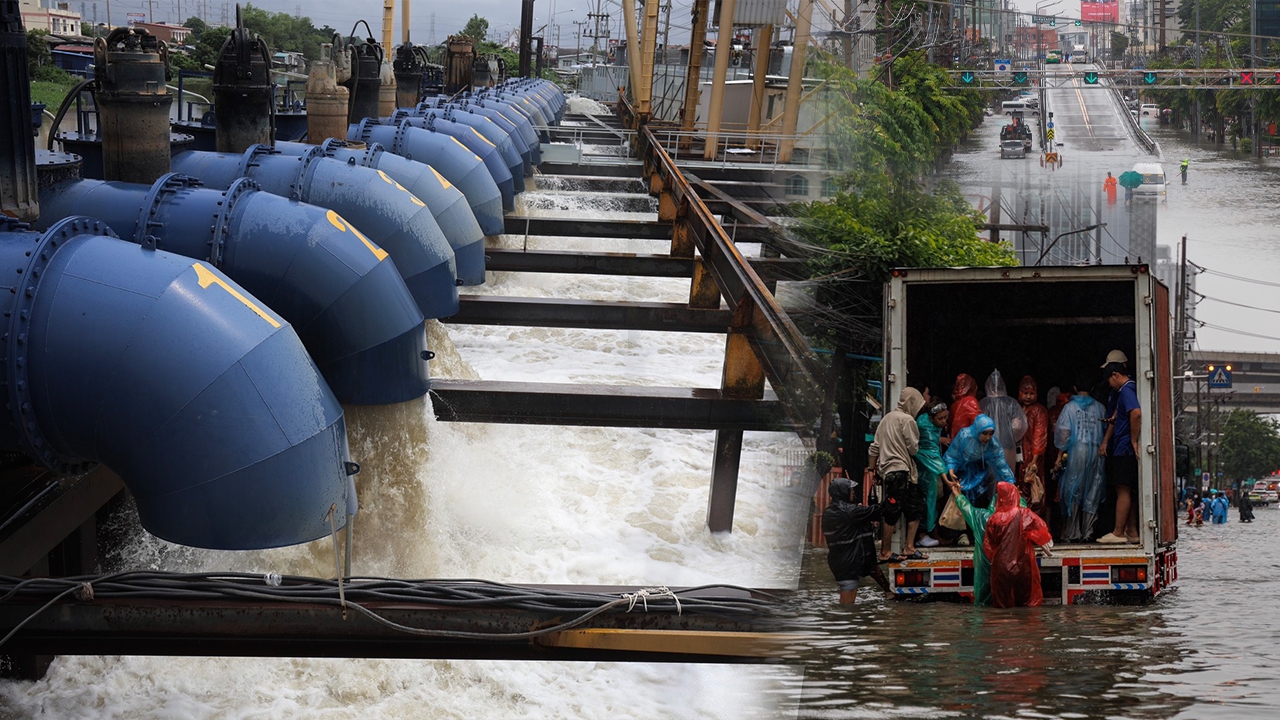
Explaining why, despite the rain stopping, some areas in Bangkok remain deeply flooded. Water authorities and experts highlight spatial constraints like basin-shaped depressions and turtle-back terrain. Main canals receive water from all directions, but some pumping stations are not yet operating at full efficiency. The situation is expected to return to normal within one week.
Since heavy rains hit Bangkok starting 24 Sep, many areas have experienced severe flooding, making roads impassable. Although rainfall has eased as of today (27 Sep), many locations still have high water levels, some even worse than before, raising public questions about the true causes.
The Thairath Online special reporting team inquired into this issue with Mr. Thanaroj Waratsaprasert, Director of the National Water Command Center (NWCC) at the Office of National Water Resources (ONWR), and Assoc. Prof. Dr. Seri Suparat, Director of the Climate Change and Disaster Center at Rangsit University and Vice Chairman of the National Disaster Warning Council Foundation.

Mr. Thanaroj explained that the current rain has moved westward, causing rainfall in Bangkok and its vicinity to lessen. Although some cloud clusters follow, they are not large enough to cause prolonged heavy rain like before. Areas still deeply flooded or with rising water despite no new rain are likely low-lying basins retaining water, awaiting drainage.
Previously, Bangkok had prepared for the rain by lowering water levels in canals to the minimum. However, heavy rains on 25-26 Sep caused water levels in prepared areas to exceed critical thresholds, especially in places with physical constraints such as basin-shaped depressions or turtle-back topography.
Additionally, some water could not be pumped out to the pumping stations quickly enough. Even with many pumps, they might not operate at full capacity, as only a few are run at a time to allow water to fill the pump basins; pumps cannot work if water levels are too low. There are also limitations from equipment failures or the need to rotate pump usage for maintenance. For example, at the Rangsit pumping station, out of 20 pumps, only 15 operate in rotation with rest periods. If water flow is insufficient, fewer pumps may be used.
Water gates may be opened to push water out during low tide, but if closed late, seawater can flow back in. Between 25-30 Sep 2026, there was tidal water intrusion.

, Assoc. Prof. Dr. Seri predicts that persistent flooding despite no rain is due to high water levels in canals. This is not just in Bangkok; all surrounding areas are actively draining water into canals, causing continuous inflow.
“The point is, it’s not only Bangkok but all areas diverting water into canals. Pumps at canal outlets are overwhelmed. If water levels don’t drop, it means pumping capacity has reached its limit.”
Assoc. Prof. Dr. Seri recommends organizing drainage into blocks, assessing water volume per block, determining pump needs, and clearing each block gradually to speed up operations. For flooded roads and damaged vehicles, relevant agencies like the Department of Disaster Prevention and Mitigation (DDPM) or the Office of Insurance Commission should provide psychological support and guidance. Bangkok must clearly communicate to residents when water levels will recede in each area.

Regarding water management, Mr. Thanaroj disclosed there is the Rapeepat Canal, a northern water receiving canal where authorities have reduced outflow, diverting water toward the Rama VI Dam to prevent adding water to already flooded areas.
Under normal conditions, the pumping system allows for 3 hours of surface flooding and can lower canal water to minimum levels within a day. Currently, nearly 80% of Bangkok’s canals remain at critical (red) levels, accumulating water awaiting pumping while rainfall has decreased.
The situation is expected to improve within 1-2 days except in low-lying areas or basins where drainage systems cannot function properly and additional pumping is required per area. Normalcy is expected within a week depending on district capacity or sharing of equipment among districts already recovered.

Mr. Thanaroj revealed that the rain cluster moving west is forecasted to continue toward the upper area above the Chao Phraya Dam, potentially adding more water. Rainfall of up to 100 millimeters in one day would not rapidly increase water levels and the situation would improve, but heavier rain would require revising water discharge plans.
The Chao Phraya Dam’s water discharge plan is set at 2,500 cubic meters per second. At this rate, river levels in Bangkok would rise by no more than 30-50 cm, reaching +2 meters above mean sea level, which is below Bangkok’s flood barrier at +3.5 meters, and is considered manageable.
Addressing physical geographic issues is a major task. Mr. Thanaroj noted ongoing large-scale irrigation management projects like the Chainat-Pasak and Pasak Yai projects aimed at solving flooding and drought problems in central Thailand.
This includes expanding canals both longitudinally and transversely in Bangkok and improving slopes to allow smoother drainage, such as the Pravet Canal, which is a basin-like depression requiring canal water to rise and overflow before draining to lower areas.

As of today (27 Sep), Bangkok Governor Chadchart Sittipunt reported that the overall rainfall situation has improved because the low-pressure area affecting the city over the past three days has moved westward. Current rainfall is typical monsoon rain with reduced amounts expected.
However, the Drainage Department continues to expedite water drainage. Canals near the Chao Phraya River are seeing water levels decrease, but main canals remain critically high (red level), including Prem Prachakorn, Lat Phrao, Saen Saeb, and Pravet-Buriram canals. The main challenge is that pumping water out of these canals causes surrounding water to continuously flow in, replenishing the system.
Going forward, Bangkok will focus on pushing water from Saen Saeb and Pravet-Buriram canals from east to west toward the Chao Phraya River. Once water levels in these main canals drop, pumps can be deployed more effectively to clear water from smaller side alleys.