

Civil society opposes the World Bank and IMF, criticizing their support for big capital and calling for a complete overhaul of Thailand's economic structure, with the state acting as market guard and stall renter to stop blue capital's monopoly.
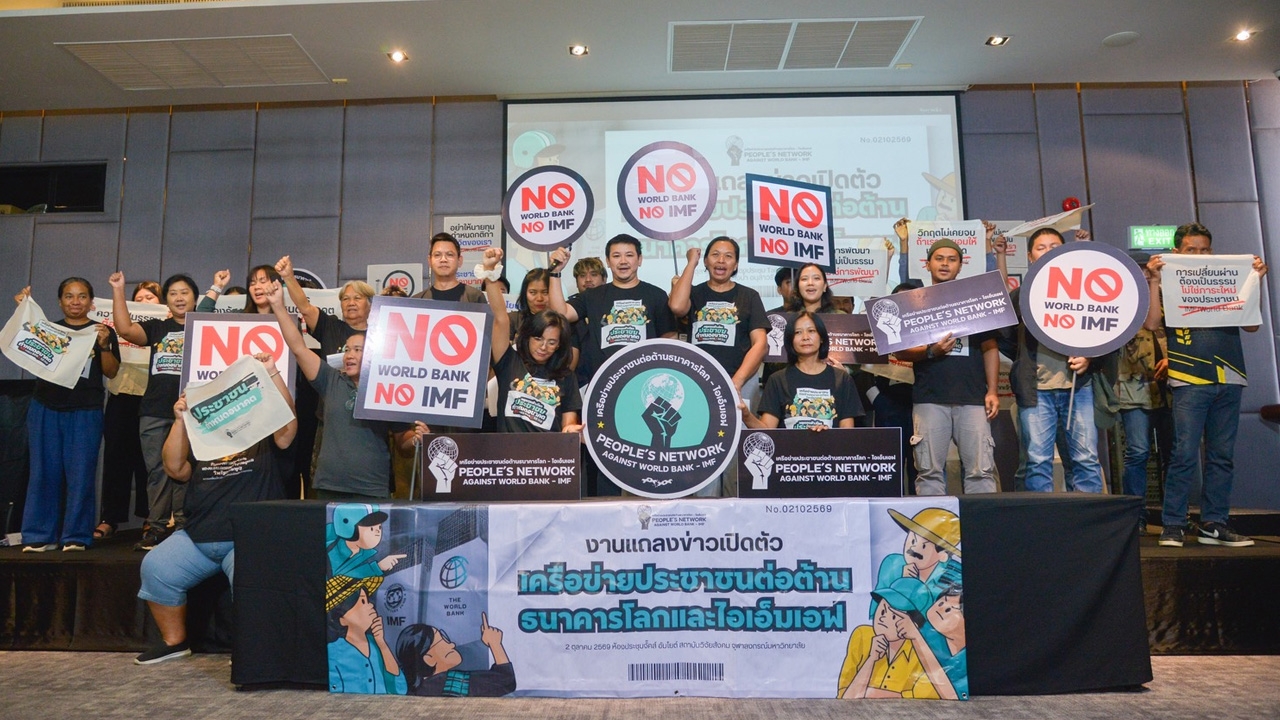
On 2 Oct 2026, the People's Network Against the World Bank and IMF held a press conference to officially launch their network and hosted a discussion titled “Who Pays This Bill?” at Tailor Hall, 9th floor, Deprime Hotel, Rangnam. They highlighted the silent costs borne by the people in exchange for unchosen dreams, reflecting structural impacts ahead of Thailand hosting the World Bank and IMF Annual Meetings from 12–18 Oct. Representatives from civil society, activists, women’s groups, and urban poor gathered to unite in opposition.

Network representatives jointly read a statement titled “Stop Capital's Global Takeover, People Decide the Future: NO WORLD BANK × NO IMF.” They oppose the system where capital dominates lives—not just opposing institutions but rejecting neoliberal capitalism and economic imperialism. The state is not shrinking but shifting costs from public budgets onto citizens’ shoulders while shielding big capital and privatizing essential life services into commodities.
The 1997 crisis taught that when the economy collapses, it is the people who pay the repair bills. The 1.32 trillion baht debt from the Financial Sector Restructuring Authority became public debt payable until 2031. Millions lost jobs, and women bore increased family burdens.
Land is not empty space for investment but home, food, and democracy—not merely a market asset. Green investments, carbon credits, or mining must not infringe on communities' rights to manage their resources.
Justice for the urban poor means recognizing that cities belong to those who build them. Workers like street sweepers and drivers have the right to live in the city. Forced evictions destroy life networks; housing must be secure, not subject to price speculation benefiting the wealthy.

People bear the costs even before mines open. Loans for resource exploration shift debt and ecological risks onto communities from the start, without villagers having decision-making rights.
Universal welfare means reclaiming wealth collectively created by the people to care for lives, not mere welfare handouts or poverty tests, but restoring power to the people.
An economy that ignores women is an economy that ignores life. Care work, which supports society, must be recognized and compensated. Women should not be unpaid labor filling gaps for the state and capital groups.
A green transition must shift power, not just change from fossil fuels to new technologies while allowing big capital to monopolize transmission or greenwash through carbon credits. The people must own the energy.
GDP growth is insufficient if wealth concentrates at the top while the bill falls on the bottom. The country may appear richer statistically, but workers’ wages remain inadequate, monopolized by the “blue regime” linking influential families, state mechanisms, and big capital.
Seeds, medicine, labor, and bodies should not be dictated by profit. Monopoly over basic life necessities must end. Farmers must have seed rights, patients must access medicines, and workers must receive social protections.

Saengsiri Treemarka said the coalition formed from social workers, women’s groups, people living with infections, and urban poor who see that the 'neoliberal capitalist system' is creeping to dominate Thai society under the blue regime. People question how far the state will follow big capital and how long it will keep burdening citizens. Their goal is to oppose neoliberal capitalism, where the state reduces welfare burdens but keeps power unchanged, lets big capital monopolize, and pushes citizens to face fate and land grab struggles.

Charassri Chan-ai said blue capital policies have severely undermined community rights, including "community land titles" and "land banks," which communities should manage. Especially land banks aim to distribute land ownership to the poor, not to be treated as commodities benefiting foreigners. If blue capital or foreign investors are allowed to buy and seize land, the poor cannot build secure lives. Land, minerals, and underground resources should belong to the people to determine their own future.
Meanwhile, Nattawut Krompakdee said those bearing these "bills" most heavily are the urban poor, vulnerable groups, and those without life capital at society’s bottom. As development encroaches, it becomes a mechanism that pressures and pushes them far away—away from visibility, family, and opportunities for a better quality of life.