

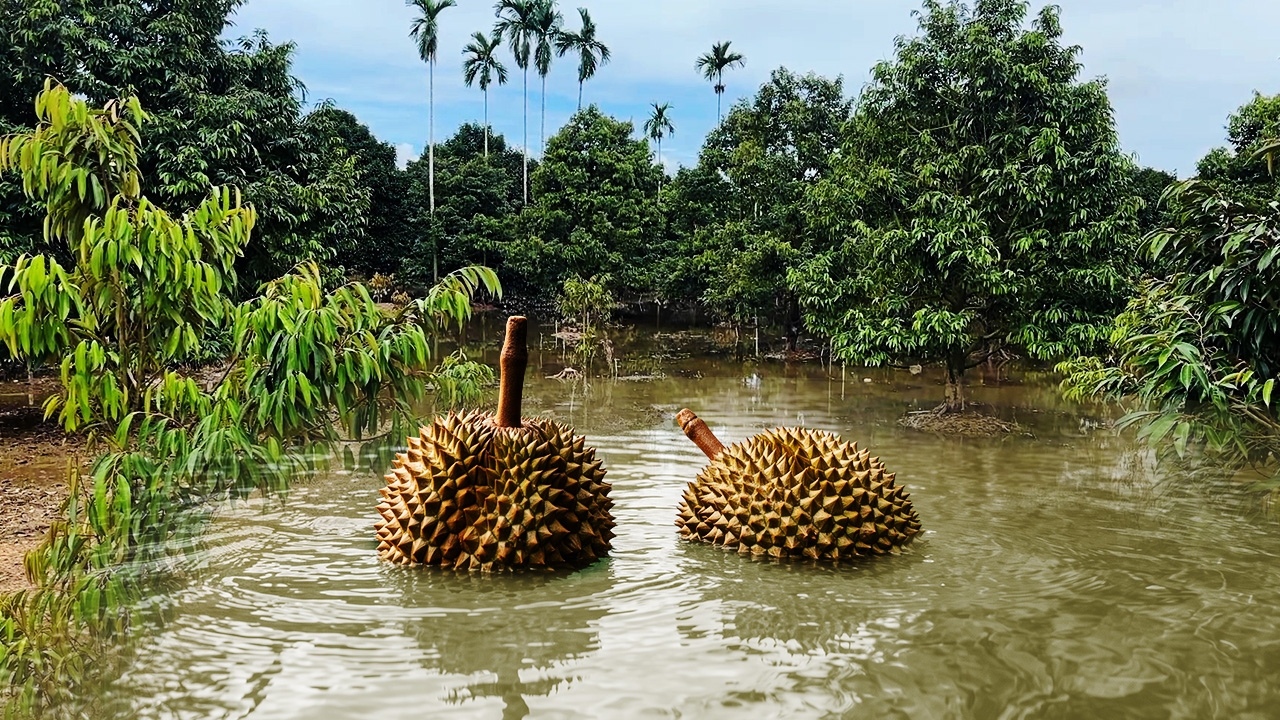
"Flooding" has damaged 20,000 rai of durian orchards in Chanthaburi and Rayong provinces, severely impacting farmers. Root rot damage averages 2.5 million baht per rai. Rehabilitation is not cost-effective, and replanting requires five years, causing reduced yields. Customers are poised to buy at higher prices.,
Due to continuous heavy rain in the eastern region, flash floods inundated durian orchards in Chanthaburi and Rayong from 25 to 30 September 2026. The root systems were deprived of oxygen. As floodwaters receded and farmers assessed the damage, durian trees began dropping leaves and deteriorating severely because of root rot. Recovery takes 1-2 years and costs more than replanting, which requires 5-6 years.
Thairath Online’s special news team spoke with Mr. Panusak Saipanich, Advisory Chairman of the Thai Durian Association, who revealed that initial damage assessments show over 20,000 rai of durian orchards affected, representing massive losses due to the high investment costs per durian tree.
, Durian trees aged 1–10 years are at highest risk because their root systems are not yet strong, resulting in high rates of root rot and mortality. In contrast, trees aged 15–20 years and older are more resilient, with deeper roots and stronger trunks, thus having a higher survival chance than younger trees.
Although floodwaters have receded, compacted mud remains at the tree bases, suffocating roots and causing root rot. The main variety, Monthong, is especially susceptible, gradually becoming infected and dying off.

Mr. Panusak pointed out that if 80–90% of branches or root systems are damaged, it is not advisable to try to save the tree, because such trees become “deformed trees” yielding insufficient returns to justify fertilizer, pesticide, and care costs. Cutting down and replanting is a better long-term option, requiring at least five years before new trees bear fruit and 7–8 years to reach full production. Grafting onto old rootstocks is not recommended despite saving 1–2 years, due to damaged roots causing stunted growth and disease susceptibility. Rehabilitation costs include:
1. Root growth stimulants/hormones, such as amino acids, humic acid, fulvic acid, or root growth promoters (priced around 200-600 baht per bottle/liter).
2. Chemicals to prevent and control root and collar rot,
- Soil drench or spray types like metalaxyl or fosetyl-aluminum, costing about 300-800 baht per pack/liter,
- Trunk injection types such as phosphonic acid, priced 350-650 baht/liter depending on concentration, brand, and formulation.
3. Soil and foliar fertilizers,
- Organic fertilizers or soil amendments to restore soil after flooding,
- Foliar fertilizers or micronutrients (e.g., calcium-boron, zinc, magnesium) to aid photosynthesis and recovery (around 200-500 baht per bottle/liter).
While waiting for durians to mature over five years, farmers should cultivate short-term crops like papaya or banana to generate interim income.

Mr. Panusak said the flooding crisis impacts the economy, finances, and farmers’ mental health, as most borrowed funds to invest. Some durian orchards aged 4–5 years were about to produce income in their "first year" but suffered damage instead, incurring wasted expenses on wound and fungicide treatments with little chance of survival. This unnecessary spending and loss of livelihood and income cause severe psychological stress for families, compounded by existing debts.
Mr. Panusak expects overall durian exports to decline due to tree deaths and disease. As supply decreases, unit prices will rise. Nationally, total export value may not fall significantly because of higher prices, but farmers with completely damaged orchards will not benefit from these price increases. Quality also depends on weather before harvest; heavy rain or overcast skies limit photosynthesis, causing waterlogged durian flesh that tastes bland and watery, affecting export market acceptance.
Mr. Panusak recommends the government implement debt relief measures with the Bank for Agriculture and Agricultural Cooperatives (BAAC) and other financial institutions to ease psychological pressure. They should provide low-interest loans to fund clearing mud from tree bases, purchase new durian saplings, and improve irrigation and orchard infrastructure. Concrete, accessible assistance is needed rather than mere policy statements, as farmers’ mental health is severely affected.
He concluded by encouraging farmers to persevere despite hardships, saying, "No matter how tough it is, if we don’t give up, solutions will come. I understand the pain because this is a livelihood and a passion—some care for their trees as if they were children."

Mr. Chonlathi Numnu, a fruit farmer and former Director of Agricultural Research and Development Region 6 at the Department of Agriculture, reported severe damage mainly in Rayong’s Klaeng district and Chanthaburi’s Tha Mai and Kaeng Hang Maew districts, totaling about 20,000 rai out of 400,000 rai in Chanthaburi. Most affected orchards are near the Prasae River basin in Rayong and the Khlong Wang Tonot basin in Chanthaburi. Flooding had not occurred there for 20-30 years, so locals were unprepared. In contrast, Trat province experiences frequent floods, so damage there was less severe.
Mr. Chonlathi explained that durian trees are intolerant to flooding; waterlogged roots for about 3-4 days cause gradual illness and death. Annual income per tree averages 10,000 baht; over 10 years of harvests, this totals 100,000 baht per tree. One rai typically has about 25 trees. This equates to an estimated damage value of about 2.5 million baht per rai.
When roots stay submerged and become diseased, recovery takes 1-2 years involving root stimulation, chemical treatment against root rot, fertilization, and leaf care, all costly. Replanting takes 5-6 years but costs less, as only sapling costs apply. However, farmers must clear soil and start anew, causing some to hesitate between rehabilitation or switching to other crops due to fears of repeated flooding, though alternative crops do not match durian’s returns.
Mr. Chonlathi suggests the government offer two rounds of compensation: first for trees that die immediately, then for those that die within 6 months to 1 year. Support should include debt relief with the BAAC, deferred repayments, and guidance for farmers on planning planting or rehabilitation.
He added that heavy rains and flooding are often followed by severe droughts in March-April, further stressing already weakened durian trees. Farmers must prepare to cope with these challenges.