

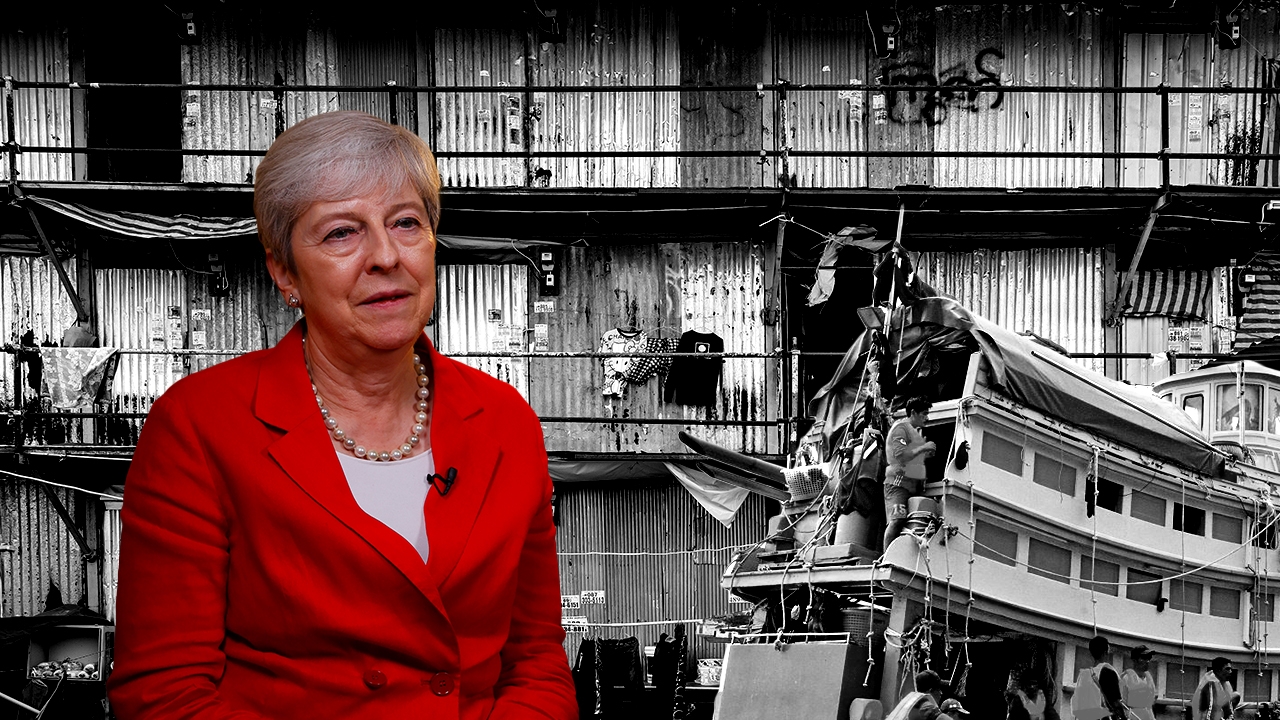
In a conversation with former UK Prime Minister Theresa May, she advised Thailand to raise labor quality and resolve forced labor issues, emphasizing it as a worthwhile investment that enhances productivity and supports sustainable economic growth in Thailand.
During the period of the IMF-World Bank 2026 meeting, Thairath Online had the opportunity to speak with Baroness Theresa May, the UK's Prime Minister from 2016 to 2019. One of her most notable achievements was pushing the Modern Slavery Act 2015, when she was Home Secretary in 2015. This law addresses the problems of "slave labor," forced labor, and human trafficking,
increasing the maximum penalty to life imprisonment and requiring private companies with annual revenues over £36 million (approximately 1.6 billion baht) to publicly report their measures to prevent slave labor in their supply chains. The law also established a national committee to oversee and drive anti-human trafficking policies, which many countries have since adopted into their own legislation.
Currently, Theresa May sits on the Global Commission on Modern Slavery and Human Trafficking. At the IMF-World Bank 2026 meeting, she urged all sectors to monitor, verify data, and use technology to detect any human trafficking or illegal labor in supply chains. Upon detection, all parties must collaborate to suppress, improve, and resolve these issues. She believes that when workers have good living conditions, their performance improves, benefiting profits and industrial progress.

Baroness May revealed that efforts to address " modern slavery" began with her work on violence against women and girls. Studying cross-border human trafficking cases in the UK, she found many victims were women and girls.
Later, a report showed that being a "slave" was not limited to cross-border trafficking but also existed within the UK itself, with people kidnapped and forced into harsh living conditions, stripped of freedom and human dignity.
As a result, while Home Secretary, she promoted the Modern Slavery Act 2015, which was then among the most advanced laws globally, inspiring other countries to adopt similar legislation.
"I want to see comprehensive laws on this issue worldwide because the core is restoring human dignity. We must not treat others as second-class citizens undeserving of respect, honor, and dignity through appropriate employment."

Regarding some businesses still viewing labor condition improvements as cost-increasing and competitiveness-reducing, May stated that the Global Commission on Modern Slavery and Human Trafficking found cases where businesses detected using slave labor in supply chains and, after addressing the issue, saw higher productivity and better products.
"Taking these actions is truly a sound business investment. If governments worldwide require companies to monitor and immediately correct slave labor use in their supply chains, it can elevate not only labor conditions but also global economic opportunities."
When asked if she would revise any provisions in a potential 2026 modern slavery law update, Baroness May highlighted one key issue: "business supply chains" where she wants companies to enforce stricter monitoring and corrections.
The Global Commission on Modern Slavery and Human Trafficking released a report to the United Nations in 2025 recommending clear legal mandates requiring companies to check their supply chains for forced labor and act promptly if found.

In today’s advanced technological era, governments can hardly claim ignorance or turn a blind eye to forced labor problems. Baroness May shared that at this meeting, she attended a World Economic Forum session involving a project on forced labor enforcement, in which the Thai government participates.
This project aims to gather all available data to study where forced labor exists within company supply chains and how it operates, while allowing involved sectors access to review this information for analysis and other uses.
"Although the project is still in its early stages, Thailand’s participation is very important and demonstrates the country’s role as a positive example on this issue."
When asked how improving overall welfare, including a "good social security system," benefits the country’s economy beyond enhancing workers’ living conditions, Baroness May pointed out that addressing forced labor issues in supply chains improves workers’ lives and positively impacts the economy.
From the government’s perspective, if workers are underpaid, tax revenues decline, reducing budgets for public services. Enhancing welfare benefits all parties—workers, businesses, government, and the overall economy.
Solving these problems requires recognizing that no single sector can do it alone. While the government plays a crucial role, it cannot resolve these issues alone; it depends on collaboration among government, businesses, civil society, and all sectors.
"Another important issue for workers is that when facing difficult working conditions, they must feel they have channels to seek justice without fear of retaliation against themselves or their families. This is another key consideration for governments worldwide."

When asked how Thailand, which relies on food product manufacturing and exports, should prioritize forced labor issues, Baroness May noted that many countries require governments to address forced labor problems, directly impacting trade. Therefore, Thailand, as a trade-dependent country, must act on this.
Looking back at 2014-2015, when Thailand faced issues in the fishing industry, the government took real action to resolve them. However, the problem is not limited to the fishing sector. As an exporting nation, Thailand must comply with trade agreements globally, especially since many countries now incorporate forced labor concerns into their trade policies.