

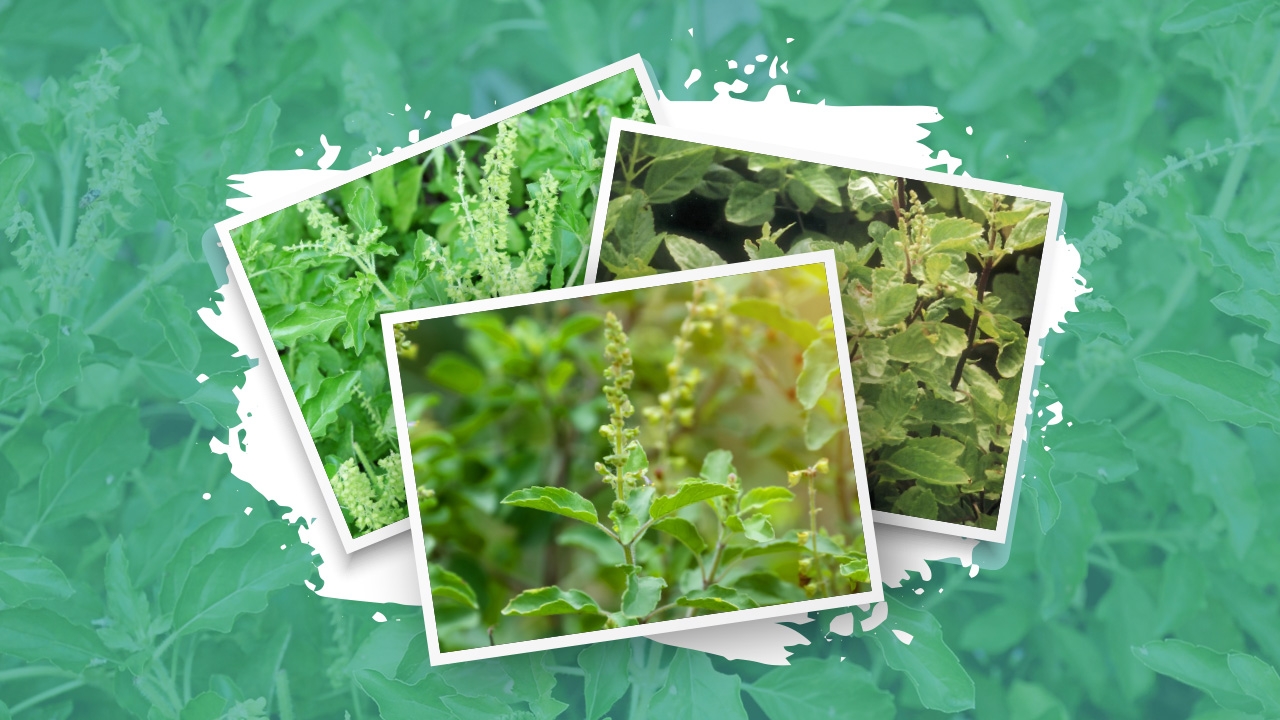
Survey of varieties "Thai Holy Basil" Sources from the Department of Agriculture reveal "White Holy Basil" dominates 70% of the market, with the possibility "Kaewjuree" competing to become a major market player and driving prices higher in the future?
Following the case where the Biothai Foundation disclosed that CP RAM Co., Ltd. has registered protection for "four new holy basil varieties" namely Kaewjuree01 on 12 March 2024 and Kaewjuree02, Kaewjuree03, and Kaewjuree04 on 24 May 2024, with protection lasting 12 years until 2036 under the Plant Variety Protection Act B.E. 2542 (1999).
Most recently, on 21 Oct 2026, Mr. Suriya Juangroongruangkit, Minister of Agriculture and Cooperatives, clarified concerns regarding private companies registering plant varieties "holy basil" stating that the law allows private sector entities engaged in research and development of new plant varieties to apply for protection rights over the varieties they develop, similar to intellectual property protection in pharmaceutical research.
He confirmed that such registration does not affect the general public, who can still cultivate the protected holy basil varieties for household consumption normally, but are prohibited from propagating and selling the protected varieties without permission. (See details: "Suriya" clarifies registration of holy basil variety protection does not affect personal cultivation)

Thairath Online's special news team spoke with a source within the Department of Agriculture about the basic information and current situation of Thai holy basil, learning that generally "holy basil" is a vegetable and herb that naturally spreads in tropical humid regions of Asia, such as India, Sri Lanka, Myanmar, Thailand, Laos, Cambodia, Vietnam, the Philippines, and Indonesia. India has the longest history of use, primarily for religious ceremonies.
Regarding "holy basil" cultivated and used in Thailand, it is divided into three main groups, all suitable for cooking depending on preference:
1. White Holy Basil which has the typical green color without other shades mixed in. This variety is the most widely planted and used, estimated to represent over 70% of all holy basil.
2. Red Holy Basil with stems or leaves showing purple-red hues, possessing a stronger aroma. It suits those who prefer a more distinct holy basil scent in their food and is estimated to account for about 20% of all holy basil.
3. Wild Holy Basil which has a stronger aroma and more hair on leaves than the white and red types, with smaller leaf size, comprising about 5% of all holy basil.
In the case of the private company registering protection for four holy basil varieties, this pertains to plant variety protection with the Department of Agriculture under the Plant Variety Protection Act B.E. 2542 (1999) since 2024, with a 12-year protection period. This is essentially "acknowledging the breeder" as the developer, in collaboration with Kasetsart University, Kamphaeng Saen campus, focusing on increasing leaf size, improving growth, and enhancing aroma suitable for the food industry.
"Plant variety protection grants rights to the rights holder, but does not mean owning all holy basil varieties in Thailand—only the registered varieties, Kaewjuree01-04, out of thousands of existing holy basil strains."
According to the Plant Variety Protection Act B.E. 2542 (1999), protected varieties can be cultivated for household consumption normally. Researchers can further improve these varieties, and farmers may purchase seeds from rights holders to cultivate for sale, but cannot propagate seeds for others to grow. When asked about concerns from some farmers that accidental mixing of Kaewjuree varieties in their crops might lead to legal issues, the source pointed out that registration under the Plant Variety Protection Act B.E. 2542 (1999) is not as strict as

the UPOV 1991 law or the International Convention for the Protection of New Varieties of Plants, which provides absolute rights to breeders. Thailand has not signed as a member of UPOV. Moreover, proving such cases is difficult, so enforcement actions are unlikely. This registration is seen as positive in encouraging breeders, supporting research and development of Thai plant varieties, aligning with one of the objectives of the Plant Variety Protection Act B.E. 2542 (1999). However, until now, no private sector had registered
"new plant varieties"for"holy basil"which may cause some concerns.Concerns over market competition and price increases
that it might be possible, since if private companies pay higher prices, farmers would want to grow the more profitable varieties. However, currently, cultivation is mainly for the private food industry, so demand
is limited and relatively small compared to the total holy basil used or consumed daily nationwide. Therefore, farmers are advised not to worry excessively and can continue to cultivate holy basil as usual.