

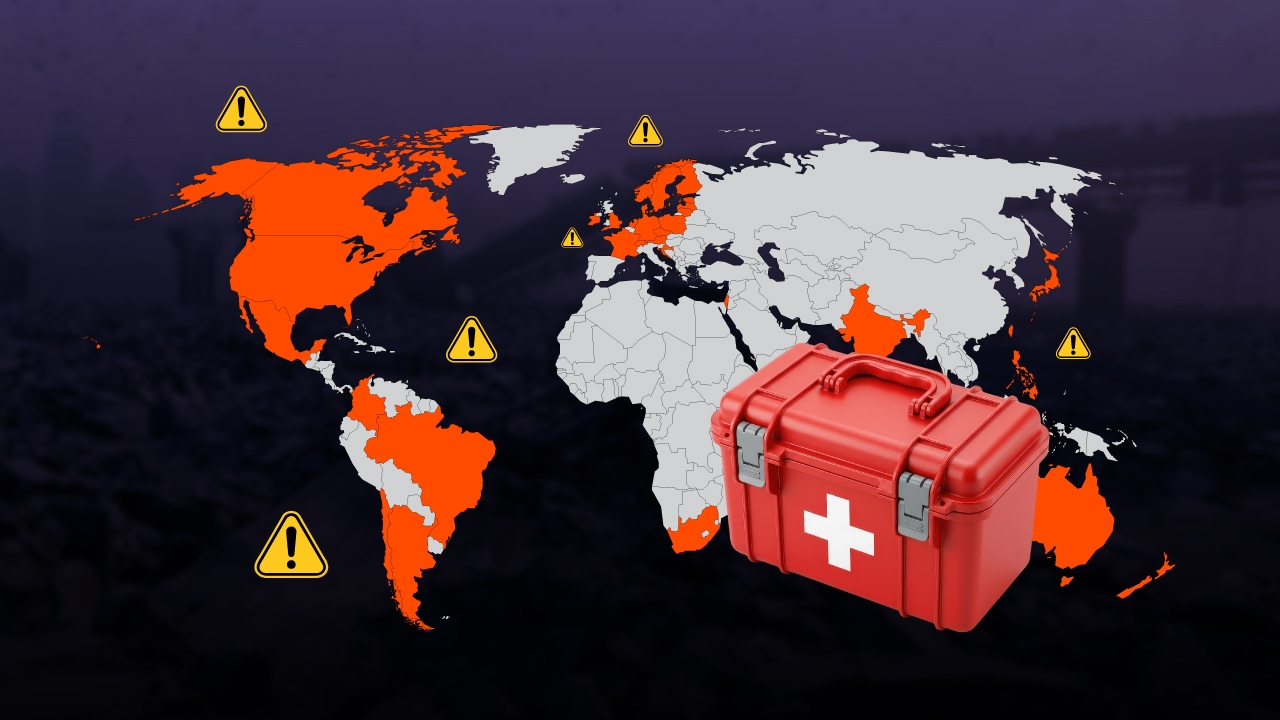
Analyzing the issue of 33 countries advising their citizens to stockpile supplies for 72 hours, Dr. Patithan views the world as elevating its response to three threats—natural disasters, cyber threats, and war—encouraging more self-reliance among people amid geopolitical uncertainties, with a recommendation for governments to establish clear early warning systems.
Following announcements by many countries worldwide urging citizens to prepare food and essential items for 72 hours in emergencies, questions and concerns have arisen about whether this signals an impending global danger or simply follows standard national security protocols.
Regarding the situation in Thailand, Prime Minister and Minister of Interior Anutin Charnvirakul gave an interview on 29 Oct 2026 about the global announcements urging citizens to prepare for emergencies, stating, “I am not yet aware of this matter.”
When asked whether the public should avoid panic over these international announcements, the Prime Minister said, “We should remain aware at all times, but not panic.”
Meanwhile, theNSC Insightpage of the National Security Council stated that the 72-hour stockpile advisories abroad are not related to war but to general disaster and emergency preparedness. For example, Japan follows this routinely to prepare for earthquakes and disasters, easing the burden on authorities to assist vulnerable groups first. In Finland, Sweden, and Norway, the focus is on citizens being self-sufficient for 72 hours to a week to cope with severe cold and cyber threats that could impact electricity grids and payment systems.
The advice for Thai people is to prepare appropriately for common natural disasters like flash floods and power outages but without panic or large-scale stockpiling.
Most recently, on 30 Oct 2026, General Chaipruk Duangprapat, Secretary-General of the National Security Council (NSC), revealed Thailand’s preparedness plans following global advisories for 72-hour supply stockpiling, stating that on 4 Nov, the NSC will convene relevant agencies and experts to jointly analyze response strategies for various scenarios and prepare appropriate public information.

According toNewsweek,at least 33 countries worldwide have advised citizens to prepare food and essential supplies for 3 to 7 days, including:
Europe: United Kingdom, Ireland, France, Germany, Netherlands, Denmark, Norway, Sweden, Finland, Estonia, Latvia, Lithuania, Poland, Czech Republic, Austria, Switzerland, and Croatia.
North America: Canada, Mexico, United States.
South America: Chile, Colombia, Argentina, and Brazil.
Africa: South Africa.
Asia: Japan, Taiwan, Israel, India, Philippines, Singapore.
Australia and Oceania: Australia, New Zealand.
Each country has differing announcements or measures. For example, the European Union implemented the EU Preparedness Union Strategy on 26 March 2025 to build proactive systems against diverse threats including natural disasters, cyberattacks, and geopolitical tensions or war. It recommends citizens in member states be self-sufficient for at least 72 hours, while some countries like Sweden and Norway suggest one week’s supplies, and Germany advises up to 10 days.
The United Kingdom’s Be Ready program advises stocking about 9 liters of water per person, dry food, medicine, and a flashlight to last 3 days during emergencies.
Japan, Mexico, and the Netherlands also recommend 72-hour emergency kits, while some countries like India’s National Disaster Management Authority advise households to have emergency kits without specifying a precise timeframe.
Certain countries offer area-specific advice. For instance, Western Australia urges cyclone-prone residents to prepare emergency kits including food, water, and medicine. Cape Town in South Africa advises households to stockpile supplies for at least 3 days.

Thairath Online’s special news team consulted Associate Professor Dr. Panithan Wattanayakorn, an expert in foreign affairs and security, who explained that the elevated preparedness standards stem from increased risk assessments in three main areas: more severe natural disasters, cyber threats caused by natural or human factors, and the rising likelihood of large-scale wars in Europe or Asia. These risks may occur simultaneously, creating a polycrisis.
“Especially in Europe, the major threats including issues related to Russia and China are expected to increase, prompting faster warnings and defenses. These three threats occur concurrently as a polycrisis, creating urgency to elevate preparedness.”
Dr. Panithan noted that following the EU’s announcement of the EU Preparedness Union Strategy, many non-member countries such as the UK, Luxembourg, Japan, Singapore, and Taiwan have also raised their preparedness standards to align and facilitate cooperation in rescue efforts.
The new European standards were approved in March 2025 and have been gradually implemented according to each country’s context. Many countries announced updated standards recently, likely accelerated to prepare before winter when natural disasters may increase.
Dr. Panithan highlighted three major changes from the new strategy: improving government crisis management structures to enhance warnings and rescue operations; increasing coordination with the private sector to leverage their disaster relief capabilities;
and the most publicized, raising citizens’ preparedness levels, encouraging self-reliance for at least 72 hours or extending from 3 to 7 days, or even up to 10-14 days in some countries.
Thailand, currently applying to join the Organisation for Economic Co-operation and Development (OECD), must also upgrade its threat response systems to align with these standards, given its exposure to cross-border threats like wildfires and haze.

However, the news causing public alarm may stem from simultaneous moves by European countries combined with geopolitical uncertainties, such as the US midterm elections, Israel’s elections with potential Middle East confrontations, and recent cyberattacks.
This can cause panic, especially in countries unfamiliar with these threats or where public warning systems are not well established, like Thailand. Although the NSC has preparedness plans, public communication and readiness may still be insufficient.
“The EU has 32 countries; simultaneous moves make the issue seem bigger. Coupled with actions from non-EU countries like the US, where the defense minister ordered a three-month food reserve system—though this applies to the military—people may panic without examining details.”
Dr. Panithan revealed that the NSC holds ongoing meetings to address threats at various levels. First, natural disasters specific to Thailand, such as increasingly severe floods, storms, and wildfires, sometimes affecting border areas.
Second, regional external threats like war. While Cambodia is stabilizing, Myanmar remains volatile, impacting Thailand’s energy and labor sectors.
Third, global threats like conflicts in the South China Sea and the Middle East, which affect energy transport routes and tourism.
Regarding the Middle East, recent developments include positive moves with Iran engaging in talks mediated by Middle Eastern and European parties, alongside expectations that the US may increase military pressure post-midterm elections to expedite Iran’s negotiations, requiring close monitoring.

The Foreign Ministry and Thai military have confirmed evacuation plans for Thai nationals in Middle East risk areas but have not clearly indicated the risk level, causing confusion.
“Risk levels should be clearly communicated, for example, escalating from yellow to orange alerts, so people understand. Officials’ statements urging awareness but no panic remain abstract and cannot prevent public anxiety. The NSC should consider clearer, concrete warnings so people don’t rely on varied standards from social media or private sectors.”
Government should improve communication systems for disaster and threat preparedness and enhance coordination, which currently remains fragmented. Improving this would align with Europe’s new standards.
Most importantly, citizens’ capacity for self-care should increase. Although people may feel burdened, the government should provide incentives. For example, during recent floods when government aid was slow, how could people better care for themselves first? Success here would improve public safety.
Given current news trends, citizens wishing to prepare food or essentials can do so by focusing on general supplies such as dry food and medications for 2-3 days, without needing to stockpile for a week or more.