

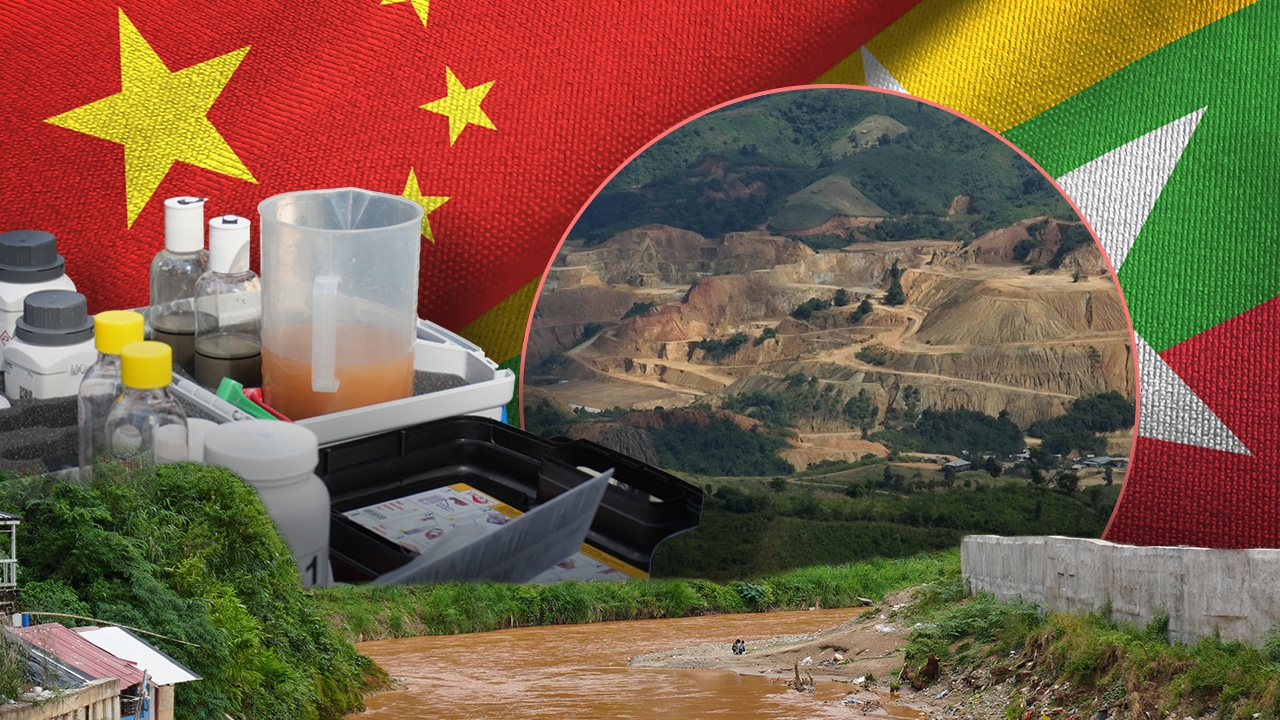
Monitoring China and Myanmar's stance on resolving toxic substances in cross-border rivers: "Experts" see a six-month mine closure as difficult to achieve. They advise Thailand to set clear timeframes, invoke the "Global Governance Principles" to demand accountability from China, and use international interests as leverage if progress stalls.
Regarding the issue of toxic substances crossing borders in rivers flowing from Myanmar, including the Kok, Sai, Salween, and Mekong rivers, all originating from mining activities. On 24 Nov 2026, a Joint Working Group on Water Quality Management in Boundary and Transboundary Rivers meeting was held among Thailand, Myanmar, and China, involving representatives from Thailand including Mr. Sihasak Phuangketkaew, Deputy Prime Minister and Foreign Minister; Mr. Yotsanan Wongsawat, Deputy Prime Minister and Minister of Higher Education; and Mr. Suchat Chomklin, Minister of Natural Resources.
Myanmar's side included the Permanent Secretary of the Ministry of Natural Resources and Environmental Conservation, the Myanmar Ambassador to Thailand, and representatives from Shan State. China's delegation was led by Mr. Zhang Jianwei, Chinese Ambassador to Thailand.
Mr. Sihasak disclosed that the leadership level expresses a joint commitment to resolve the issue. When Senior General Min Aung Hlaing, Myanmar's President, visited Thailand, he reaffirmed readiness to cooperate, as did Chinese Premier Li Qiang during his recent visit.
Subsequently, Thai Prime Minister Anutin Charnvirakul met with Chinese President Xi Jinping during the APEC summit, with China reaffirming commitment to support both countries in addressing the problem.
Mr. Sihasak added that China drives the Mekong-Lancang cooperation framework for water management. In discussions with Xi Jinping regarding private Chinese mining in Shan State, China confirmed it would not support any illegal or harmful activities causing damage.
Mr. Yotsanan stated that mines under government control would follow joint practices with scientific input from both Thai and Chinese sides. Private mines have requested through the Chinese Ambassador to establish scientific verification and traceability standards for mining operations.
Regarding possible trade measures, such as banning mineral imports from Myanmar or exports to China, and proposals to close mines near water sources, Mr. Yotsanan said, personally he supports a six-month mine closure, with the working group to prioritize which mines can comply.
When asked about mines located in ethnic minority areas, Mr. Yotsanan said the meeting included Shan State representatives who acknowledged the difficulty, setting standards requiring on-site inspections mine by mine. Those that cannot comply would need further Chinese government assistance."Yotsanan" eyes a six-month mine closure after agreeing on the source of water toxins.)

On 25 Nov 2026, the first day of the two-day Joint Working Group on Water Quality Management in Boundary and Transboundary Rivers meeting (25–26 Nov) between Thailand and Myanmar took place.
The meeting approved a cooperation framework under five TOR points: water quality monitoring, public health, pollution source investigation, capacity building, and joint foreign affairs actions. Myanmar proposed a second JWG meeting in Naypyidaw, Myanmar.
They agreed in principle on an initial one-year work plan, setting joint water sampling points at four sites per country along the Kok River and two sites per country on the Sai River, with the first joint water sampling planned between Dec 2026 and Jan 2027, depending on readiness and coordination.
They also agreed to exchange water quality test data at least twice yearly and discuss expanding testing to river sediments, accumulation of substances in organisms, agricultural soils, and crops, along with related health issues.Results of the first Thai-Myanmar joint working group meeting: pushing water quality inspections and protecting public health.)

Thairath's special team discussed this issue with Assoc. Prof. Dr. Dulyapak Preecharatch a faculty member of the Southeast Asian Studies Department, Faculty of Liberal Arts, Thammasat University. He sees this as a process that must start, but no concrete timelines or guidelines have emerged. China's position that it will not support illegal or harmful activities aligns with diplomatic protocol, but no clear corrective or punitive actions against Chinese business violators have been seen.
He suggests setting clear timelines and measurable goals, specifying what cooperation should be achieved within one, two, or three months to solve the problem quickly and effectively. Otherwise, it is unclear how long this will take, while affected Thai populations, especially in Chiang Rai and Chiang Mai, cannot wait.
If Myanmar or China cannot specify timelines, Thailand should set its own, ideally within the first quarter of 2027.
"For example, within one month, Thailand should assess the level of cooperation. If insufficient, what pressure or strategic negotiations will be applied? There is currently no framework overseeing these efforts. We may need to wait and observe further."

Regarding Mr. Yotsanan's proposal to inspect and close mines near water sources for six months, Assoc. Prof. Dr. Dulyapak believes it is difficult, possibly achievable only for some mines and perhaps only for one to two months.
This is because Myanmar's government is fragile against internal interference and cannot fully control all mines, some of which are under ethnic armed groups like the United Wa State Army, which grant mining concessions to fund weapons purchases and territorial control. These are valuable resources unlikely to be relinquished.
At the same time, ordering Chinese private mine owners to suspend operations or allowing deep business inspections is not easy, especially for mines with opaque or illegal activities.
"What may happen is superficial inspections or token activities, allowing Thai officials limited site access. Deep investigations face resistance from polluters or business interests."

China's companies have caused cross-border pollution and environmental problems in multiple countries without decisive resolution. A clear example is the Mekong River dams impacting downstream water levels, causing long-standing issues with civil society protests and government concerns. However, pressure on China is limited due to reliance on Chinese investment and China's geographical position upstream, granting sovereign rights. This raises doubts about Thailand's ability to secure accountability from this major power.
Nevertheless, although Thailand is much smaller and the mining occurs outside its sovereignty, shared water usage grants some bargaining power. Additionally, last year Chinese President Xi Jinping announced the Global Governance Initiative (GGI) which emphasizes sovereign equality, adherence to international law, multilateral cooperation, people-centered approaches, and practical implementation.
Assoc. Prof. Dr. Dulyapak suggests Thailand should invoke the GGI to demand transparency and enthusiasm from China regarding problems caused by Chinese company investments. This must be done respectfully, recognizing China's status as a major power, but with clear deadlines for accountability.
Thailand could raise this issue in meetings such as the Mekong-Lancang Cooperation (MLC), where all stakeholders are members, or the Mekong River Commission (MRC), where China and Myanmar are dialogue partners. Recently, mining in Laos has also caused cross-border pollution in the Mekong, becoming a subregional concern.

He proposes that if timelines and negotiations fail, Thailand should adopt other measures or escalate strategic pressure, such as leveraging international interests as bargaining chips. For example, Thailand might delay major Chinese projects like the Thailand-Laos railway until China seriously cooperates in resolving water pollution. If Myanmar seeks Thailand's role as a founding member and future ASEAN chair to connect Myanmar with ASEAN, beyond political reform and peacebuilding, Myanmar must actively address pollution problems.
Another approach is for Thailand to collaborate with third countries to balance and enhance negotiation power. For instance, if countries like Japan or the United States wish to develop environmental and agricultural technology to assist the Kok and Sai river basins, Thailand could open to development diplomacy, encouraging China to intensify its problem-solving efforts; otherwise, others may compete with China in the Mekong basin.
"Without leveraging interests in negotiations, success is unlikely because upstream countries like China are unaffected and may only acknowledge or offer help without deadlines. Thailand must be proactive and negotiate with greater strategic assertiveness."
Assoc. Prof. Dr. Dulyapak concludes that despite Thailand's limitations, strategic planning and skillful negotiation could still offer hope.