

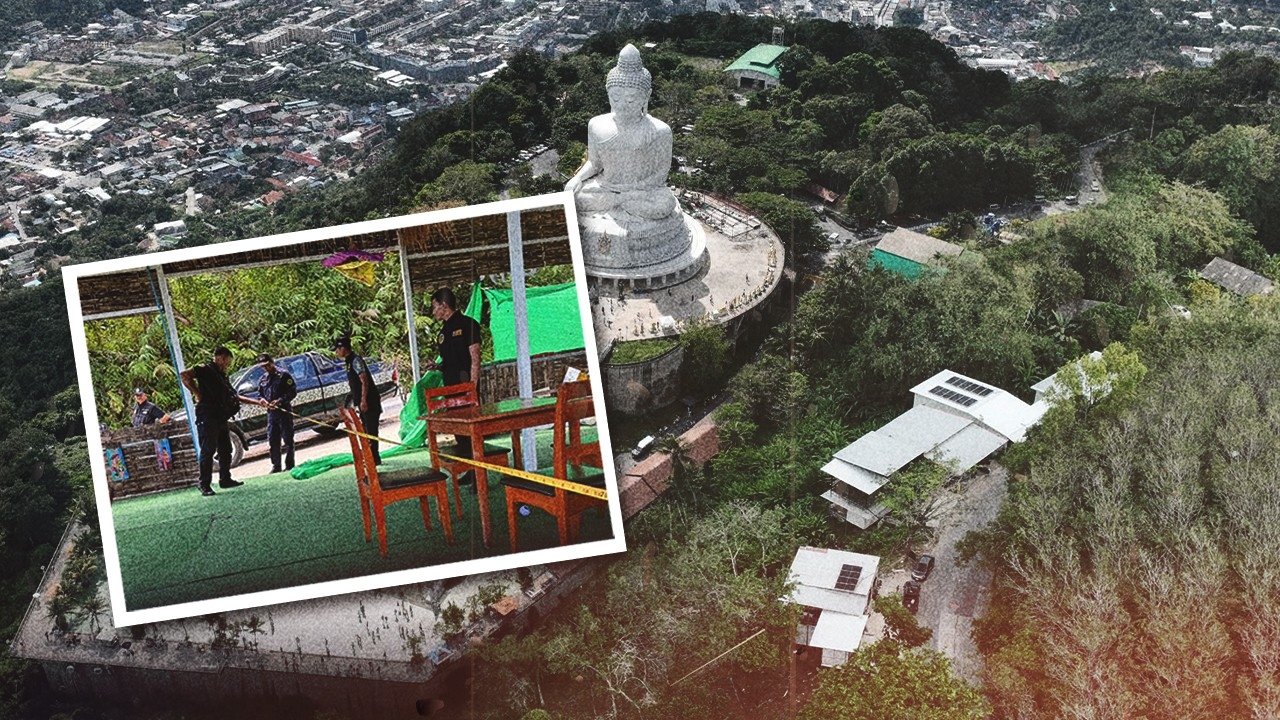
The Royal Forest Department launched a thorough inspection of 47 sites surrounding Phuket's Big Buddha, uncovering illegal forest encroachment involving hotels and restaurants. Initial cases have been filed against five locations. The Deputy Director-General highlighted problems with "inflated" and "floating" Sor Kor 1 land documents, referring to possession beyond actual land and the use of documents from other areas to fraudulently claim rights.
Regarding the incident on 25 Nov 2026 GMT+7, The Royal Forest Department conducted a comprehensive survey around the Phra Phuttha Mingmongkol Eknakiri (Big Buddha) including business establishments such as restaurants, shops, coffee shops, and tourist transport services along the route up to Big Buddha, all located within the Nakkerd Mountain Forest Reserve area in Karon and Chalong Subdistricts, Mueang Phuket District, Phuket Province, under the "Phuket Model" operation. "Phuket Model" This followed findings of possible illegal occupation and use of land not in accordance with authorized conditions or legal rights, based on detailed examination of Sor Kor 1 documents.
In this operation, the special task force (Phayak Phrai) divided into six teams to conduct inspections. It was found that the Royal Forest Department had authorized the National Office of Buddhism to utilize or reside within the Nakkerd Mountain Forest Reserve to build or house the Phra Phuttha Mingmongkol Eknakiri (Big Buddha) statue over an area of 15 rai. However, inspection of the permit's attached conditions revealed eight violations and failure to comply with three other conditions. Officials notified the permit holder to comply within 30 days or face legal action according to regulations and laws.

Additionally, officials conducted a thorough X-ray-style inspection of business establishments including shops, restaurants, coffee shops, and tourist service venues along the road to Big Buddha. In the first phase, aerial photo analysis revealed six establishments occupying a total of 6 rai, 1 ngan, and 72 square wah within the forest reserve without legal permits under the National Forest Reserve Act, nor were they allocated land under the government's Community Land Allocation Project (CLAP).
Officials collected evidence and filed complaints with investigators at Division 5 of the Natural Resources and Environmental Crime Suppression Division (NRSCSD) for violations under the National Forest Reserve Act B.E. 2507 (1964) and its amendments, Sections 14, 31, 26/4, as well as the Forest Act B.E. 2484 (1941) and its amendments, Sections 54, 55, and 72 ter.
For the remaining businesses including shops, restaurants, coffee shops, and tourist service venues, the Forest Resource Management Office Region 12, Krabi branch, was assigned to conduct detailed inspections to ensure fairness to operators and legal compliance.

Thairath Online's special task force followed up on the issue with Mr. Patpong Samittiphat, Deputy Director-General of the Royal Forest Department, Ministry of Natural Resources and Environment, who disclosed that initial investigations divided the cases into two categories.
The first case concerns the Big Buddha area, covering 15 rai, where the National Office of Buddhism was not authorized for commercial use. The permit was for meditation or educational purposes related to the temple. However, tourism has become a byproduct due to the area's natural beauty. Guidelines are needed to differentiate religious activities from tourism, with experts managing the latter. The Forest Department may control development standards to determine permissible activities. Additionally, landslides occurred in 2023-24, potentially impacting the area, requiring joint management by the Forest Department, Office of Buddhism, and Phuket Provincial Administrative Organization.
The second case involves the route up to Big Buddha, which is forest reserve land. Inspections covered 47 business sites, some lacking documentation to present to officials, leading to legal action against those without evidence.
For those with documents such as Sor Kor 1, verification was sent to the Land Department to confirm authenticity, and coordination with NRSCSD ensured that land plots matched those shown in Sor Kor 1. Checking for "inflation" was done, for example, where a Sor Kor 1 document indicated 5 rai, but the plot measured 9 rai, and actual occupation was 30-40 rai. This plot has been subject to prosecution.

Regarding this, Sor Kor 1 is a land possession notification (issued before 1954), not a title deed granted by the government. It roughly specifies the location and approximate size, with boundaries described by the owner in relation to neighboring lands or landmarks, such as a stream to the north, including acquisition details and land condition.
The Deputy Director-General cited another example where a business occupied 50 rai, with ownership transferred three times. The owner presented purchase evidence, but it was not accepted as valid proof by the state.
Even with Sor Kor 1, proof is required that the land is genuinely at that location. If confirmed, possession is recognized as predating the forest reserve declaration. However, if boundaries do not match and appear to correspond to other areas, the occupation is considered "floating over" meaning documents from elsewhere are fraudulently applied to this forest area, constituting deliberate encroachment with false documents, warranting prosecution.
Asked whether "floating over" cases stem from government corruption, Mr. Patpong said that the Land Department only verifies Sor Kor 1 lands when citizens request surveys to convert them to title deeds. The survey process confirms neighboring land boundaries. If inaccurate, no documents are issued. Meanwhile, the Forest Department, as land owner, verifies whether Sor Kor 1 lands truly cover the area; if not, revocation is required. He added that the Forest Department's role is to verify document locations and enforce revocation when appropriate.

The Deputy Director-General revealed that among the 47 sites inspected are large hotels, restaurants, go-kart and ATV areas, and elephant camps ranging from 3-4 rai up to 40-50 rai, all illegally occupying forest land. Most operators are Thai nationals.
Recently, legal cases have been filed with the NRSCSD against 4 or 5 establishments. Others remain under investigation and will be prosecuted when evidence is sufficient.
"Once cases are filed, if illegal structures remain, we will proceed under the Phuket Model, as with Freedom Beach, invoking Section 25 to order immediate demolition, simultaneously pursuing legal action for encroachment and enforcement of demolition authority," he said.
Following prosecution and demolition, measures will prevent re-entry, including volunteer tree planting activities. In high-risk areas prone to landslides, check dams and vetiver grass planting will be implemented as preventive measures.
To prevent repeated encroachments, forest officials will collaborate with the Office of Buddhism and Phuket provincial authorities to jointly manage the area by developing a master plan addressing environmental issues and improper land use, ensuring compliance with the Forest Department's authority.
However, since Big Buddha has become a renowned tourist spot recognized by international visitors for its scenic views of Chalong Bay and Kata-Karon Bay, tourists must receive good management services from government agencies. The area should be properly organized and managed, including regulated fees to generate revenue for the country.

The Deputy Director-General concluded by assuring that the Forest Department's work in overseeing the area, especially regarding the "Phuket Model", aims to maintain Phuket Province as a tourist destination with proper standards. Public spaces must remain truly public—for example, public beaches should not have excessive fees. Tourism should be accessible freely to Thai citizens or, if fees apply, they should not be excessive.
"It is government policy that all public areas in Phuket must remain genuinely public. Forest reserves must be maintained as such. Services for the public must be of quality and standard, not operated privately without control or standards, as we care about safety and the nation's image."