

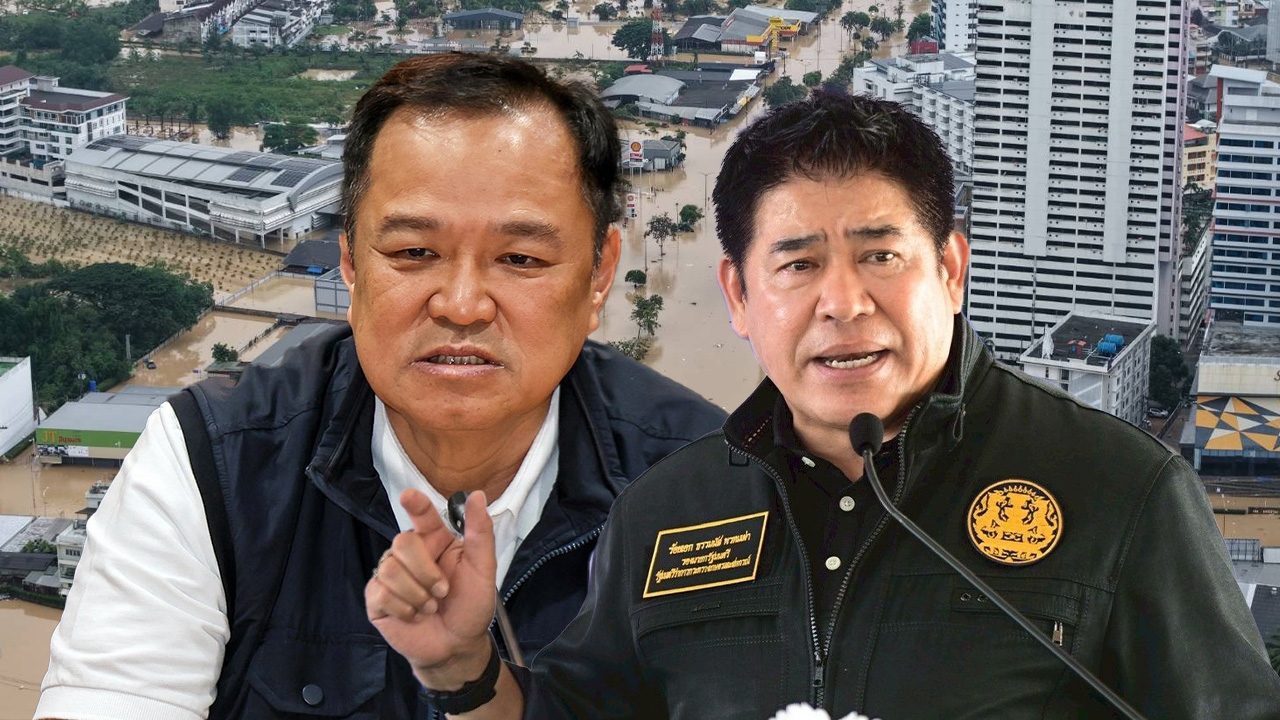
Flooding in Hat Yai and southern Thailand exposes failures in the government system. Who is the true commander of the situation? Tracing the timeline of top-level appointments reveals overlapping roles, frontline confusion, and citizens left only waiting with hope for relief.

The flood situation in southern Thailand, especially in Songkhla and Hat Yai provinces in November 2025, has been severe and complex. This has led to adjustments in the command structure and responsible officials over time, reflecting efforts at integrated management but also raising issues regarding unified disaster management.

Based on initial data and the situation’s progression, the timeline of appointments for situation commanders can be summarized as follows:
Approximate date | Appointed individual/position | Role/position assigned |
Before/about 24 Nov 2025 | Lieutenant Colonel Thammanat Prompao (Deputy Prime Minister) | Director of the Water Management Center for Natural Disaster Situations (WMC) |
24 Nov 2025 | Central Department of Disaster Prevention and Mitigation (DDPM Central) | Established as a forward command center (for 5 southern provinces: Satun, Songkhla, Yala, Pattani, Narathiwat) |
25 Nov 2025 | Prime Minister declared a state of emergency in Songkhla Province. | Appointed the Supreme Commander as the chief responsible official for emergency management. |

Starting point: Prime Minister Anutin Charnvirakul (as chair of the Committee on Natural Disaster Administration and Management) signed to establish the WMC and appointed Lieutenant Colonel Thammanat Prompao as director to oversee and integrate water management.
Forward center: The Central Department of Disaster Prevention and Mitigation set up a forward command center in Songkhla to coordinate and direct resources into the five southern provinces affected.
Escalation: As the situation in Songkhla worsened, the Prime Minister declared a state of emergency and appointed the Supreme Commander as the chief responsible officer and situation commander under law (within Songkhla province).
On 26 November 2025, Prime Minister and Minister of Interior Anutin Charnvirakul signed Prime Minister’s Order No. 11/2568 assigning Deputy Prime Ministers and Ministers to be responsible for relief, rehabilitation, and recovery efforts to ensure effective and tangible aid for flood victims by province.
Having multiple commanders or command centers simultaneously (WMC under Lieutenant Colonel Thammanat, DDPM Central forward center, and Supreme Commander as chief responsible officer for the emergency) may strengthen and accelerate aid but carries high risk of problems in disaster management, including:
1. Lack of Unity of Command:
Operational units on the ground may be confused about which center to follow, especially when command powers overlap (e.g., WMC Director vs. Chief Responsible Officer).
Conflicting or redundant orders will reduce the efficiency and timeliness of resource deployment (personnel, equipment, budget).
2. Coordination and Communication Problems:
Multiple command centers require time-consuming "cross-center communication," causing delays in information and critical decision-making.
There may be competition or duplication of resource use in the same area, neglecting other areas needing aid.
3. Unclear Accountability:
Multiple responsible parties complicate evaluation and post-event review because there is no single clearly designated Incident Commander responsible for all outcomes.

DDPM is the primary agency under the Ministry of Interior, mandated by the Disaster Prevention and Mitigation Act B.E. 2550 (2007).
Main overseer: Minister of Interior as chair of the National Disaster Prevention and Mitigation Committee and supervisor of DDPM.
Legal director: Under normal conditions, the DDPM Director-General serves as secretary and oversees operations of the Central Disaster Prevention and Mitigation Operations Center (CDPMOC).
Preparedness: Risk analysis, planning, disaster risk prevention and reduction.
Response: Monitoring, incident reporting, warning issuance, establishment of special operations centers at provincial/local levels, and managing/supporting disaster machinery and resources.
Recovery: Damage assessment and coordination of rehabilitation and aid.

Countries with advanced disaster management systems often apply the Incident Command System (ICS), emphasizing a single Incident Commander (IC).
Examples from the United States (FEMA) and ICS include:
The Incident Commander (IC) holds full authority:
The IC is the sole individual responsible for setting objectives and strategies for the entire disaster response.
The IC may be a local official (e.g., governor, mayor) or a specially assigned officer depending on the disaster’s scale and complexity.
Flexible structure:
ICS allows the organizational structure to scale up or down according to the severity of the situation.
An Emergency Operations Center (EOC) serves as the hub for resource support, communication, and planning, led by the IC making field decisions.
Integrated operations:
All involved agencies (police, fire, rescue, military, public health) work under the ICS structure, with the IC issuing clear commands and assignments, effectively resolving duplication and communication issues.
Lessons learned:
Effective disaster management requires adherence to Unity of Command—meaning there should be a single Incident Commander per operational area with clear authority and responsibility over all units involved to ensure fast, efficient, and consistent decision-making and resource use across the disaster zone.