

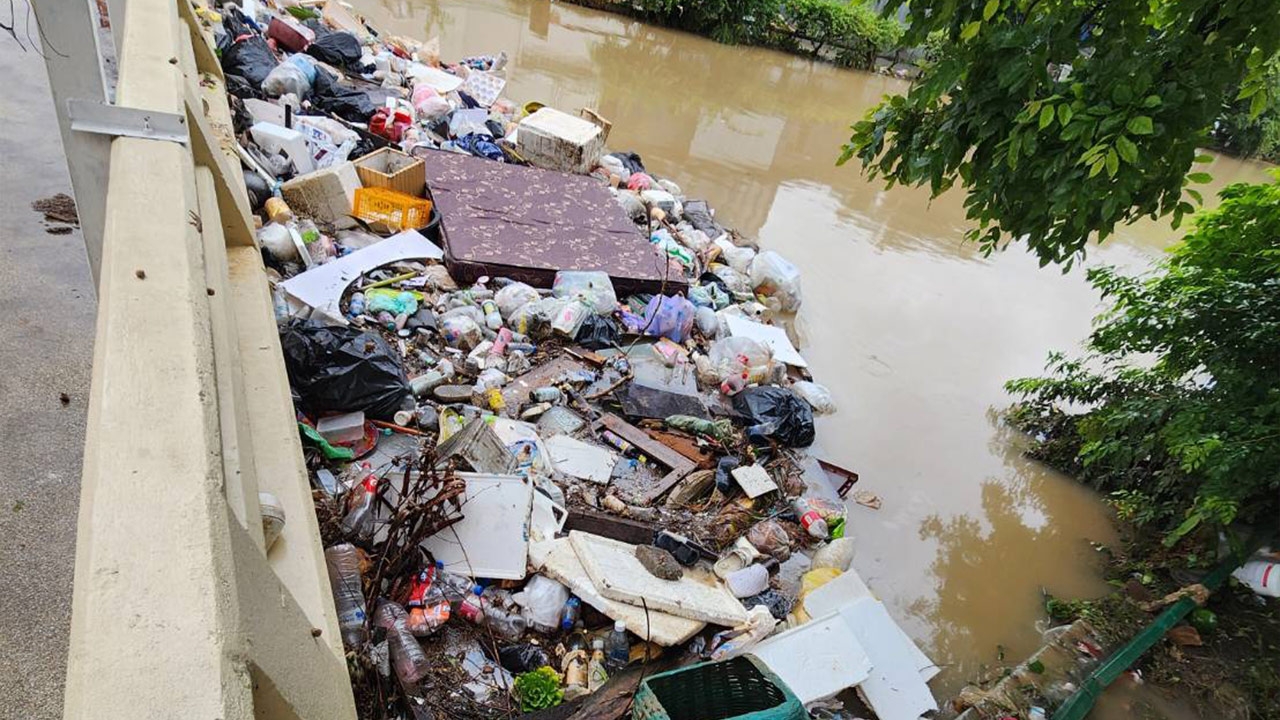
Flooding in Hat Yai continues, with debris blocking drainage and downstream areas still severely affected. A local academic points out that water is flowing faster into Songkhla Lake, and road explosions further worsen conditions downstream. The complex nature of Thai government agencies results in delays in emergency assistance.
On 26 Nov 2025 GMT+7, government officials revealed plans to open a drainage route at the old railway road, which is no longer in use. This action must be taken immediately to accelerate water flow into Songkhla Lake. However, local academics oppose this, citing potential negative impacts on downstream communities that could experience higher water levels.
Thairath Online’s special news team interviewed Assistant Professor Dr. Natthapon Kaewthong, head of the Water Management and Geoinformatics Innovation Research Unit at Rajamangala University of Technology Srivijaya, and a researcher in the Stable Water Project focused on flood and drought prevention in the Hat Yai area of Songkhla. He said that the water situation in Hat Yai is steadily decreasing. Data from the Khlong Hwa and Sadue water stations, located at the uppermost points of the city, show that water is now flowing almost entirely into normal river channels, preventing overflow into residential areas. However, water levels remain high in lower zones like Bang Klam and Khlong Hae. He added that blasting bridges or cutting roads blocking water flow should have been done early during the heavy flooding.

Bridging explosions or cutting roads that obstruct water flow should have been done early before water reached the central basin area of Hat Yai city. Now that water has entered this basin, diverting it elsewhere is no longer possible. The immediate priority is for government agencies to reach affected households because water levels are beginning to fall and people are starting to move around, except in some lower areas where flooding remains high.

"If bridges are blasted now where water is still stagnant, it will negatively affect downstream residents who have not yet been evacuated. Currently, those upstream can cope, but those downstream cannot. Water levels in downstream Hat Yai are rising, which is difficult to predict because there are no water monitoring stations in that area."
Water is now freely draining from Hat Yai into Songkhla Lake. During the flood, heavy rain and strong winds caused the lake’s water level to rise, slowing drainage from upstream areas. But today, 27 Nov 2025 GMT+7, there is no rain or wind like before. After visiting the downstream area, it is expected that water levels in Hat Yai will begin to decrease within one to two days.

I visited the outlet where water from Hat Yai drains into Songkhla Lake. Water is draining quite quickly, and the Irrigation Department has installed large pumps at Sathing Phra to accelerate direct drainage into the sea.
What must be urgently addressed now to drain remaining water in Hat Yai is clearing the large amount of debris accumulated at bridge necks blocking water flow. Before the flood, many households were unprepared and did not move belongings; when flooding occurred, tables, cabinets, and beds were swept into these choke points, obstructing drainage.
Surveys in Hat Yai show that nearly every bridge neck is clogged with significant debris, slowing water flow. Additionally, after the first flood, some residents mistakenly believed flooding would not recur and began cleaning their homes, with some disposing of waste directly into waterways, further impeding drainage.

What the government must urgently do within 12 hours is to reach residents. But is there a plan for post-flood recovery? Many problems will follow, especially infectious diseases, since people have been living in floodwater for days without access to clean water.
The flood in Hat Yai highlights a critical lesson: the overly complex structure of government agencies prevents timely emergency response. Local water management experts lack sufficient expertise. For example, the Meteorological Department forecasts rainfall, and the Irrigation Department calculates river flow, but there is a shortage of personnel who can analyze various factors causing localized flooding in the area.