

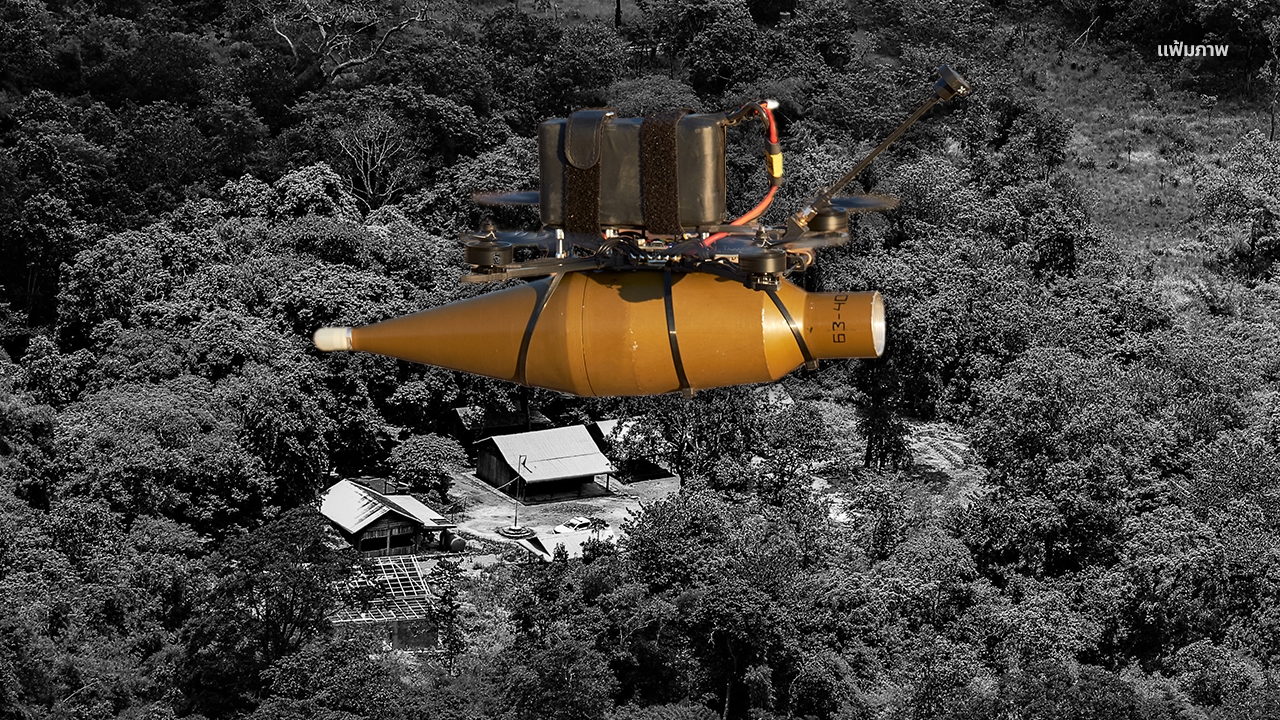
Introducing the "Suicide Drone FPV UAV," Cambodia's tactical innovation of modifying drones with explosives to crash into and destroy targets, a new form of threat to Thailand's security, and its implications.
Following the latest clashes along the Thailand-Cambodia border that erupted on 7 Dec, the 2nd Army Region reported today (9 Dec) that Cambodia has been employing "suicide drones" to attack multiple locations within Thailand, including Phaya Satbann, Chong An Ma, and Hill 561.

Regarding the "suicide drone" used by Cambodia, the Royal Thai Army stated it is a type of "FPV UAV" where UAV stands for Unmanned Aerial Vehicle, or drone, and FPV means First-Person View, indicating that the drone is equipped with a camera transmitting live footage to the operator, allowing precise control to strike the intended target.
FPV UAV are often modified from commercial drones to carry explosives. They are small, highly maneuverable, and cheaper than specialized military drones, making them widely used as disposable suicide drones in warfare, notably in the Russia-Ukraine conflict.
Mr. Anaryo Koskul owner of the Thaiarmedforce page, revealed that a "suicide drone" is a drone that crashes into and detonates on the target. They usually attach an "explosive grenade" normally launched from grenade launchers to the drone. Cambodia's detected drones follow this pattern. There are two main ways to control suicide drones:
1. An FPV drone where the operator wears goggles to view footage from the drone's camera and pilots it to crash into the target.
2. Using a master drone to control, with suicide drones following. The master drone sends signals back to the operator to identify targets and command the suicide drone to strike. More advanced systems employ AI to detect human targets and autonomously direct the drone upon command.

Mr. Anaryo further explained that suicide drones have limited control ranges of about 1–2 km, but actual operations usually occur within 500–600 meters, focusing on targets close to the front line, typically support troops.
Defending against suicide drones is challenging. Even major powers still face difficulties since these are modified drones that continuously adapt to new countermeasures.
"There are many defense methods, but drones keep evolving. For example, jammers can disrupt drone signals, but in Ukraine, drones have been equipped with fiber optic cables to prevent signal cutting."
Intercepting suicide drones is difficult because they fly fast—nearly 100 km/h—and maneuver erratically, making targeting hard. Shotguns against drones require very close range, about 30–40 meters.

According to the 2nd Army Region, several FPV drones have been detected infiltrating to attack ground targets, supported by rocket artillery such as BM-21 multiple rocket launchers.
The attack pattern involves using a "lead drone" to lead the swarm, distract, or designate targets. Suicide drones carry explosives like 82 mm grenades, have GPS boxes for improved accuracy, and may use special control systems for automatic coordinate tracking.
Authorities advise the public not to touch any suspicious objects and to report them to security agencies for inspection.