

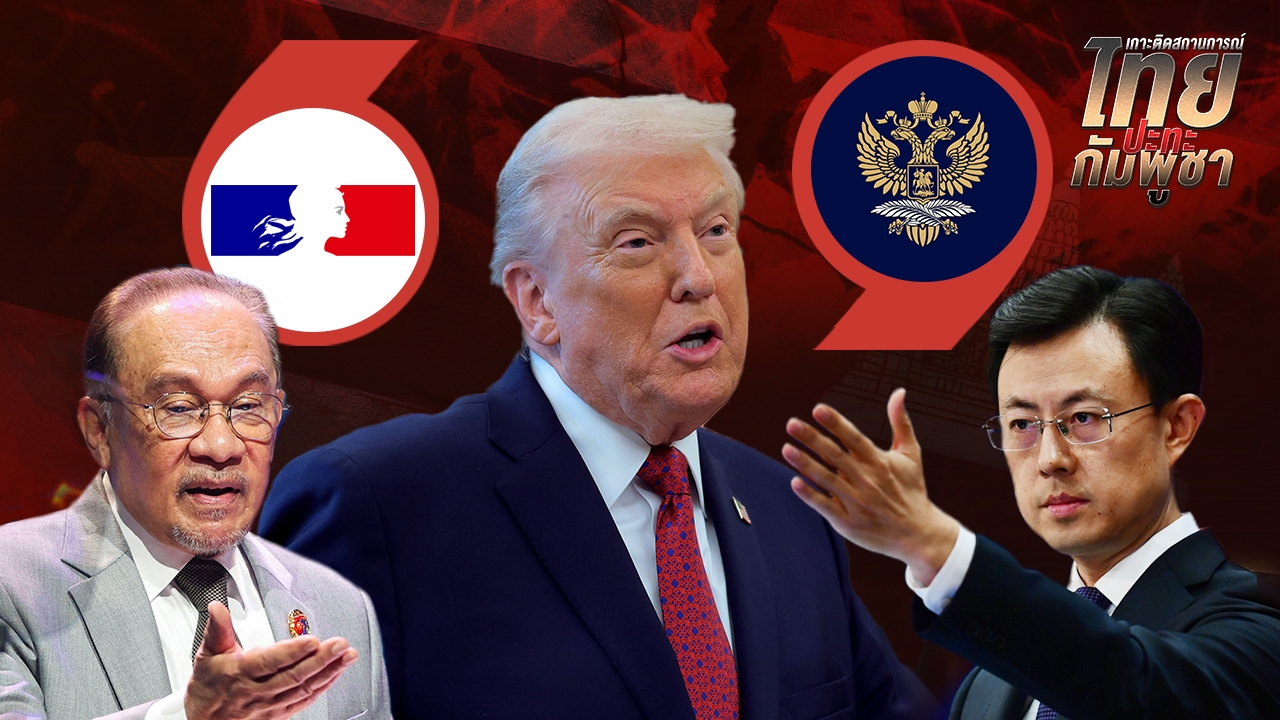
A look at international reactions to the latest Thai-Cambodian border clashes shows support for negotiations and calls for a ceasefire, with Trump boasting of helping to end the war once again.
Since the Thai-Cambodian border clashes erupted again on 7 Dec, many countries have expressed their views on the renewed conflict. Thairath Online summarizes the latest positions as follows.

U.S. President Donald Trump has played a significant role in the Thai-Cambodian conflict as a witness to the joint statement signing by Thailand and Cambodia on 26 Oct.
The U.S.'s initial stance after the new clashes on 11 Dec was that President Trump revealed plans to call the leaders of Thailand and Cambodia. Then on 12 Dec, he posted on Truth Social that he had spoken with both leaders, and both sides agreed to a ceasefire and to return to the original peace agreement. He also stated, "The incident involving the bombs that caused many Thai soldiers to be killed and injured was an accident. Nevertheless, Thailand responded with strong retaliation."
Following this post, on 13 Dec, Deputy Prime Minister Anutin Charnvirakul clarified that the talks did not include mention of a ceasefire agreement or a return to the peace declaration. He affirmed that regarding the conflict between the two countries, Thailand must fully protect its sovereignty and its people.
Meanwhile, in an interview with The Wall Street Journal on 12 Dec, President Trump reportedly threatened to impose tariffs if fighting did not stop. However, Foreign Ministry spokesman Nikorn Dechplangkur explained that in talks with the U.S. leader, there was no indication of tariff measures and no notification about such measures.
Similarly, on 16 Dec, Commerce Minister Supachai Sutthumpan confirmed that President Donald Trump did not use tariffs as a bargaining condition for a Thai-Cambodian ceasefire. Trade negotiations with the U.S. have not progressed or changed.
Most recently, on 15 Dec (16 Dec Thai local time), President Trump spoke again about the Thai-Cambodian conflict during an interview about the Russia-Ukraine war.
"As you know, we have ended eight wars, and one of them, yesterday, had a small problem—that is, Thailand and Cambodia. But we managed to resolve the situation. There was killing that should never have happened. We appreciate their efforts in handling this, and they really did it."

China is the source of most weapons used on Cambodia’s front lines, but has consistently denied supplying weapons to Cambodia to attack Thailand or being involved in the border conflict.
On 15 Dec, Gao Jiakun, spokesperson for China’s Ministry of Foreign Affairs, responded to reporters’ inquiries about China’s stance on the Thai-Cambodian border conflict and its efforts to promote a ceasefire.
Gao said that as a neighboring country and friend of both Thailand and Cambodia, China has been closely monitoring the border situation and expresses deep condolences and concern over the casualties and injuries among the people of both countries. Thailand and Cambodia are neighbors who cannot be moved.
China has an ancient proverb, “Living with neighbors in friendship and kindness is a precious treasure for one’s own country.” The most urgent task now is to stop the fighting, halt hostilities, and protect civilians. China sincerely hopes both sides will prioritize peace and stability in the border area and the interests of their people, restrain themselves fully, and take all measures conducive to achieving a ceasefire to quickly ease tensions.
Since the border conflict began, China has communicated closely with both sides through multiple channels and levels as requested by them, actively mediating and promoting dialogue to create opportunities and set up a platform for Thai-Cambodian talks. China supports direct negotiations and consultations between the two parties, endorses ASEAN’s mediation efforts, especially Malaysia’s, and backs seeking solutions within the ASEAN framework accepted by both sides. China is fully committed to mediation and dialogue and will continue to play a constructive role in promoting ceasefire and restoring peace.
Regarding weapons, on 16 Dec, Foreign Minister Sihasak Phuangketkaew revealed that China explained the weapons supplied to Cambodia were old, with no new arms delivered. However, there may be various ways to acquire weapons due to open markets. Thailand will monitor this closely because Cambodia’s use of Chinese heavy weapons to attack Thai territory has caused damage and civilian deaths, requiring ongoing discussions with China.

As ASEAN Chair, Malaysia has consistently played a role in mediating the Thai-Cambodian conflict. Immediately after the new clashes on 8 Dec, Malaysian Prime Minister Anwar Ibrahim posted expressing concern over the situation and urged both countries to exercise restraint, stop fighting, and return to diplomacy.
On 13 Dec, after talks with President Trump, Anwar called for an immediate ceasefire along the border by 10:00 p.m. local time. However, no ceasefire occurred.
On 16 Dec, a special ASEAN foreign ministers meeting originally scheduled was postponed due to escalating fighting between Thailand and Cambodia.
Anwar said the meeting aimed to gather ASEAN members’ views to resolve the border crisis, but both Thailand and Cambodia requested a temporary postponement. He noted ongoing coordination among all parties, slight delays due to logistical details, but reiterated calls for both sides to end hostilities.
“We continue to urge them to stop fighting. This is very important. I am in contact with them almost daily.”

On 8 Dec 2025, France’s Ministry of Foreign Affairs issued a statement expressing concern over the renewed Thai-Cambodian tensions leading to loss of life. It called on both countries to respect and implement the ceasefire agreement of 28 July and the joint statement from the ASEAN meeting on 26 Oct 2025. France affirmed support for ASEAN’s mediation efforts and believes the only sustainable and peaceful solution is negotiation, respect for international law, and adherence to existing agreements.
On 14 Dec, France issued another statement expressing deep concern over the escalation of Thai-Cambodian border clashes and praised Malaysia’s efforts as ASEAN Chair in promoting peaceful negotiations.
“France supports Prime Minister Anwar’s call for an immediate ceasefire and urges both sides to cease hostilities promptly and resume talks under the Kuala Lumpur Peace Declaration to seek a peaceful resolution to the dispute.”
On 14 Dec 2025, the Russian Embassy in Thailand reported statements by Maria Zakharova, spokesperson for Russia’s Foreign Ministry, from 11 Dec. She noted Russia’s longstanding good relations and cooperation with Thailand and Cambodia and expressed concern about the conflict.
Russia called on both sides to exercise restraint to avoid civilian casualties, enter ceasefire negotiations promptly, and comprehensively resolve the dispute as agreed during the ASEAN Summit in Kuala Lumpur on 26 October 2025.
On 15 Dec 2025, the Russian Embassy in Thailand clarified reports of Russian mercenaries fighting alongside Cambodian forces, stating, “These reports are baseless and likely fabricated by sources outside the region aiming to undermine the rights of Russian citizens residing in Thailand as tourists or businesspeople, damaging the longstanding friendship between Russia and Thailand.”
Russia’s Foreign Ministry has a clear stance on the Thai-Cambodian border conflict, as stated by its spokesperson on 11 Dec 2025:
Russia has friendly relations and cooperation with Thailand and Cambodia. We affirm and support resolving this dispute by peaceful means only.”