

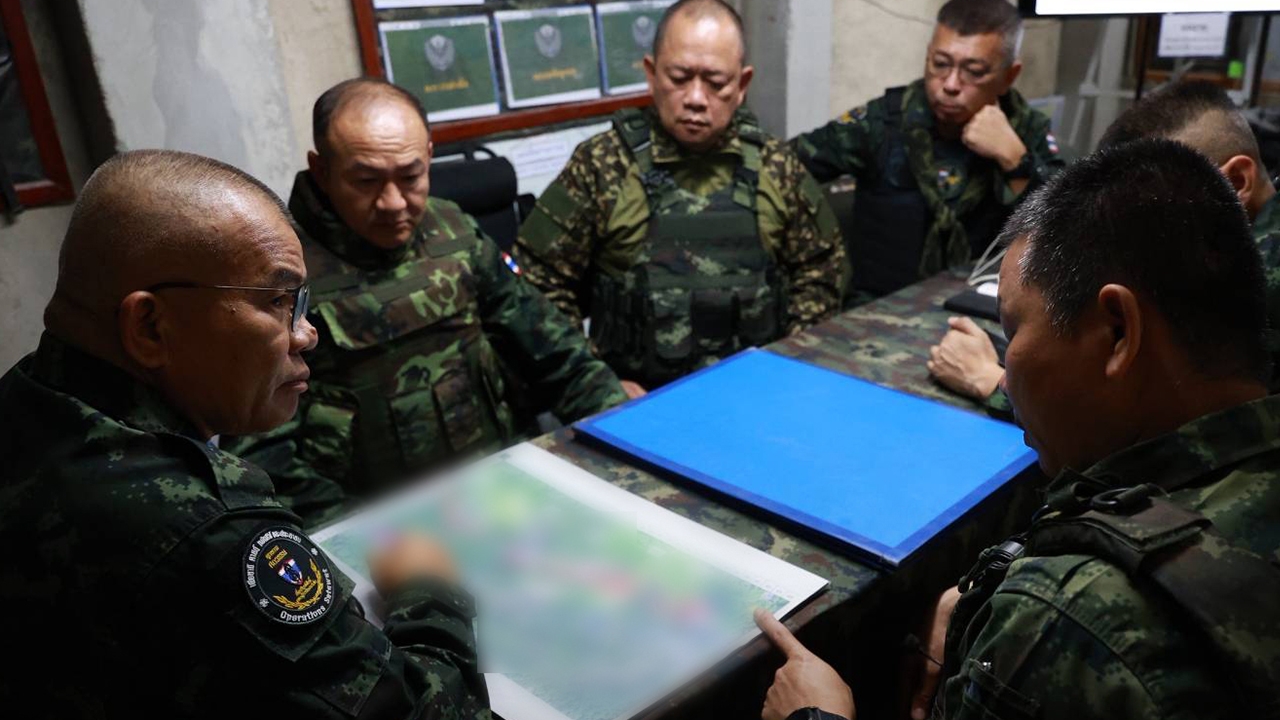
Behind the Operation at Hill 350: a 120-hour mission, a proof beyond victory. The "Commander of the 2nd Army" took the lead at the front line with a mission higher than winning: to conclude the situation with dignity and establish a true foundation for lasting peace.
After securing the area, the more important question is how we will end this situation without repeating losses. Taking control does not mean the war is over, nor does the sacrifice of brave soldiers only signify a momentary victory. It means more when such loss need not recur. Throughout the operation, Lieutenant General Weerayut Raksin, Commander of the 2nd Army, led the battle at the front line to inspire confidence among the troops.

The situation around Hill 350 near Prasat Ta Kwai reminded Thai society that “high ground” is not just a point on the map but a decisive factor in security. It serves as both watchpoint and shield, marking the line between civilian safety and frontline risk.
Under the 2nd Army’s command, operations in that area proceeded with caution, precision, and careful control to minimize losses. Every decision considered not only immediate outcomes but also long-term effects on overall stability and security.
To provide a concrete picture,

The focus was on halting enemy advances and securing key areas.
Additionally, efforts aimed to prevent enemy reinforcements. The main goal was to avoid repeated losses and prevent violence from expanding.

They operated under principles of caution, accuracy, and minimizing risks to personnel.
“Today’s calm is not hesitation but a decision made without emotion.”
News reports indicated progress in controlling the area. Enemy movements in the strategic zone were limited. The situation reached a point where threats could no longer significantly escalate.
It was confirmed that Thai forces controlled Hill 350 and the Prasat Ta Kwai area. The bodies of fallen soldiers were respectfully recovered for proper ceremonies. The area was thoroughly secured, and weapons were seized from enemy bases to prevent renewed violence.
“Today is not a day for celebration but a day when losses were ‘stopped’ by dignified decisions.”

Military history worldwide consistently shows that
securing territory alone is never enough without linking it to conflict resolution.
Hill 609 (Tunisia, 1943) demonstrated the role of high ground in shifting battlefield balance.
Hamburger Hill (Vietnam, 1969) highlighted the importance of connecting territorial gains with plans to end the conflict.
Kargil (India–Pakistan, 1999) showed that controlling high ground can limit conflict expansion and lead to localized resolution.

These three cases from different eras unanimously confirm that
high ground is not for isolated occupation but to change the entire strategic equation.
Ending the situation with dignity—rendering the threat “combat-ineffective”—is not rhetoric fueled by anger or hatred but a practical operational concept aimed at stopping the cycle of losses as quickly as possible.
Soldiers standing on the front line do not serve for praise but to halt violence at the frontline and prevent its spread to innocent civilians.
Today we may have secured the area, but the higher mission remains: to end the situation with dignity so that the sacrifices etched in the nation’s heart become the true foundation of lasting peace.