

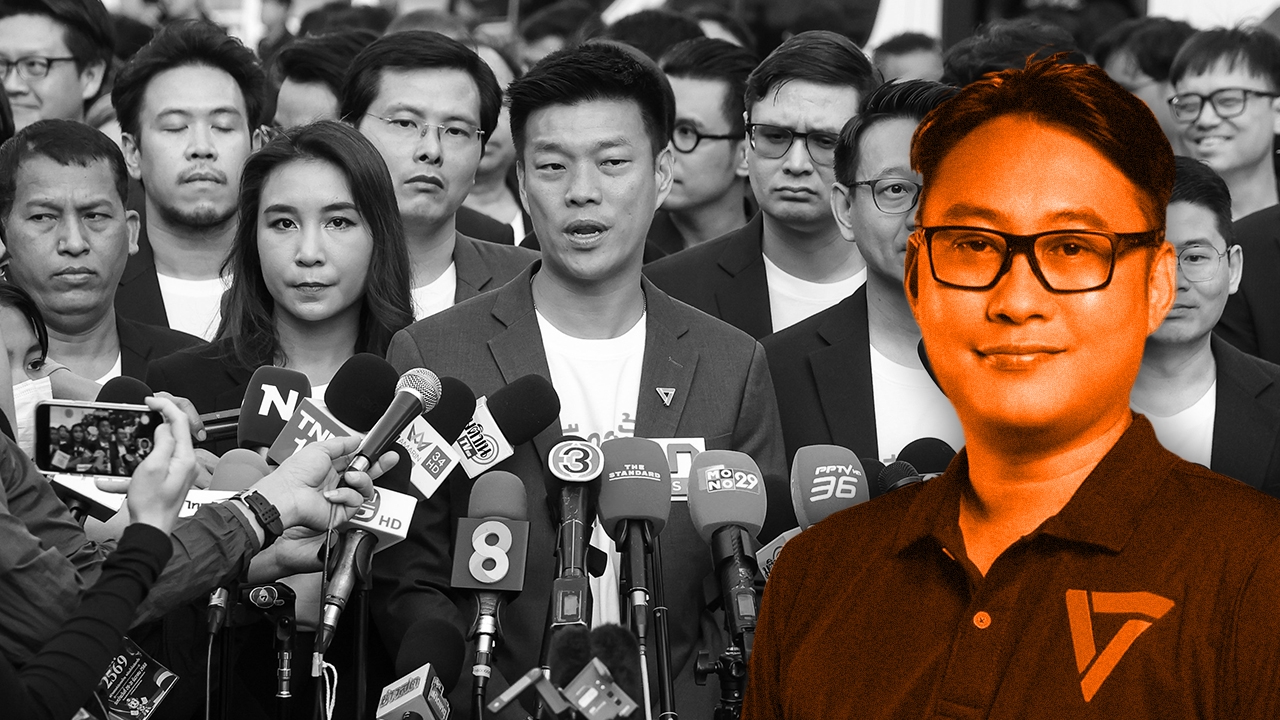
Revisiting the troubles of the Orange Party: Progressive and Prachachon MPs have caused scandals shaking public confidence. Recently, a Bangkok MP candidate received an arrest warrant linked to laundering 20 billion baht in drug money, shaking the "Orange yes, gray no" principle.
On 28 Dec 2025 GMT+7, narcotics suppression police raided and dismantled a drug trafficking network with seven arrest warrants issued, including one warrant for Boonrit Rerungroj, a Prachachon Party candidate for Bang Phlat-Bangkok Noi district, accused of involvement in laundering 20 billion baht of drug money.
Pichan Chaowaphatwanong, a Prachachon Party executive responsible for the Bangkok election campaign, held a press conference apologizing to the public and announcing the replacement of the candidate. He explained that the warrant was issued after the party had completed its criminal background checks on candidates and affirmed "Orange yes, gray no." There will be no protection for anyone, even our own candidates, nor any tolerance for gray capital, corruption, or bribery. The party will handle this matter transparently and as swiftly as possible. (Read more:Prachachon apologizes to the public and replaces MP candidate after arrest warrant issued for money laundering case)
Meanwhile, Boonrit posted on Facebook announcing his resignation from the party, asserting his innocence regarding the allegations and stating he will cooperate with the justice process. Former Bangkok MP Taepiphop Limjitrakorn, who had earlier announced his political retirement, volunteered to run in this district and reportedly won the party primary vote at around 16:30.

The "Orange Party" across three generations has often faced issues related to its candidates. In the first generation, represented by the Future Forward Party, there were issues with nearly 20 party-hopping MPs, which led the next generation, the Progressive Party, to enforce stricter candidate selection. After the 2023 election, although no party-hoppers were found, individual MP misconduct remained a problem. .
For the Orange Party’s third generation, the Prachachon Party, has experienced one party-hopping MP: Krit Cheewathammanon, MP for Chonburi district 6, who announced his move to the Kla Tham Party without being expelled by Prachachon.
Meanwhile, on 16 Dec, Jirath Thongsuwan, MP for Chachoengsao district 4, a prominent parliamentarian, was sentenced by the Criminal Court to two years in prison for forging a medical certificate (Form 43). He was found guilty of using forged official documents and inputting false information into a computer system. The forged document charge was dismissed. Jirath was granted bail and intends to appeal. The Prachachon Party nominated his wife, Praewnapas Thongsuwan, as candidate for the 2026 election in the same district, stating she underwent normal selection procedures without special privileges.
Later, after Prachachon announced its list of 100 party-list candidates on 18 Dec 2025, the name of Chotisak Onsung, an activist and political campaigner, sparked backlash due to his past critical comments on Islam and sexist remarks. On the same day, Chotisak posted his withdrawal from candidacy, citing a desire to prevent controversy affecting the party.

Thairath Online’s special report spoke with Nattawut Buapratum, Prachachon Party registrar, who revealed that candidates must receive party certification before running. Candidate replacements require re-entry into the selection process, including provincial primary votes, with an urgent party member meeting scheduled for today.
However, regarding candidate vetting, he apologized to the public and accepted responsibility for mistakes. The individual in question was found to have an arrest warrant only after passing the party’s screening. The candidate had previously assured the party of no criminal record or related issues, and there were no citizen reports.
The party’s vetting process requires candidates to undergo criminal background checks via fingerprint verification through the Forensic Science Department. Financial checks, including credit bureau and financial trails, are done within legal limits.
Candidates must complete party training courses and pass selection committees at provincial, regional, and central levels. The process includes public and party member input on candidate suitability. Additionally, the Election Commission will conduct further verification before the 2026 election.
"Following party operations, several candidates, both district and party-list, have been removed after final stages when inappropriate conduct was discovered or citizen complaints received. However, this does not excuse us from responsibility," he said.

Nattawut added that future elections will require reviewing and improving any weaknesses, especially as the party firmly declares "Orange yes, gray no." The party must act decisively from the start by rejecting unsuitable candidates and must take strict action if problems arise later. Should similar cases occur in the future, decisive measures must be applied.
"We don’t yet know if this case will ultimately be proven true or false; the individual must go through the justice system. However, given the situation, we certainly need to improve further. We want the public to trust that Prachachon is serious about these matters," he said.
Regarding whether the incident will affect campaigning, Nattawut acknowledged the impact, as the public holds high expectations for party candidates. Although such issues can occur in any party due to individual behavior, society expects high standards. The party aims to avoid gray-area politics and will prove through actions that it will not tolerate such matters, allowing the public to decide whether to continue trusting Prachachon in parliament or future cabinet roles.