

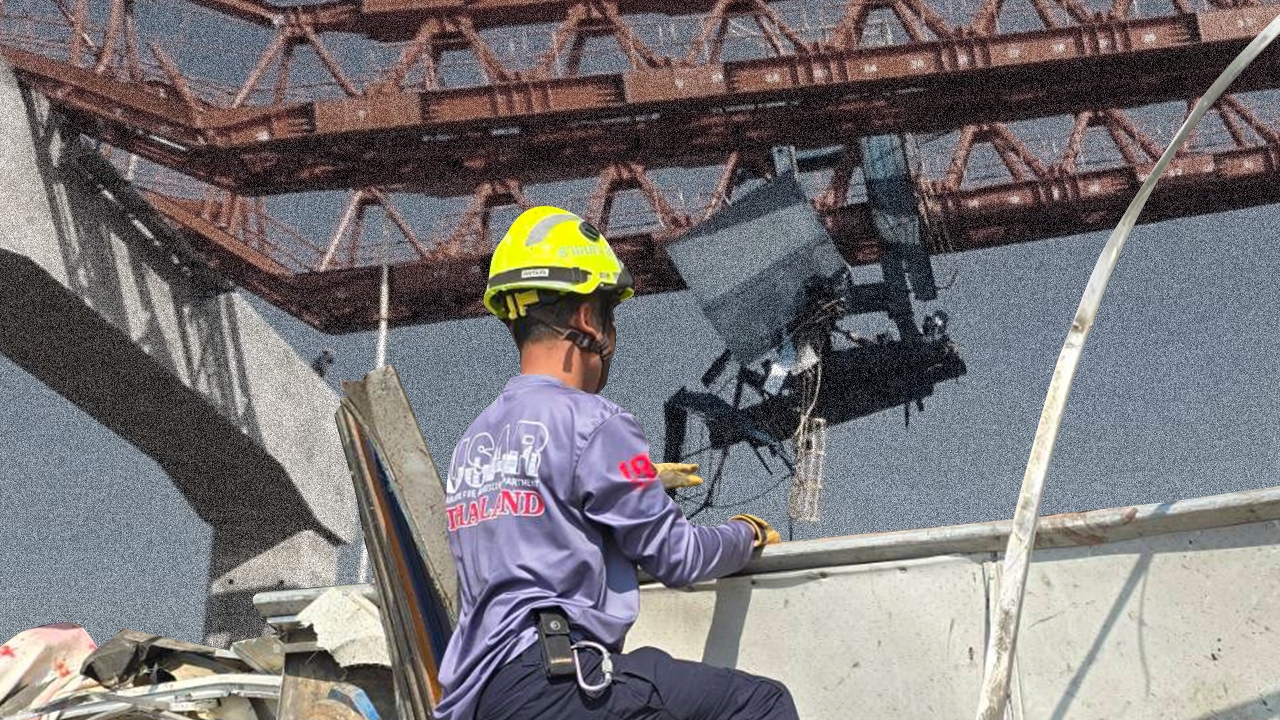
A crane fell onto a train at Si Khio, causing a recurring cause. The president of the Engineering Institute compared it to the Rama 2 Road collapse, highlighting the risk of sliding cranes over moving trains.
This morning (14 Jan 2026), a crane from the high-speed rail construction project collapsed onto a train traveling from Bangkok to Ubon Ratchathani near Ban Thanon Kot railway, Si Khio Subdistrict, Si Khio District, Nakhon Ratchasima Province. The incident left many dead. Express train 21, originating from Bangkok and bound for Ubon Ratchathani, had 86 people affected: 22 dead and 8 seriously injured. The accident happened while the train was passing under the crane, which was under construction overhead and collapsed. Observers noted similarities to a previous crane collapse on Rama 2 Road.
The Thairath Online special news team asked Associate Professor Anek Siriphanichkorn, president of the Engineering Institute of Thailand under Royal Patronage, who analyzed that the collapsed crane is a sliding beam type. The beam moves gradually during the completion of elevated construction. Over 90% of such collapses share the same main cause.

The sliding beam must be appropriate. For example, it was previously slid 40 meters during construction, but when changed to 30 meters, the risk increased because the original extension was longer. Therefore, proper design calculations are necessary. To prevent accidents, sensors should be installed to detect if the crane is distorted or extended beyond the planned design, indicating a risk of collapse.
The crane that collapsed onto the train at Si Khio is similar to those that collapsed during the construction of the electric train and on Rama 2 Road. Cranes are less dangerous when stationary than when sliding.
The recent accident at Si Khio involved the crane collapsing while sliding, coinciding with the train's passage underneath, causing it to fall onto the train and resulting in fatalities.
A major risk is the crane's setup, operating while trains run below, which is highly risky. Ideally, the crane sliding should occur only when no trains are running, ensuring greater safety. Allowing trains to run under ongoing overhead construction poses risks.

"From an engineering perspective, trains running below cause vibrations to the crane. Although the crane's support columns are separate and strong enough to resist vibrations, the collapse was primarily caused by the sliding movement of the crane, which made the upper structure fall," he explained.
Preventive measures must include devices that detect incorrect sliding of the beam. Additionally, coordination between train operators and construction teams is essential to ensure caution or halt crane sliding when trains pass.

For example, sliding cranes on Rama 2 Road are placed on construction sites where work is restricted to nighttime hours from 10 p.m. to 5 a.m.
Comparing the crane sliding collapse on Rama 2 Road with the collapse onto the train at Si Khio shows similarities because the crane collapsed while sliding in both cases.