

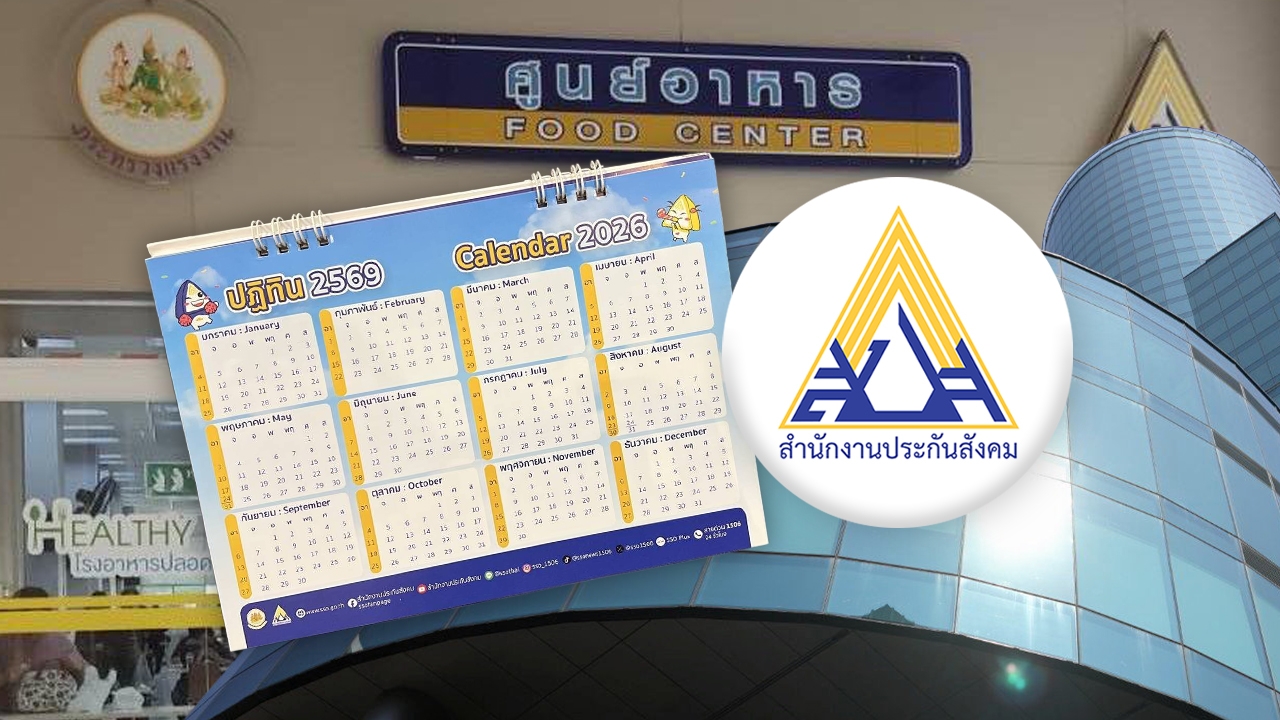
From producing calendars to renovating cafeterias, what has the Social Security Fund spent its money on? After questions arose about whether the budget was used correctly and cost-effectively, the Social Security Office (SSO) stepped forward to clarify.
A heated issue has arisen regarding the Social Security Fund or the SSO again, after Ice Rakchanok Srinok a candidate for Member of Parliament with the People's Party and the Progressive Social Security team revealed and questioned the SSO's budget usage, including spending on cafeteria construction and investments in unprofitable projects, as well as changes to the election criteria for the new Social Security Board. This sparked intense reactions from insured persons, prompting the SSO to quickly issue clarifications.
In recent times, what budget spending issues involving the SSO have become major news? Thairath Online special news team reviews these issues in order:
This matter was revealed during the “HACK Social Security Budget” meeting held by the Committee for Budget Study and Oversight on 15 Feb 2025, highlighting issues such as first-class plane tickets for overseas study tours, spending 850 million baht on a new app, and most notably, an annual calendar production budget of 50-70 million baht over eight years, totaling more than 450 million baht.
Then Minister of Labor Phiphat Ratchakitprakarn explained this was to communicate benefits specifically to insured persons, especially informal workers who lack access to digital media.
However, opposition among insured persons continued. On 2 Dec 2025, it was announced the 2026 calendar production would be canceled, but a few days later on 12 Dec, an SSO letter indicated plans to proceed, causing confusion. The latest update on 20 Dec confirmed the 2026 calendar was canceled, while the 2027 budget framework was approved but no action taken yet.
On 10 Mar 2025, Ms. Rakchanok Srinok and Mr. Sahaswat Khumkhong, People's Party MPs, held a press conference outside the SKYY9 Centre building in Rama 9, Bangkok, stating the SSO bought the building valued around 3 billion baht for 7 billion baht. At the time of purchase, occupancy was only 1-2%, and last year the building had 20-30% occupancy, generating about 40 million baht profit, while management fees reached 50 million baht. Even at full occupancy, it would take 30 years to break even. They questioned why the SSO approved this off-market investment at such a high price and whether political figures had conflicts of interest.
The SSO responded that the purchase was through a Private Equity Trust, with an income approach valuation of about 7.3 billion baht, so the 6.9 billion baht price was "below appraised value." They noted 45% of leases were signed, but only 25% of the space was occupied, with the rest gradually moving in. However, a committee was formed to investigate this matter. In June 2025, the investigation concluded that the SSO overpaid for the building, with a fair market value between 3.4 and 3.9 billion baht, prompting the Labor Minister to set up a committee to pursue those responsible.
3. Spending on cafeteria renovation at the Ministry of Labor On 20-21 Jan 2026, Ice Rakchanok

This raised questions about whether the SSO was using insured persons' money for such purposes instead of state budgets, and whether this was inappropriate or illegal. The SSO later clarified to the media that the project began in 2018, following proper approval and legal processes by the Social Security Committee and budget authorities. They obtained official permission to use government property from the Treasury Department correctly. Insured persons and the public had been aware of this project throughout.
They emphasized that revisiting this already-reviewed and completed issue should be based on complete facts to avoid misunderstandings in society. The Bangkok Social Security Office Area 3, responsible for Din Daeng, Phaya Thai, Ratchathewi, and Huai Khwang districts—covering over 597,960 insured persons, 12,905 employers, and 13,314 workplaces—serves an average of 300-400 people daily. This area also houses other Ministry of Labor units, such as the Smart Job Center, mainly serving workers, employees, employers, and the public. The renovation aimed to improve convenience and service efficiency as a non-profit public welfare.
Meanwhile, Labor Minister Treenuch Thienthong requested the SSO to summarize all facts and report to her within 24 hours, concerned about impacts on insured persons' confidence. She thanked civil society for exposing these issues, stressing that the SSO must work carefully and remember that insured persons own the money, not just pay contributions. This is an opportunity for the SSO to enhance transparency and listen to insured persons' feedback for improvement. 4. Investment in "TU Dome" shares plummeting in value
On 21 Jan,
the Progressive Social Security group exposed additional SSO budget and investment issues involving the TU Dome dormitory near Thammasat University in Pathum Thani province. They noted that besides the Ministry of Labor cafeteria and SKYY9 building, the SSO invested in another asset that appears underutilized, specifically

officially called the TU Dome Residential Complex (TU-PF). The SSO is the largest shareholder with 80 million shares, representing 76.75%. The initial investment was about 800 million baht (at 10 baht per unit), but current SET-listed share value is only 1 baht per share, reducing the SSO's net asset value to under 100 million baht, with dividends received totaling no more than 170 million baht. On 22 Jan 2026, the SSO explained this was an investment in a 30-year real estate leasehold fund, TU Dome Residential Complex (TU-PF), made in 2006 after following SSO's investment procedures. So far, the SSO has received 159 million baht in returns. Market value dropped significantly due to increased competition. For fiscal year 2025, occupancy rates were 89% for dormitories, 80% for apartments, and 55% for plazas, improving from previous years with operational profits. The SSO received 8 million baht back. For 2026, they expect increased returns by improving tenant recruitment strategies and marketing plans. The SSO also noted it currently has 30.3 billion baht invested in domestic real estate funds, with total dividends exceeding 18.6 billion baht since inception. In 2025 alone, dividends totaled 1.847 billion baht, a 6.09% return.
Real estate investments are long-term, aiming for returns via dividends and asset appreciation. The SSO diversifies across property types to spread risk and ensure stable long-term benefit payments to insured persons.
SSO affirms fund's strong status On 22 Jan 2026, the SSO disclosed the Social Security Fund’s financial status and investment management for 2025 (Jan-Dec). Total accumulated investments amount to 2,859.4 billion baht, from contributions by employers, employees, and government totaling 1,728.7 billion baht since the fund's establishment. Investment returns have accumulated 1,130.7 billion baht.
In 2025, returns amounted to 80 billion baht, a 6.1% portfolio yield, attributed to a strategy emphasizing fund stability to ensure long-term benefit payments. Investments consist of 69.01% in stable securities and 30.99% in riskier assets, with 60.47% domestic and 39.53% foreign investments.
For the Workmen’s Compensation Fund, accumulated investments total 88.1 billion baht, with net employer contributions of 52.7 billion baht and investment returns of 35.5 billion baht. In 2025, returns were 4.2 billion baht, a 5.68% yield. The fund follows strict capital safety policies, investing 81.37% in stable securities and 18.63% in riskier ones, with 71.54% domestic and 28.46% foreign allocation.
Reports show that as of September 2025, total insured persons number 24,811,929: 12,145,018 under Section 33 (employees), 1,648,668 voluntary insured under Section 39, and 11,018,243 self-employed under Section 40.