

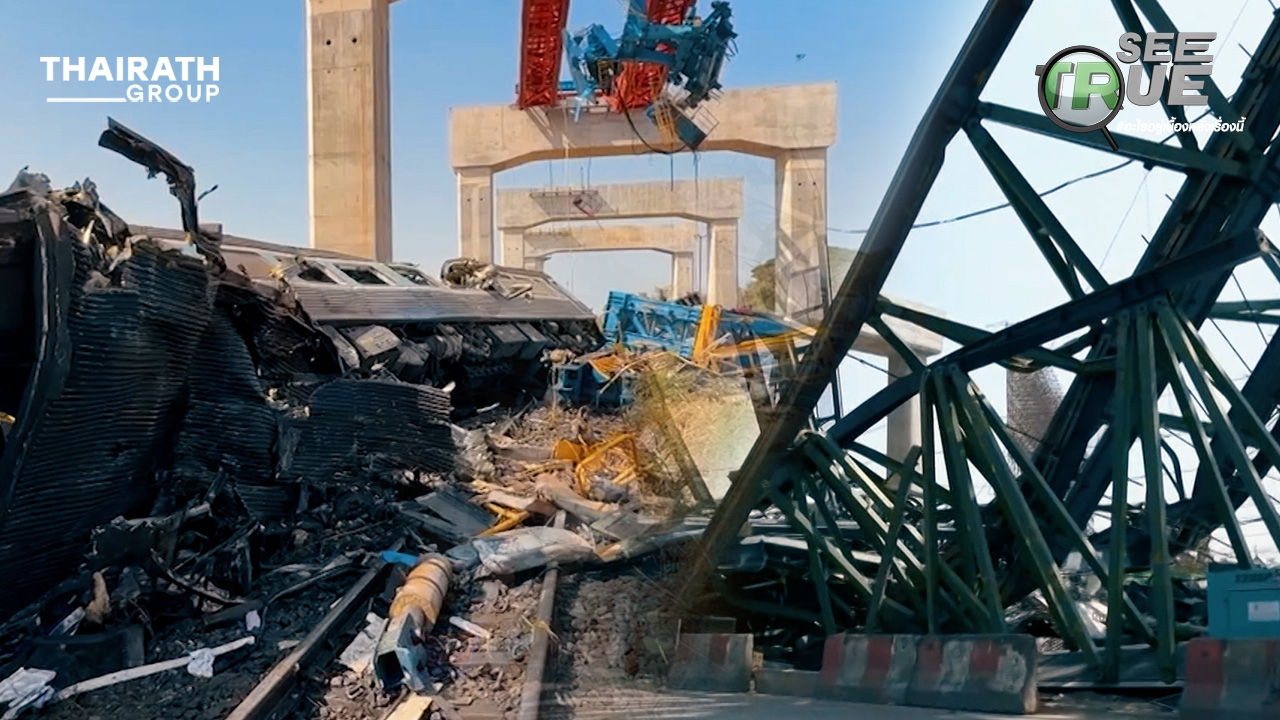
Kickbacks paid with lives: repeated tragedies of crane collapses and accidents on Rama 2 Road reveal deep-rooted safety failures in state projects.
Are these repeated tragedies truly "accidents" or the result of governmental "negligence"? A crane collapse in Sikhio district, Nakhon Ratchasima province, crushed a train carriage passing beneath, causing many deaths. Shortly after, a similar fatal incident occurred on Rama 2 Road. These incidents expose underlying corruption in managing large-scale state project funds.
Kickbacks paid with lives: when negligence and corruption become the executioners on our roads.
Recurring road tragedies—from a crane collapsing onto railway tracks in Sikhio district to terrifying incidents of steel and beams falling onto vehicles on Rama 2 Road—raise a critical question society demands answered: Are these truly "accidents," or are they consequences of government agency negligence backed by a cycle of corrupt practices?

An investigation into on-site negligence uncovered suspicious safety standard violations at multiple points. For instance, a witness on Rama 2 Road noted that if the incident had occurred during peak hours (6:00–8:00 a.m.), casualties could have been far higher. This raises serious questions about the safety of lives hanging by a thread, as these large construction projects may conceal conflicting interests.
The cycle of "kickbacks" and dark power above the law behind these safety failures is linked to a system of kickbacks paid to politicians. When corruption occurs, contractors gain power over government officials, even to the extent of ordering transfers or demotions of officials who try to enforce regulations.

This creates a chain reaction: failed oversight as government officials must "turn a blind eye" despite seeing negligence or substandard machinery on site, due to political pressure.
Project monopolization: public construction contracts often fall to the same companies repeatedly, raising suspicions of rigged specifications and unfair competition.
Budgets fail to reach the public: projects that genuinely benefit society are neglected because they are seen as "small change" without profit for those in power.

Solutions and system reform: experts suggest fixing the system by creating transparent and fair competition, so state projects do not become tools for politicians' personal gain. Additionally, installing CCTV cameras at construction sites to closely monitor work is recommended, as "exposure" acts as a motivator to improve quality.

Ultimately, if "kickbacks" remain more important than "human lives," state construction projects touted as progress nationwide may simply become "death traps" ready to claim innocent lives at any moment.
Follow #SpecialNewsReport, the sharp news variety show that investigates and verifies truths from every location, exposing every fact every Saturday at 6 p.m. on Thairath TV, Channel 32.