

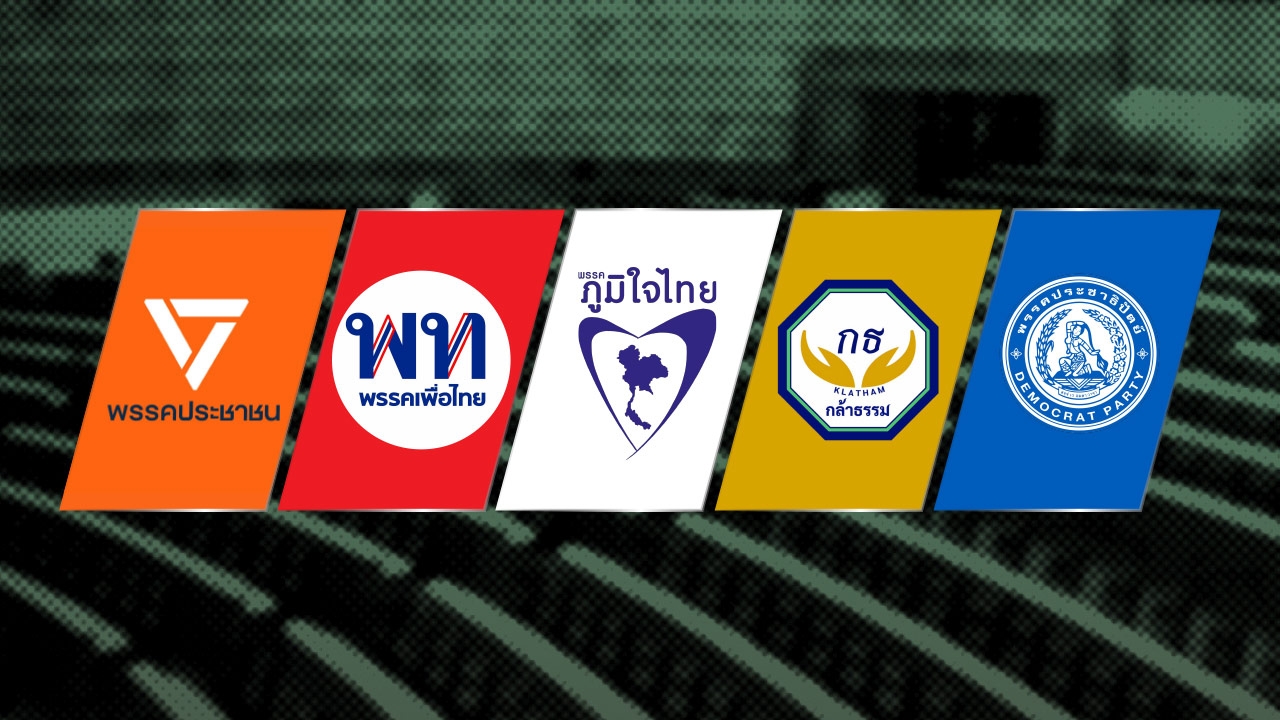
In the final stretch of the 69th general election, five political parties are employing 69 strategies to vie for votes. Experts observe that 'powerful families' are tightly holding their territories, aiming to secure constituency seats. Meanwhile, the Prachachon Party is igniting momentum behind Pita to contest party-list votes.
The final phase of the general election is entering its most intense period amid a competitive atmosphere, with each political party carefully strategizing to gain an advantage in the last moments before voters decide at the polls. The election results will not only reflect short-term political trends but may also shape the balance of political power in the near future.

Throughout this period, Thai politics has seen continuous activity, including internal party reshuffles, the return of key figures to prominent roles, and the adoption of distinctly different strategies. Some parties focus on generating national momentum, while others work quietly at the local level to maintain their existing voter base and systematically expand new alliances.
Entering the final stretch, the competition is measured not only by popularity or leadership image but also by the strength of party structures, local networks, and the precision of strategies developed over several years. All of these will be tested by the upcoming election results.
The Thairath Online special news team interviewed Professor Dr. Yutthaporn Isarachai, Associate Professor of Political Science at Sukhothai Thammathirat Open University, to analyze the overall political situation in the final phase before the 2569 (2026) general election. Professor Dr. Yutthaporn assessed the trends and strategies of five major political parties fiercely competing in the final stage of the 2569 election as follows.

Bringing back Mr. Pita Limjaroenrat, former leader of the Move Forward Party, to campaign for the Prachachon Party has revitalized its voter base, especially among orange-shirt supporters, who have shown noticeably increased enthusiasm, as seen by larger rally attendance recently. In the last two weeks, the party’s main strategy is to have Mr. Pita visit key areas where vote margins remain uncertain, such as Bangkok, Samut Prakan, Chiang Mai, Phuket, and Chonburi.
Professor Dr. Yutthaporn believes that Mr. Pita will certainly be active in these remaining days to stimulate the party's vote base again. However, expecting a landslide victory remains uncertain, as the current political momentum is not as strong as in the 2023 election.
In the 2023 election, Mr. Pita’s popularity played a crucial role in the success of the Move Forward Party, but it was not the sole factor. Other forces contributed, including it being the first election after the true loosening of military control, heavy government criticism during the COVID-19 pandemic, and the dissolution of the Future Forward Party leading to youth movements in 2020 and 2021. All these were significant drivers behind Move Forward’s victory in 2023.
The campaign strategy of political polarization, such as the slogan “Uncle but no us,” although viewed by some as fostering political hatred, has become a strength for the Prachachon Party today. For example, reviving the phrase “What are the military for?” underscores the party’s consistent approach and highlights the distinct context of this election compared to 2023.
Regarding the number of party-list MPs, Professor Dr. Yutthaporn expects Prachachon to secure a number close to that in 2023, as much of the party’s popularity stems from social media trends, which favor gathering votes directly through the party-list system.

A key advantage of Bhumjaithai is its substantial base of 'powerful political families' within the party, currently numbering about 86 families, up from around 40 previously. This provides the party a significant edge in constituency elections. Although it may lose about 20–30% of seats, most MPs remain from these longstanding powerful families across many areas. Bhumjaithai faces direct competition with Prachachon in provinces like Chonburi, where it employs focused strategies to lock targets and tightly control vote leaders.
Although recent momentum around Bhumjaithai and its leader, Mr. Anutin, seems quieter, this does not mean the local voter base has weakened, as grassroots work continues steadily. The party does not emphasize high-profile public appearances or debates, as these are not its main strategies. Instead, it focuses on maintaining and managing its existing support base to enter the final phase of the 2569 election securely.
Regarding party-list MPs, Bhumjaithai won only 3 seats in 2023. In this 2569 election, with more powerful families and their associated vote bases, it is expected to win about 15 party-list seats, but likely not more, as its national popularity still trails behind Prachachon and Pheu Thai.

Previously, Pheu Thai was often seen as a 'declining party' at risk of political extinction. However, Professor Dr. Yutthaporn is among the few who have consistently asserted that Pheu Thai still has the potential to win up to 100 constituency seats. The narrative of 'Pheu Thai’s bleeding' does not align with facts. Data over the past four years show the party lost only about 9% of its MPs, and it has gained MPs defecting from other parties, so its overall picture remains stable.
An important factor is the presence of prime ministerial candidate Mr. Yotsanan, who helps attract votes and maintain the party’s existing base. The three prime ministerial candidates clearly represent different groups: Mr. Suriya represents supporters, Mr. Yotsanan represents the Shinawatra family, and Mr. Julaphan represents MPs and party insiders as party leader, giving Pheu Thai a complete presence on all fronts.
Structurally, Pheu Thai still enjoys support from older, middle, and younger generations, making structural weaknesses less of an issue. The original supporter base remains loyal. Some constituency MPs have defected to Bhumjaithai, but this has not reduced Pheu Thai’s chances of exceeding 100 seats, and it remains a contender for second place.
Overall, Professor Dr. Yutthaporn believes the three major parties—Prachachon, Bhumjaithai, and Pheu Thai—will have similar seat counts, with gaps unlikely to exceed 20–30 seats, resulting in a closely fought election.
Regarding party-list MPs, Pheu Thai won 29 seats in 2023, but in the 2569 election, this number is expected to decrease to no more than 20.

Kla Party has quietly entered the scene, barely visible in debates, social media, or polls, as it does not rely on momentum-based strategies. When asked where Kla Party has gone, Professor Dr. Yutthaporn suggests it has 'disappeared into parliament' instead, focusing primarily on targeting vote leaders locally.
Professor Dr. Yutthaporn estimates Kla Party will win about 40–50 seats. It has also attracted around 20 MPs who defected from the Democrat Party, along with votes from lower Northern and Northeastern regions taken from Pheu Thai, making Kla a medium-sized party and an important variable to watch.

In this election, the Democrat Party has improved its vote count in the South, partly due to the return of Mr. Abhisit, who has revitalized the old supporter base. However, many southern candidates are newcomers, which could be a weakness that limits seat gains.
The party may win about 10 seats in the South and possibly some additional party-list seats. In Bangkok, where the party aims to reclaim its stronghold, it is expected to win only 1–2 seats. Professor Dr. Yutthaporn estimates the Democrat Party might secure about 10 party-list seats, buoyed by Mr. Abhisit's popularity.
The final phase of the election reveals intense competition and diverse strategies across parties: accelerating national momentum, maintaining local bases, and leveraging long-established political networks. These factors are crucial variables influencing voters’ decisions just before election day.
At the same time, the overall competition is expected to be close, with final outcomes depending not only on momentum but also on the strength of party structures, sustained local engagement, and the accuracy of each party’s strategy, all reflected in the election results on 8 Feb 2569 (2026).