

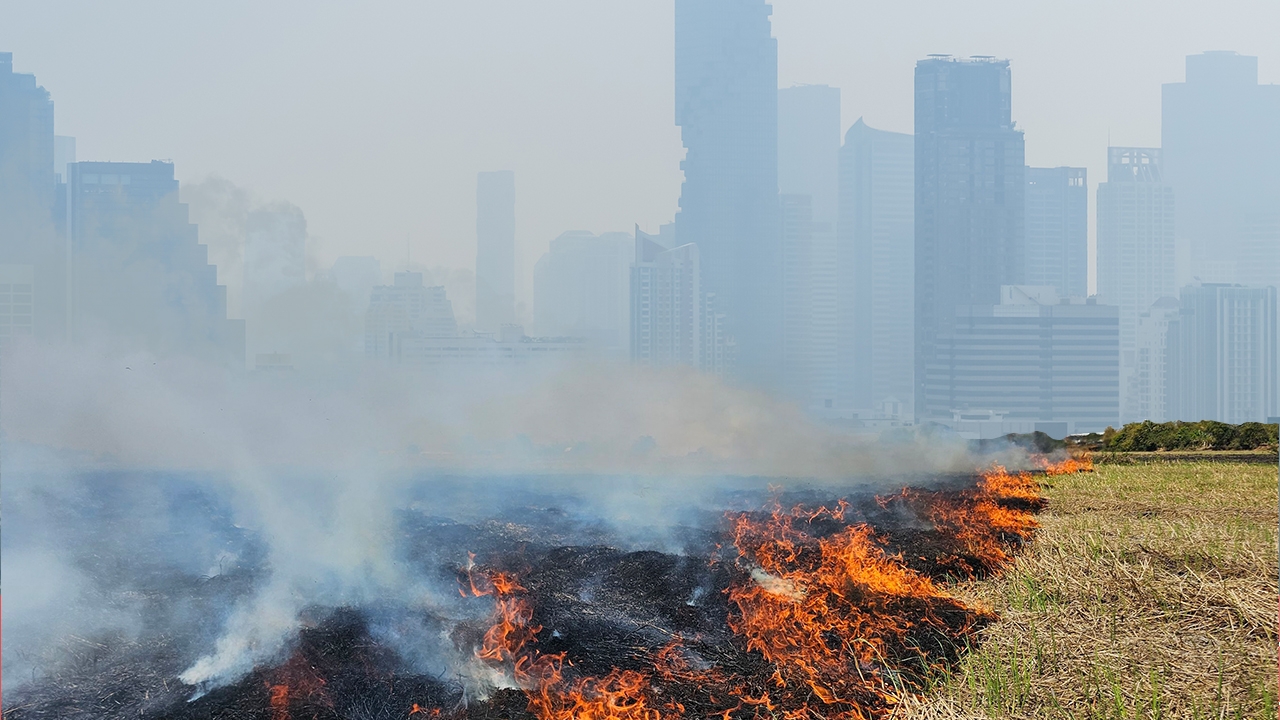
Bangkok is engulfed in PM 2.5 dust as three key factors accelerate fires burning over 10,000 rai in Nakhon Nayok, shaking inner city areas. The impact of cold winds and urban heat stimulates dust accumulation, gradually damaging lungs.
Bangkok is becoming increasingly vulnerable to the encroachment of PM 2.5 dust, especially in the early winter season, when severity rises each year. This is clearly evident from the agricultural fires in Pak Phli District, Nakhon Nayok Province, where fires spread over more than 10,000 rai on 27 Jan 2026. Unusually large hotspots were detected, with damage extending over 13,000 rai. The smoke dispersed following wind patterns into Bangkok, causing thick dust today (28 Jan 2026). Recently, Bangkok authorities requested residents to work from home on 29-30 Jan to mitigate the dust impact.

The worsening PM 2.5 dust affecting Bangkok each year partly originates from burning activities in nearby provinces and neighboring countries. The Thairath Online special news team consulted Professor Dr. Pisuth Pianmonkul from the Environmental Engineering Faculty at Chulalongkorn University, who has long monitored this issue. He analyzed that the agricultural fires in Nakhon Nayok leading to PM 2.5 spread into Bangkok stem from these main causes:
1. PM 2.5 dust from burning agricultural land in Nakhon Nayok is much finer compared to dust from neighboring countries like Cambodia last year. This allows the dust to travel 200 to 300 kilometers, enabling smoke from Nakhon Nayok to reach Bangkok quickly.
2. The influence of cold northeast winds blowing into Bangkok acts as an accelerator, pushing PM 2.5 dust rapidly into the city area.
3. Bangkok’s overall temperature is higher than nearby provinces. When the surrounding areas are cooler, they create higher air pressure that causes the dust-laden air mass to flow from the high-pressure zones into the lower-pressure area of Bangkok.

Meanwhile, when asked how long the air mass carrying dust from these fires will affect Bangkok, it depends on the following factors:
1. Whether the agricultural fires in Nakhon Nayok can be extinguished quickly. Rapid fire suppression can reduce the amount of PM 2.5 dust entering Bangkok. Additionally, the wide area of burning—comparable in size to Bangkok itself—also accelerates the influx of dust.
2. If the northeast winds weaken, the amount of dust blown into Bangkok will decrease.

The dust problem from Nakhon Nayok spreading into Bangkok is compounded by other nearby provinces that may also be sources of smoke. Professor Dr. Pisuth noted that eastern and northeastern provinces near Bangkok, such as Saraburi and Nakhon Ratchasima, are other high-risk areas producing smoke dust.
To address the dust problem entering Bangkok, solutions must target the source—agricultural burning. For example, early in the year, attention should focus on the eastern areas where winds primarily blow into the city, while later in the year, western areas of Bangkok require caution.

Another solution is to cool Bangkok’s air mass by reducing greenhouse gas emissions, which would improve air circulation and ventilation.
Bangkok is becoming increasingly sensitive to PM 2.5 dust problems, despite being a coastal city. Urban planning issues limit air circulation, and the city's high temperatures act as catalysts, causing PM 2.5 dust to accumulate more than in other areas. For instance, dust from Nakhon Nayok affects Pathum Thani less than Bangkok because Pathum Thani has more open spaces and better air flow.