

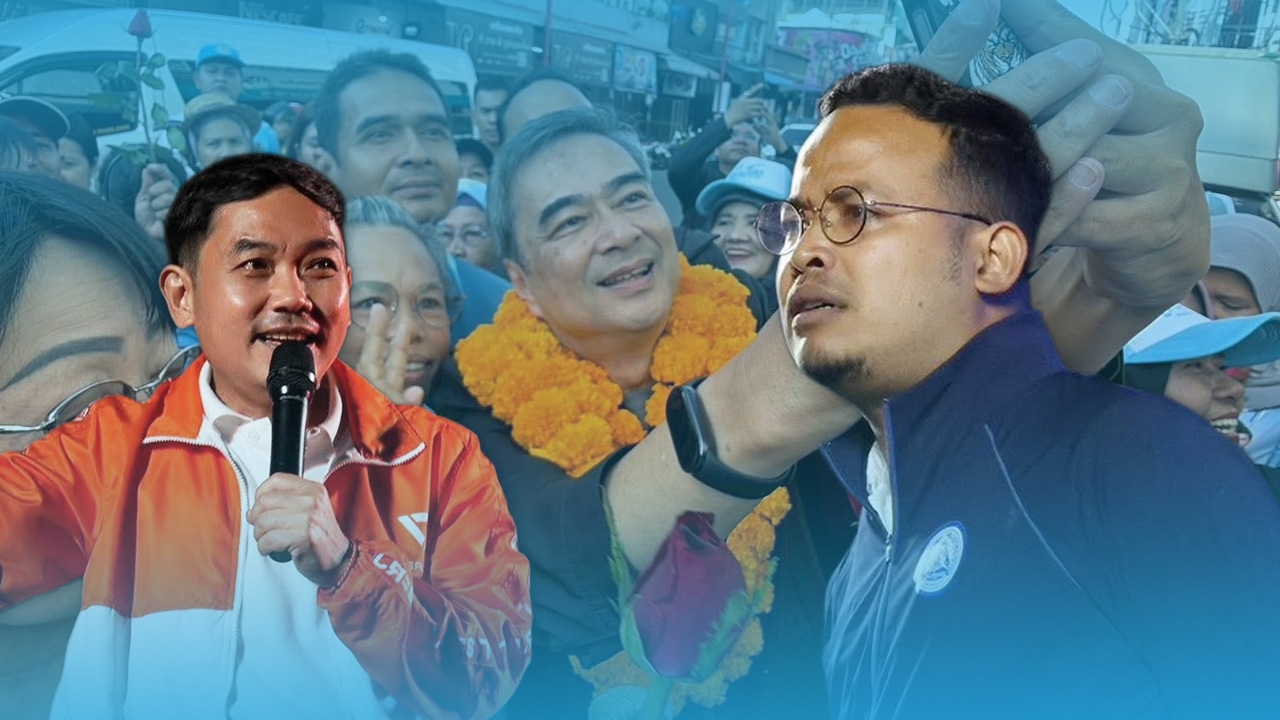
Operation “Sky Returns to the South” marks the regional political contest, unveiling vote-base strategies to win local support ahead of the 8 Feb 2026 election.
The political arena in southern Thailand is reaching a critical turning point as political attitudes and perspectives begin to shift from previous clear-cut positions. This election is not just a contest between political parties but also reflects adaptations in economic and social aspects, along with public expectations for addressing local issues.
Amidst the diverse geography and distinct identities of southern people, traditional politics are being challenged by new strategies, ideas, and candidate placements. This has made the overall competition more complex and harder to predict than in past elections.
Therefore, political party movements in each province are crucial, especially regarding vote bases, goal setting, and political direction. The Democrat Party, with its long-standing ties to southern voters, faces the key question: in this changing political equation, how well can it maintain its traditional base, and are its strategies sufficient to handle the ongoing changes?

Thairath Online's special news team consulted Assoc. Prof. Dr. Yutthaporn Issarachai, a political science lecturer at Sukhothai Thammathirat Open University, to analyze the direction and strategies of the Democrat Party regarding its voter base in the South.
An interesting aspect of this election is the Democrat Party’s potential to “revive” in southern Thailand. However, it remains uncertain whether it can reclaim the top spot, as several factors still require consideration despite the party’s current momentum.
Although Abhisit Vejjajiva is not a native southerner, his working style and image resemble those of Chuan Leekpai, a key figure who has long symbolized the Democrat Party’s connection with southern people, often regarded as a “southern son-in-law.”

Before 1992, the Democrat Party had not clearly won the hearts of southern voters. But afterward, the party adapted to align with local identities and mindsets, gaining continuous popularity. Later, changes in party personnel led to a decline in support, but as those figures moved to other parties, both Abhisit and Chuan regained attention, along with renewed southern momentum that might help the Democrat Party regain influence.
However, structurally, most of the party’s candidates for MPs in this election are newcomers, which is a significant weakness as they are less known and lack strong voter bases. This is closely watched by many to see how it will affect election outcomes.
The Democrat Party is likely to gain considerable votes in the party-list system because votes there are not tied to local candidates. Even with new candidates, having Abhisit as prime minister candidate and Chuan on the party list still attracts votes from southern voters.
Another key area is Bangkok. Dr. Yutthaporn believes Abhisit’s image still draws support, and the party might win around one to two district MP seats in Bangkok, while its party-list votes will likely mirror the South’s relatively strong share.

Regarding the Kla Party’s strategy in the South, Dr. Yutthaporn sees the party adopting a “big house lock” approach, a core style not only in the South but across various regions nationwide.
The Kla Party draws established power groups from other parties to join and focus on securing local vote bases, a strategy that could succeed electorally.
However, with this approach, Kla does not aim to become the top party or form government but targets a middle position, seeing holding local seats in parliament as sufficient.
For the party-list system, Dr. Yutthaporn estimates Kla might secure only one to two seats, a level the party finds satisfactory given it does not emphasize creating momentum, debating actively, or image-driven politics. When asked where Kla is if it is not campaigning locally, he said, “They are already sitting in parliament waiting.”

For this southern election, Dr. Yutthaporn assesses that the Bhumjaithai Party has a chance to rise to first place, considering the South’s sociological structure, which divides into two to three main parts: the western side (Andaman coast), the eastern side (Gulf of Thailand), and the three southern border provinces. Each area has distinct economic and social characteristics.
On the western side, or Andaman coast, Bhumjaithai currently holds a strong base, drawing support from tourism entrepreneurs. The local economy heavily depends on tourism, aiding the party’s expansion across nearly all provinces in this zone, from Ranong, Phuket, Krabi, to Phang Nga. Trang and Satun provinces, however, are not yet primary targets for the party.
On the eastern side, or Gulf of Thailand coast, the economy remains tied to rubber plantations and fisheries, with diverse occupations. Bhumjaithai still has chances to gain votes here, but the area remains a key base for the Democrat Party, and the Prachachon Party may also encroach on this support, making the competition more diverse.
The three southern border provinces are a special area with unique contexts, serving as the main base of the Prachachat Party, making it difficult for other parties to penetrate.
Overall, he evaluates that no party is likely to achieve a landslide victory in the South this election, given the clearly distinct political conditions across different areas.