

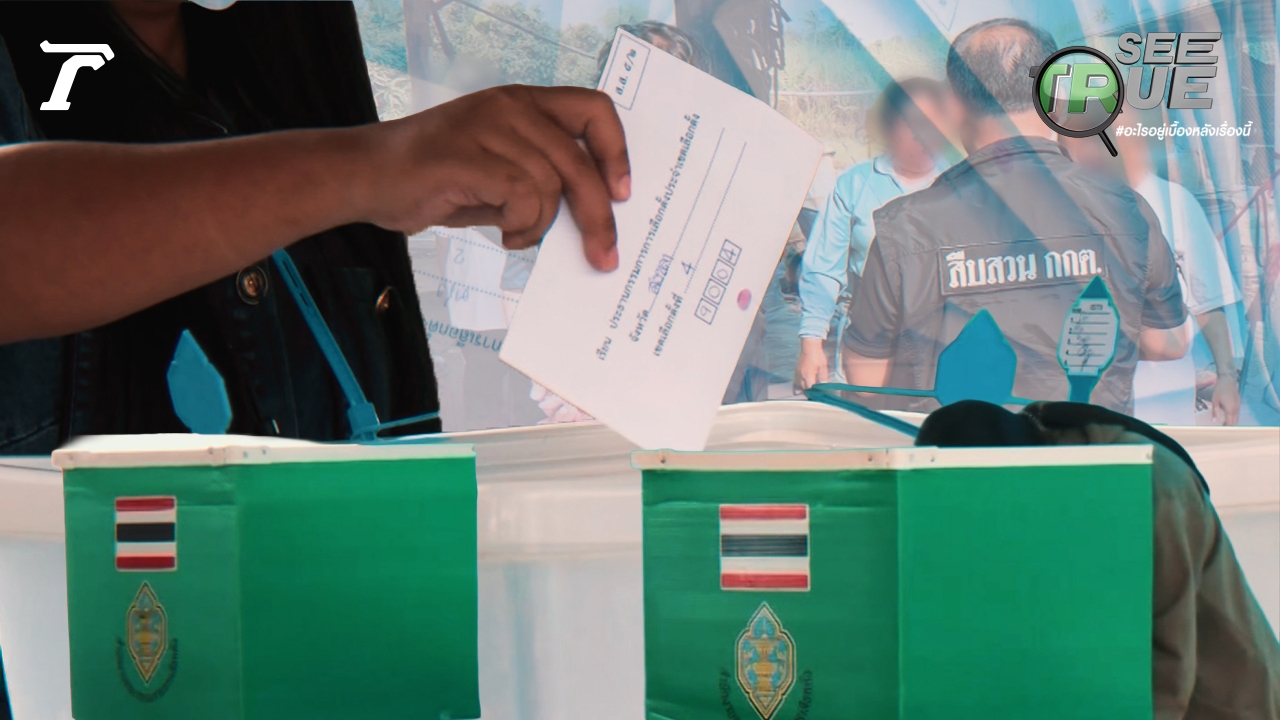
Unveiling the vote-buying scheme with name registration, verification, and payment. A political analyst exposes spending of hundreds of millions per area, asserting that vote brokers cannot truly verify who votes sincerely and who does not.
Every time an election approaches, each citizen's vote should carry equal weight. However, in some areas, a single vote may have a “price” paid in cash, white envelopes, or various goods. Silent promises have long been a tool for exchanging power in Thai politics for decades.
Despite severe penalties and campaigns to increase legal punishments, these vote-buying operations remain indifferent and unafraid. Even with more people involved in detection, the problem persists. Vote-buying is deeply rooted and methods have evolved to evade arrest. What lies behind this issue? SEE TRUE news team will reveal the truth.

“In the eastern region, prices rise to 2,000 baht per vote. On average, a candidate needs 35,000 votes, requiring at least 70 million baht to buy votes, excluding management costs. Since 35,000 votes may not guarantee victory, they must have 40,000–50,000 backup votes, equating to spending around 100 million baht.” Mr. Sakda Noppasit a political analyst and former eastern politician, disclosed.
Mr. Sakda explained the refined process for securing votes: in the past, those registering votes were usually influential people—village chiefs, local leaders, mayors, or provincial councilors. Thirty years later, these figures have passed away and younger people have taken over.
“They start by selecting people to record votes who don’t need to be local leaders but act as their agents. They receive lists of voters’ names, then go door-to-door registering them. Generally, there are no more than 50 people doing this. Registering 1,000 names earns 20,000 baht, and if they can control the votes, they receive additional rewards.”

“Their first task is to register names, then submit these lists to the campaign headquarters of the candidate buying votes. The lists are verified to confirm the individuals exist. Once verified, funds are disbursed on election day, known as the ‘7th of the barking dog’.”
Mr. Sakda added that when some fear that if they take the money but do not vote as promised, the payers will know, he confirmed that in reality, this cannot be verified. It is merely a threat from vote brokers.
“When you enter the voting booth, you mark your ballot independently. No one can know your choice unless you surrender and tell them yourself. Once the ballot is cast, no one knows. If someone pays you and threatens you, can you call that person good?”
The team decided to investigate vote-buying by conducting nighttime field surveys, as people are usually home then. This yielded evidence of vote-buying through name registration.
A local resident who was once used as a tool in the vote-buying scheme revealed that it starts with registering names without immediate payment. Money is only distributed shortly before election day by going door-to-door. Every election follows this pattern, with payments not exceeding 1,000 baht.

The resident explained that political parties dare to pay this way because if evidence is weak, those involved can evade arrest. The resident has accepted vote-buying money before but said it depends on the individual’s choice.
“They can buy our votes and then steal from us. Anyone who gives me money doesn’t get my vote.”
When votes are assigned prices, the cycle of corruption begins. Politicians who buy their way into parliament often seek to recoup their investment rather than serve the public. Budgets meant for national development are diverted into conflicting interests, leaving Thai people's quality of life stagnant.
Even if someone accepts money, there is no obligation to vote for corrupt politicians. To protect Thai democracy from being devalued, a few hundred baht should not determine the national budget for four years. Ultimately, the vote in the booth is the people's right, worth far more than the dirty money used to corrupt our country.
