

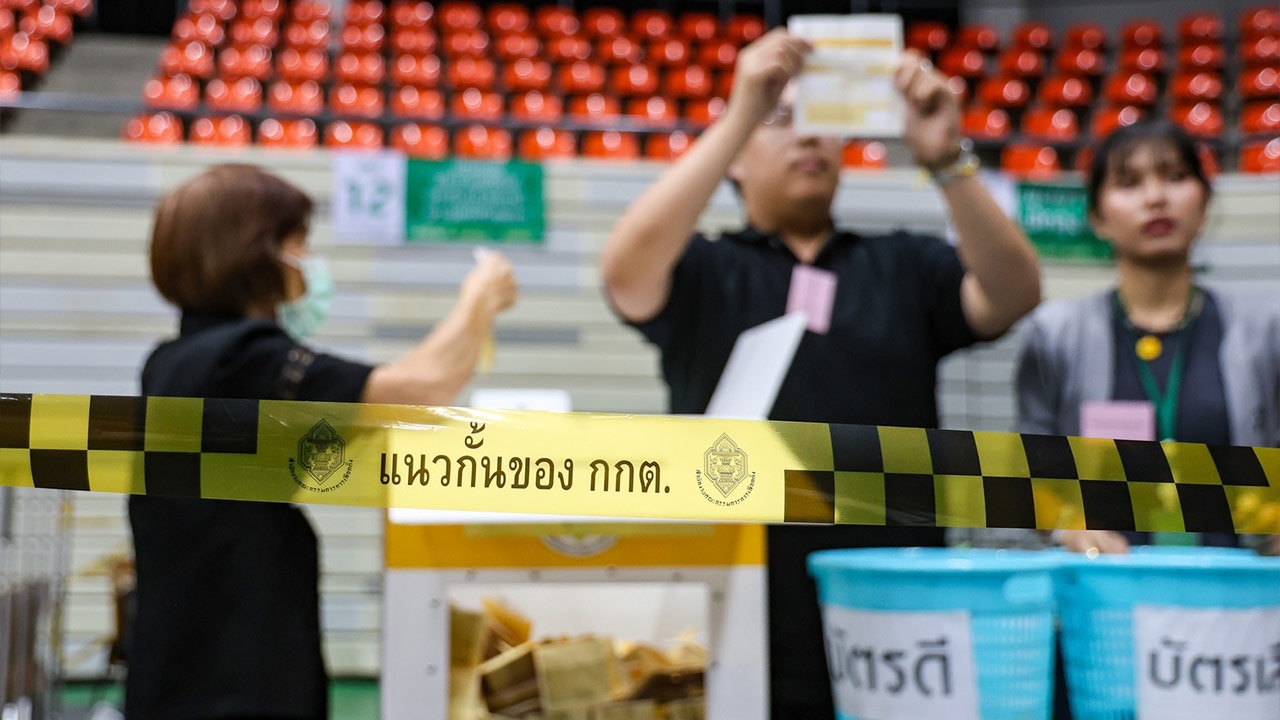
Eight election problems in 2026 identified by civil society highlight limitations of the Election Commission in protecting ballot secrecy and the transparency of documents required at many polling stations, reflecting systemic issues.
Civil society feedback on the overall election and referendum held on 8 February indicates ongoing systemic problems across multiple dimensions—from polling station management and voter facilitation to transparency in vote counting—reflecting limitations in the Election Commission's and local polling stations' operations.

The We Watch network monitored this election with over 13,670 volunteer observers nationwide, reporting irregularities from field observations and local networks continuously. This led to the compilation of findings and submission of complaints from civil society in several provinces.
We Watch's data analysis identified at least eight key issues covering voter equality, ballot secrecy, accuracy of voter data, document transparency, and poll officials’ performance. They emphasize these problems require systematic solutions in the short, medium, and long term to restore social confidence in future elections.

1. Polling station management and equality in exercising voting rights.
Many polling stations were found unsuitable for elderly and disabled voters, such as elevated areas without wheelchair ramps, for example in Phetchaburi Province, District 3. Some cases even caused accidents during voting, like in Samut Songkhram Province, District 1.
Additionally, incomplete or inaccurate information was provided to voters, such as missing candidate introduction documents, black-and-white samples of ballots and referendums, or no referendum samples shown. Some polling station relocations were not widely publicized in advance, as seen in Nakhon Si Thammarat District 1, Samut Prakan District 5 (units 52–55), and Nonthaburi District 3 Unit 5. Some locations also had insufficient lighting in vote counting areas, affecting public oversight.
2. Protection of ballot secrecy.
Several polling stations arranged voting booths contrary to principles of free and fair elections, such as lacking opaque partitions, overcrowded booths, or officials’ tables placed too close, risking others seeing votes. Such cases occurred in parts of Bangkok, Samut Prakan, Surat Thani, Sukhothai, and Nakhon Si Thammarat.
3. Errors in voter registration lists.
Multiple errors were found, including voters marked as deceased, voters still listed at old addresses after moving away long ago, or outdated information.
In some cases, voters verified their eligibility online but were missing from polling station lists. Misdelivered election location notifications forced voters to visit multiple locations, risking loss of voting rights.
4. Transparency of disclosed documents.
Many polling stations failed to post important documents, such as the number of ballots before and after voting or vote count results, or posted them in locations inaccessible to the public.
Discrepancies between ballots and voter turnout, called "ballot discrepancies," were found—for example, in Phichit District 1, 100,830 voters but 113,775 votes counted; Sakon Nakhon with 440 voters but 545 ballots counted; Khon Kaen District 11 reported 74,696 valid ballots but 97,904 votes counted—requiring further investigation.
5. Performance of election officials at polling stations.
Misunderstandings in duties were observed, such as failure to verify voter identity, providing incorrect information about the referendum, or influencing voting behavior.
Technical errors were also noted, including improper ballot handling, incorrect judgment of valid and invalid ballots, and counting mistakes.
6. Civil society participation in election observation.
Many polling stations misunderstood citizens’ rights to observe, denying observers access, prohibiting photographing disclosed documents, or forbidding recording during vote counting.
Some areas were affected by severe weather, forcing emergency relocation of vote counting sites.
7. Suspected corruption and vote-buying behavior.
Suspicious activities were reported in several areas, such as Ubon Ratchathani District 7, where photos of ballots were allegedly taken for cash exchange, and complaints of ballot stuffing or inconsistent results in Phayao, Chonburi, and other areas. These cases are under investigation by the Election Commission and police.
8. Satisfaction levels regarding the Election Commission's performance.
We Watch surveyed 1,091 voters, finding 57.6% dissatisfied with the Election Commission's work at all levels, consistent with issues observed in the field.
We Watch stated these findings reflect structural limitations in Thailand's election management and proposed systematic reforms in the short, medium, and long term to improve transparency and credibility of future elections.

1. The Election Commission must disclose raw voting data.
This includes early and out-of-district voting counted separately, along with data on problematic ballots. Data must be accessible to the public directly, promptly, and efficiently, without requiring contact with officials in multiple provinces.
2. The Election Commission should urgently investigate nationwide irregularities.
Especially during vote counting, including vote-buying and other election fraud reported through official complaints and social media, with rapid disclosure of vote counts by polling station.
3. The Election Commission must review election officials' conduct.
Particularly in areas with complaints or reports of non-cooperation with citizens or observers, obstruction, intimidation, or violence. Disciplinary actions and clear penalties should be enforced.
4. The Election Commission should issue clear regulations and guidelines.
Regarding rights and duties of election observers to prevent rights violations by polling officials, and provide training so officials understand and respect observers’ roles according to the constitution and international standards.

1. The Election Commission should reform the recruitment process for polling officials.
Recruiting general public not affiliated with local power, political parties, village heads, or officials, with continuous training curricula of sufficient duration and concrete evaluations to prepare officials adequately.
2. The Election Commission should explore technology-assisted voting.
Using open-source systems subject to independent expert and civil society oversight. Pilot testing should start with local elections or referendums, accompanied by intensive voter education and improved registration and communication systems to reduce confusion.
3. The Election Commission should involve civil society and neutral experts.
In designing election processes, observation, and evaluation, establishing formal mechanisms to gather civil society feedback systematically.
4. The Election Commission must implement disability-friendly facilitation manuals at all polling stations.
Using manuals and evaluation tools developed with disability networks and We Watch, not limited to special polling stations, as many voters cannot or choose not to use special stations. Accessible booths must be provided everywhere.
5. The Election Commission should install CCTV cameras at all polling and counting stations.
With strict data protection and voter rights safeguards to enhance transparency and reduce fraud risks.

1. Reform the Election Commission’s structure and composition.
Ensuring independence, neutrality, and credibility through transparent, open recruitment involving diverse experts and civil society. Assign the Commission direct responsibility for local elections and establish independent bodies to oversee its work.
2. Amend election laws and related legislation.
To harmonize regulations at all local levels, designate election day as a public holiday, ban state activities impeding voting, and improve referendum laws to allow early voting.
4. Integrate election principles, political rights, and civic participation into education.
Include these topics at all educational levels to build awareness and sustainable democratic culture.
5. The Election Commission should develop and test transparent, verifiable voting systems.
These systems should reduce spoiled ballots and improve access for all voters nationwide, including vulnerable groups and by-elections.

We Watch emphasizes that transparent data disclosure, independent verification, and civil society participation are essential to building public trust in election results and democratic processes.
They call on the Election Commission and related agencies to seriously consider these findings and recommendations and improve election processes at all levels to ensure future elections are democratic, citizen-centered, and make every vote count.