

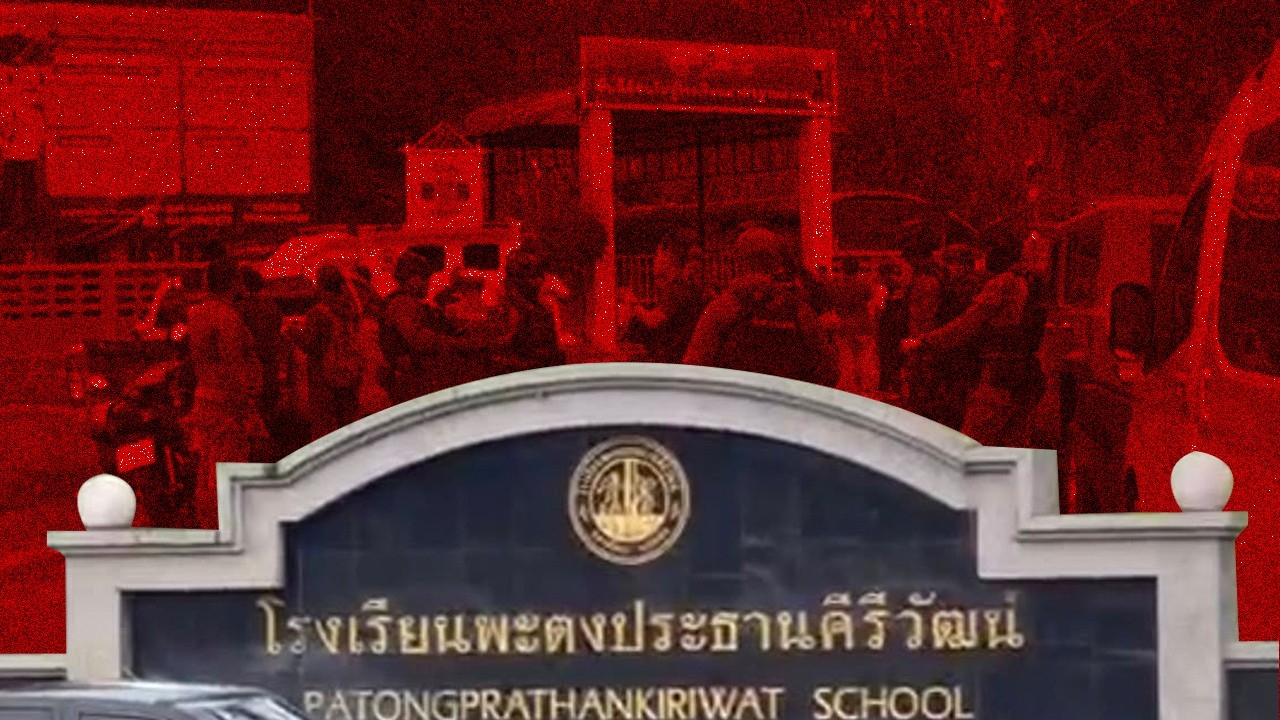
The shooting at Phatong Prathan Keereewat School reveals critical lessons on safety and security gaps in educational institutions. A former American police officer highlights these vulnerabilities and advises that controlling such situations requires training before incidents occur to be effective.
At 16:45 on 11 Feb 2026, a shocking incident occurred at Phatong Prathan Keereewat School in Phatong Subdistrict, Hat Yai District, Songkhla Province. An armed assailant entered the school and opened fire within the premises, causing multiple injuries. The exact number of injured remains unconfirmed as the situation is still unstable and under investigation by authorities.

Initial investigations indicate the incident happened near the end of the school term, when some students remained on site. The attacker, armed and visibly angry, stormed into the school and fired approximately two to three shots before taking some teachers and students hostage. This caused widespread panic and fear among those present.
Police from Hat Yai Station, special operations units, and rescue teams immediately surrounded the school to contain the situation and prevent escalation. They quickly evacuated people from high-risk areas to safety. Meanwhile, local officials coordinated negotiations with the assailant, aiming for a swift and safe resolution. As of now, the attacker has not been apprehended, and authorities continue managing the crisis.

At the same time, Songkhla Governor Ratsat Chidchu personally visited the site to closely monitor the situation, directing and commanding efforts to ensure a rapid and safe response. Further details regarding the cause of the incident or the capture of the suspect will be thoroughly investigated once the situation stabilizes.
Suvit Yongwan, a former Virginia State police officer in the United States with over 28 years of experience, said that preventing school shootings in Thailand requires security personnel stationed within schools. In the US, schools have dedicated police officers armed to control incidents immediately when abnormalities occur. Most of these officers are women, a model Thailand could adopt.
School officers are trained to manage crisis situations, whereas in Thailand, police typically only assist with traffic control around schools.
Regarding the Phatong Prathan Keereewat incident, the assailant was relatively young and attempted to wrest a gun from police. Therefore, officers need skills to prevent firearm disarmament. Additionally, American police holsters have dual-locking mechanisms to safeguard against gun snatching.

Normally, police in the US respond to school shootings within 15 minutes, but in Thailand, response times remain slower. Moreover, the lack of embedded police in schools creates a security gap, eliminating a crucial first line of defense to promptly prevent incidents. Controlling such situations aims to minimize injuries and fatalities among innocent people.
Historically, Thai police arrive after shootings begin, but realistically, having officers stationed as a preventive barrier at sensitive points is essential.
Therefore, the solution is to establish school resource officers (SROs) in every province and school, gradually expanding this program as much as possible.
Simultaneously, students and schools should be trained as valuable intelligence sources for police, since today’s students could potentially become future offenders.
Reported by Public Relations Songkhla Province.