

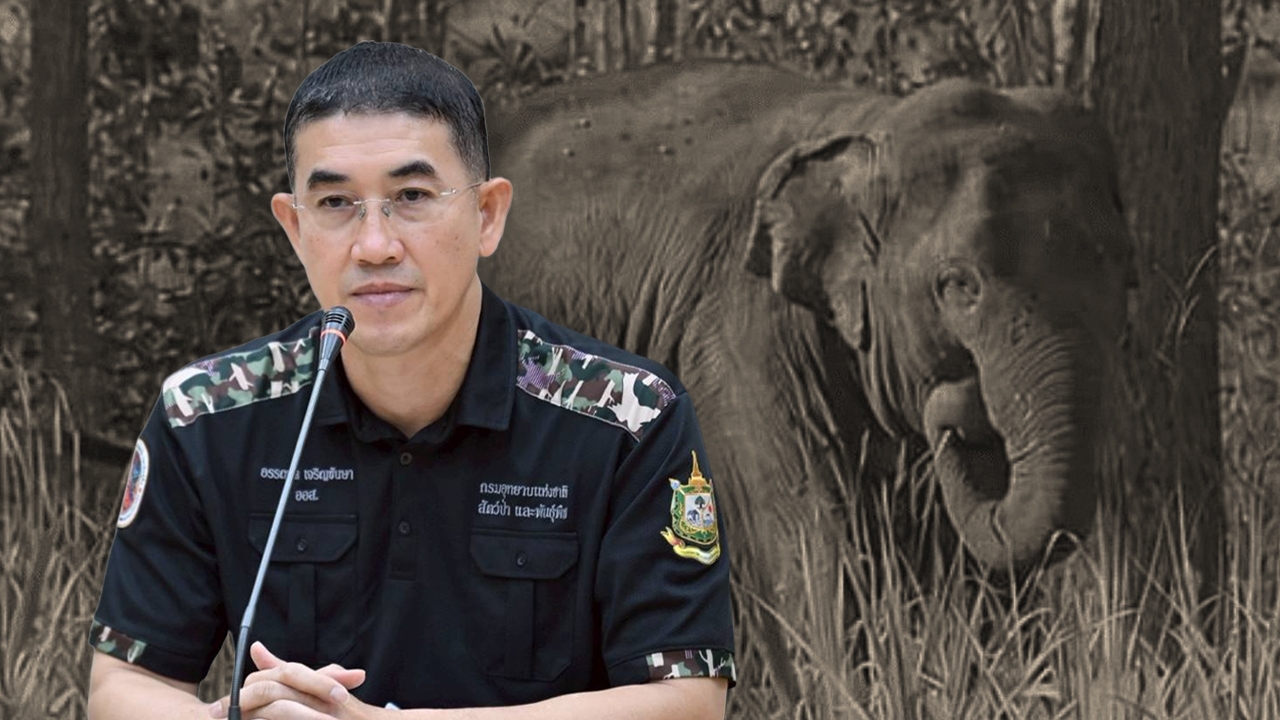
The Department of National Parks explains the issue regarding the relocation of the “Si Do Folded Ear” elephant, detailing the timeline, sedation procedures, and involvement of nine relocation teams. They confirm there was no intent to harm the elephant and have established a committee to investigate all steps thoroughly to ascertain the facts.
Today (12 Feb 2026), Mr. Attapol Charoenchansa, Director-General of the Department of National Parks, Wildlife and Plant Conservation, addressed the criticism surrounding the relocation of the wild elephant. He stated that some of the information circulated is inaccurate and may cause public misunderstanding.
The Department, both at the central and regional levels, deeply regrets the incident and is ready to take responsibility if any procedural faults are found. A fact-finding committee has been appointed to conduct a thorough and comprehensive investigation.

Mr. Attapol affirmed that all personnel involved—central officials, field staff, veterinarians, as well as administrative and community members—acted with good intentions. No one intended to harm the elephant. Their main mission was to protect both the wild elephants and public safety simultaneously. Everyone is deeply saddened and shocked by the incident.
Regarding the Administrative Court’s order, the Department filed a request to extend the temporary protection period. However, the court ruled there was no reason to halt or delay the original order. Consequently, the Department had to prepare to relocate the folded-ear elephant along with three others within the timeframe set by the court.

Mr. Attapol further revealed that during the operation, all parties faced heavy pressure from affected residents demanding swift resolution and the elephants’ removal. He acknowledged that this pressure had been ongoing for a long time. Nevertheless, the operational teams strictly followed legal frameworks, safety measures, and court orders throughout every step.
Currently, the problem of wild elephants leaving protected areas is intensifying, causing increasing harm to local communities each year. The Department does not work alone but coordinates with provincial authorities, administrative agencies, and the National Elephant Management Committee to find appropriate solutions that minimize impacts on both people and wildlife.
Mr. Attapol emphasized that the Department does not prioritize people over elephants or vice versa. Its responsibility is to protect wildlife resources and public safety concurrently. Wildlife conservation has always been the agency’s core mission. However, in conflict situations between humans and elephants, balanced management is necessary to assist both sides and reduce losses as much as possible.

Mr. Nattawat Nuisriram, Director of Protected Area Regional Office 8 (Khon Kaen), revealed that the situation began when wild elephants, believed to be from Phu Luang Wildlife Sanctuary in Loei province, left their habitat and foraged through several areas before entering Phu Wiang National Park.
Since 2024, two elephants named “Si Do Folded Ear” and “Lai Ngajew” have appeared in the area. Officials and local authorities pushed them back to their original habitat. In December 2025, "Si Do Folded Ear" returned, resulting in attacks on officials and residents, causing two injuries and two deaths, as well as extensive damage to crops.
Later, two more elephants joined, totaling four: Ngajew, Folded Ear, Husang, and Si Do Noi. Consequently, the Phu Wiang district administration and Khon Kaen provincial authorities petitioned the Department to urgently address the issue. Six residents filed a lawsuit at the Khon Kaen Administrative Court.
The Administrative Court ordered the Department to relocate all four elephants to a suitable area within 30 days, designating the Phu Luang Elephant Project in Loei province as the destination. This led to the development of the elephant relocation operation plan.

Mr. Thiti Songsan, head of the Department’s first wild elephant capture and relocation team, disclosed that after receiving approval, Protected Area Regional Office 8 convened a meeting with Khon Kaen province and related agencies, chaired by the provincial deputy governor, to carefully plan the operation.
Nine operational teams were established, including:
Search team
Support pole team
Sedation dart team
Rope control team
Rope pulling team
Veterinary team
Transport team
Traffic control team
Nursing team from Wiang Kao Hospital
Additionally, emergency response plans were prepared, including water trucks to regulate elephant body temperature, ambulance services, accident insurance for staff, and a movement sequence plan to minimize elephant stress and operational risks.

3 Feb 2026
10:00 AM: Command center opened at Wat Tham Kwang, Wiang Kao district.
1:30 PM: Meeting to divide seven operational teams (search, support pole, sedation, rope control, rope pulling, veterinary, transport).
3:00 PM: Search team and drones located the elephant near a sugarcane field close to Na Ta Pa.
3:00 PM: Veterinary team arrived on site to prepare for the operation.
7:00 PM: First sedation dart fired, dosage calculated by elephant’s weight. The elephant ran into the sugarcane forest, showing slight sedation but remained alert.
8:08 PM: Second sedation dart fired; the elephant calmed down. Staff secured all four legs and collected blood samples.
9:02 PM: The elephant began to regain consciousness and showed increased reactions. Veterinarians administered a third dose to ensure safety during loading.
9:55 PM: The elephant was successfully loaded onto the truck.
10:50 PM: Departure began; the elephant showed alert behavior, raising its trunk and making threatening sounds.
11:07 - 11:10 PM: Fourth sedation dose administered; the elephant urinated and lay down.
11:12 PM: Veterinary team administered heart and respiratory stimulants and discovered the elephant was choking on food debris. They attempted full rescue efforts.
11:36 PM: The “Si Do Folded Ear” elephant died.
Subsequently, the team returned the elephant’s body to Phu Wiang National Park and held meetings to proceed with the official handling of the wild elephant carcass.
Regarding sedation, officials explained that the veterinary team estimated the folded-ear elephant’s age at about 15–20 years and weight not exceeding 2,500 kilograms to determine the appropriate drug dosage.
The first sedation involved two darts, each containing 10 cc of drug, totaling 20 cc, calculated to match the elephant’s weight to safely control it according to veterinary science standards.
Officials confirmed that all drug administrations were supervised by veterinarians and complied with the standards used in all wild elephant capture and relocation missions.