

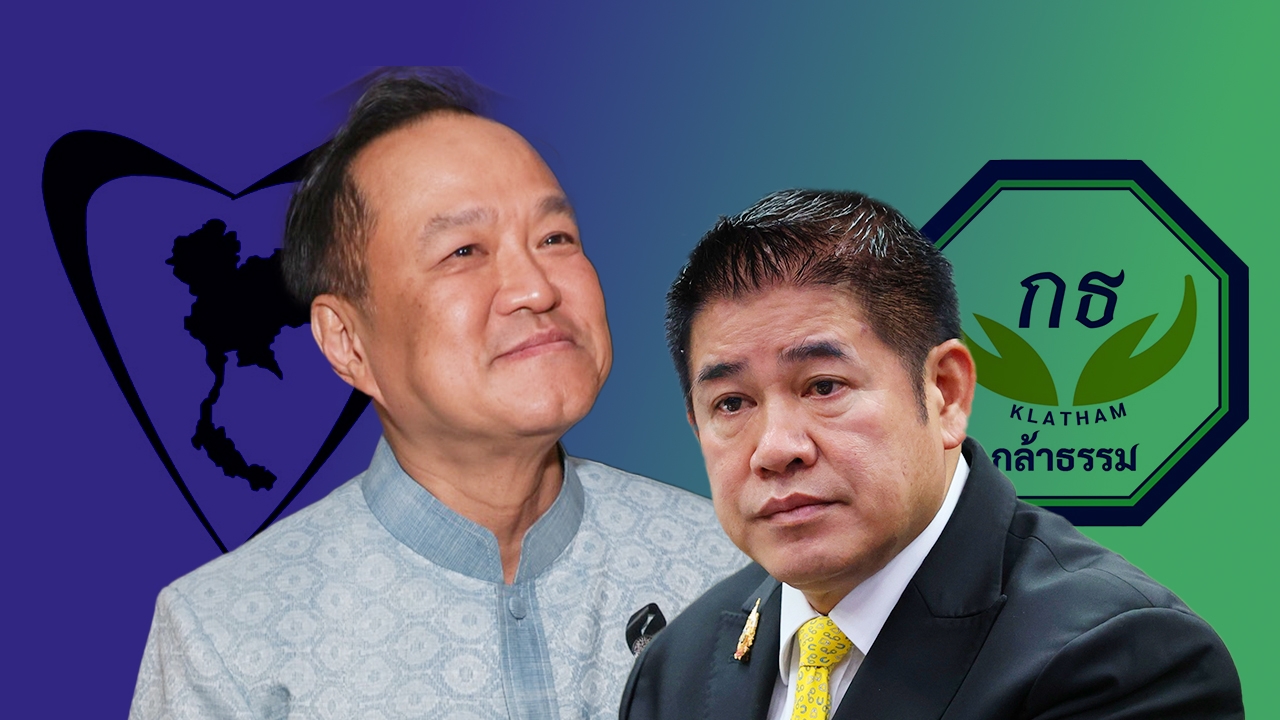
The "Bhumjaithai" government formation formula is unlikely to sever ties with "Kla Tham," with no expectation of a cross-bloc coalition. Experts suggest the government side has a chance to secure no fewer than 300 seats, while small parties are being watched as they line up toward conservatism.
After the election on 8 Feb 2026 GMT+7, political dynamics began shifting again and regained intense public interest. Unofficial results indicate that the Bhumjaithai party is likely to claim victory, possibly by a wide margin.
This outcome has prompted many political parties to adjust their stances and redefine their positions, especially Pheu Thai and Kla Tham parties, which are closely watched regarding whether they will join the government or move to the opposition side.
Assistant Professor Lt. Col. Chatupol Duangjit, a faculty member at the College of Leadership and Social Innovation, Rangsit University, told the Thairath Online special news team that both Pheu Thai and Kla Tham parties tend to want to join the government to preserve their political opportunities and roles going forward.
Regarding Bhumjaithai, Assistant Professor Lt. Col. Chatupol said the party is currently gauging social currents and political directions, with a key challenge being the "political mathematics" of forming a stable government with a majority. One of the most viable and stable formulas includes having the Pheu Thai party join the government.
Both Bhumjaithai and Pheu Thai aim for a win-win result. However, the rumors circulating might be merely tests of public and voter reaction across the broader society.
Assistant Professor Lt. Col. Chatupol stated that a stable government formula should have support from no fewer than 300 seats, including medium and small parties. He expressed confidence that a coalition between Pheu Thai and Kla Tham remains a highly probable scenario.
In the case of the Democrat Party declaring itself the opposition, Assistant Professor Lt. Col. Chatupol said this might be a clear stance within the current political formula, although historically party roles have shifted. Nevertheless, in this government formation, the Democrat Party may not hold significant ministerial positions but can clearly assert its role in the legislative branch.

Another closely watched issue is the relationship between Bhumjaithai and Kla Tham. Assistant Professor Lt. Col. Chatupol indicated that Bhumjaithai is unlikely to part ways, as during the campaign and political activities both parties have aligned closely, including in voter bases, candidate placements, and political directions.
Rumors suggesting the two parties might not continue working together are seen as possibly just testing public and academic opinions rather than signaling a serious split.
If Bhumjaithai forms a government with Pheu Thai, political friction would significantly decrease. But if it only partners with Kla Tham and other small parties, it may face strong opposition and have lower chances of broad acceptance.
Conversely, if Pheu Thai moves to the opposition, a Bhumjaithai-led government could face greater challenges in stability and political pressure, possibly leading to negotiations or political balancing in the future.

Regarding unusual government formation formulas, Assistant Professor Lt. Col. Chatupol said the only odd one might be a coalition between the Prachachon Party and Bhumjaithai, which he considered the most unusual. Another unusual formula would be Pheu Thai partnering with Prachachon and other small parties, though this might not yield a large number of seats.
Assistant Professor Lt. Col. Chatupol revealed that if Bhumjaithai leads the government formation, Anutin Charnvirakul might govern for a period, but it is unlikely to complete the full four-year term, although it may last longer than some previous governments.

Key risk factors that might prevent a full four-year government include the economic situation, social conditions, and international political pressures. If the government cannot solve major issues as promised or faces intense scrutiny without resolving doubts, its stability could be affected despite holding a majority.
Assistant Professor Lt. Col. Chatupol concluded that this government formation is a significant challenge. If personnel and power structures are allocated properly, transparently, and in ways that meet public expectations, it could gain acceptance. Otherwise, the government's progress may be difficult from the outset.