

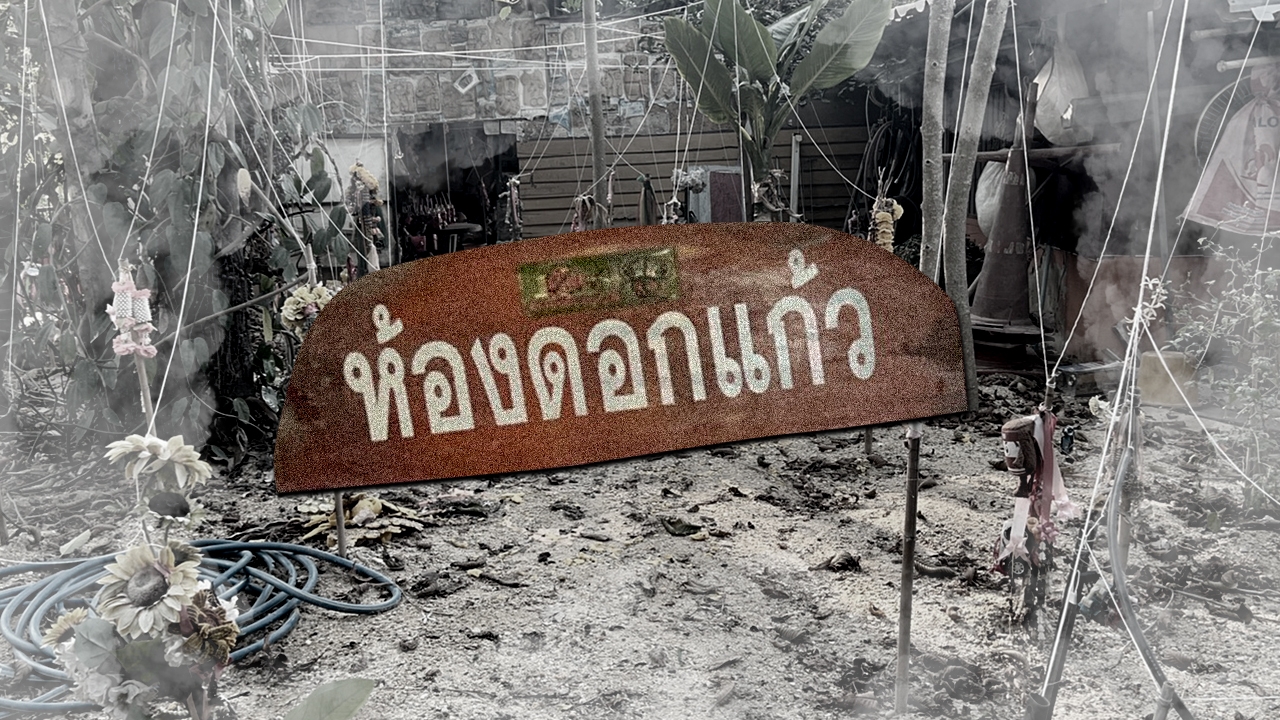
Inside the "Dok Kaew Room," a famous mortician has been accused of sexual harassment, deception in rituals, and the investigation of child burial sites. The mysterious case sparked complaints, inspections, and the exhumation of skeletal remains to verify the truth.
At 14:00 on 12 Feb 2026 at the Central Investigation Bureau (CIB), Mr. Jeerapant Phetkhao, known as Mor Pla, the ghost hunter, accompanied two female victims to meet Pol. Maj. Gen. Jaroonkiat Pankaew, Deputy Commander of the CIB, to request an investigation and legal action against Uncle Sanom, a famous mortician and exorcist in Ang Thong province, accused of deceiving them into rituals to remove curses and committing sexual offenses.
The mortician exhibited suspicious behavior. Several victims revealed that after the ceremonies, he often molested them by hugging, kissing, or asking them to remove their clothes and touching their genitals, claiming it was part of the ritual.

It was also discovered that the mortician kept child corpses from rituals in a room called the "Dok Kaew Room," used for dissecting stillborn infants. The room contained a dirty bed and numerous amulets, and all children’s bodies involved in the ceremonies were buried inside this room.
As the story spread on social media, many questioned whether the mortician’s actions were genuine rituals or merely a pretext for molesting disciples. Concerns were also raised about whether burying child corpses in this manner violated laws against concealing or destroying bodies.
Amid intense public scrutiny, Thairath Online’s special news team compiled information from several victims’ complaints to outline the mortician’s behavior sequentially—from the initial invitation to perform rituals to the alleged sexual harassment and the mystery of the "Dok Kaew Room" claimed to be a burial site for infants. This narrative raises critical doubts about whether these rituals are truly sacred traditions or merely a facade.

Multiple victims consistently reported that after the ceremonies concluded, the mortician’s behavior changed; he would approach and molest them, committing acts of sexual harassment.
The first victim said she came to perform a ritual for her sister, who had died in an accident. A monk recommended the mortician, claiming that the mother’s and child’s bodies must be separated to prevent restless spirits. However, after the ceremony, the mortician hugged and kissed her, saying he cared for her like family.
The second victim said she lost her baby a few days after birth and was unsure how to handle the child’s body. After researching on YouTube, she found the mortician’s channel and decided to perform a ritual to remove bad luck.
The worst part was the "holy water bath" ritual. During the ceremony, the mortician tugged at her skirt and used a so-called “doctor’s knife” to scrape her inner thigh and genital area to expel evil spirits. She tried to resist but failed. He continued to fondle her genitals. After the ritual, he persuaded her to stay overnight, claiming the holy water bath had to be repeated six more times. She managed to evade and escape.
A third victim said she took a sick friend to the holy water bath ritual three years ago. The mortician openly molested women, calling them "fat" and touching them during the ritual. He forced participants to cross their legs over his and rolled a crystal ball over their bodies, including their genital areas. When it was her turn, she avoided participation by claiming she was menstruating and refused to drink the holy water, spitting it out to avoid being drugged. The mortician warned that not completing seven ritual rounds would cause madness. She retorted, "Better crazy than being exploited."

Victims also complained that the mortician buried their children’s bodies in the "Dok Kaew Room," a space used for dissecting stillborn infants, with a dirty bed and many amulets, effectively functioning as a "cemetery for stillborn infants."
On 17 Feb 2026, Mor Pla, accompanied by lawyers and victims, visited a temple in San Chao Rong Thong Subdistrict, Wiset Chai Chan District, Ang Thong Province, identified as the site where infant bodies were buried after mothers died with their unborn children. They met the abbot to explain their purpose and legal considerations.
There, they met Mrs. Samreung (surname withheld), 77, the mortician’s wife, who said she and her husband never intended to keep infant bodies. She stated that if relatives wanted to reclaim the bodies for rituals, they were willing to allow it and had no intention of retaining them.
Mor Pla coordinated the process to submit the excavated infant skeletal remains for forensic examination to confirm whether they belonged to the relatives’ children as claimed. Regarding the cemetery’s removal, preliminary discussions with the local administrative organization set a 15-day timeframe for action. However, the mortician’s wife disagreed with this plan, prompting further talks between the local authority and the abbot the following day.
On 17 Feb 2026, Mor Pla and related agencies inspected Sing Temple in Ang Thong to examine the alleged child burial site. Initial proceedings await the formal complaint from the victims concerning improper burial. Further verification is required to establish the facts surrounding these actions.