

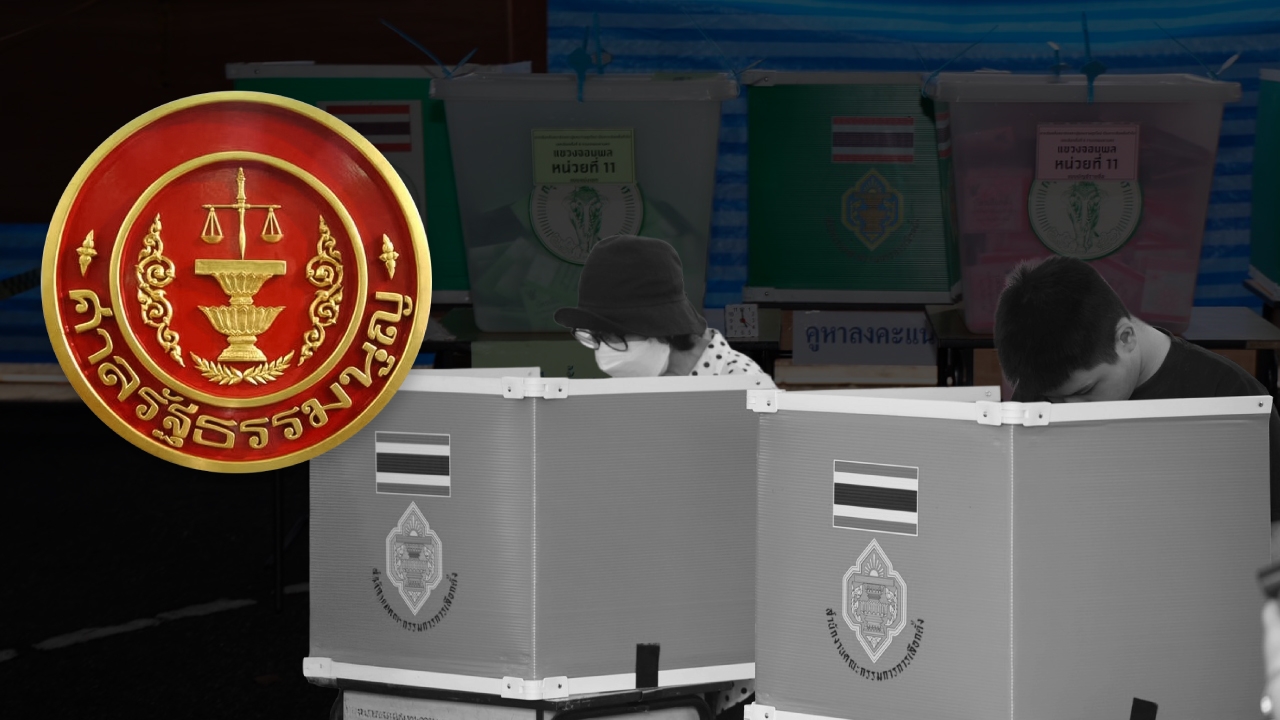
A review of two instances of "nullified elections" in Thai politics, and what could happen if history repeats itself in the 2026 election.
The crisis of confidence in the Election Commission (EC) and allegations regarding the election of members of the House of Representatives on 8 Feb 2026 continue to arise. These include suspicions about “misaligned ballots” discrepancies in voter turnout between constituency and party-list ballots, even though every voter received two ballots; issues with vote counting per unit where numbers marked on ballots did not match reports posted on boards,
as well as the appearance of “barcodes and QR codes” on ballots that could be traced back to individual voters, potentially violating Article 85 of the constitution, which mandates that voting must be direct and secret, so that no one can know who voted for whom.
These events have led political factions, academics, and civil society to file complaints and lawsuits with relevant authorities to hold the EC accountable, demand vote recounts, and even seek to have the election declared “null and void.”
Looking back at Thai political history, there have been two "nullified elections", in 2006 and 2014. What happened then, and what might happen if the 2026 election repeats these events?

The 2006 election was held after Prime Minister Thaksin Shinawatra dissolved parliament on 24 Feb 2006 to resolve protests by the People's Alliance for Democracy, which almost led to clashes between rival mobs. The new election date was set for 2 April 2006 amid a boycott by opposition parties—the Democrat Party, Chart Thai, and Mahachon parties—who refused to field candidates, arguing that the election date was set too soon.
On 2 April 2006, about 29 million people voted out of roughly 44.5 million eligible voters. Thai Rak Thai received over half the votes, 16.43 million, but many abstained, leading Thaksin to announce he would not assume the premiership yet. Questions were raised about the voting booth arrangements since booths faced outward, allowing observers to see voters' choices. There were protests including ballot tearing in many areas, and some local election commission committees resigned.
Later, Banjerd Singkaneti from Thammasat University's Faculty of Law and General Saiyut Kerdpol, chairman of the Central Organization for Democracy Foundation (PINET), filed a petition to the Ombudsman, which forwarded the case to the Constitutional Court to determine whether the election was lawful. The petition raised four points:
1. The election date was inappropriate and unfair, set only 35 days after parliament dissolution.
2. Whether arranging voting booths with voters facing outward violated the principle of direct and secret ballots.
3. To investigate whether major parties hired smaller parties to submit candidates.
4. Whether the EC certified election results without a full quorum, violating the law.

On 8 May 2006, the Constitutional Court ruled the election null and void in ruling no. 9/2549, stating: The voting booth setup was not secret. This was within the observation rights of EC staff and party representatives, who had vested interests. The election date was set too close, only 37 days after dissolution, which, although legal, combined with a high proportion of 'no vote' ballots and many constituencies with only one candidate from a single party,resulted in an election that did not reflect the people's will.
Following this, Thaworn Senniam of the Democrat Party filed a lawsuit againstthe ECalleging the election was conducted dishonestly and unfairly, especially regarding hiring small parties to run. The defendants were EC Chairman Police General Wasana Phumaprapa, Prinya Nakchatree, and Veerachai Naoboonnian. The court sentenced all three EC members to two years in prison and revoked their voting rights for 10 years for malfeasance under Criminal Code Section 157 and the 1998 Election Commission Act Sections 24 and 42.
A new election was scheduled for 15 Oct 2006, but a military coup on 19 Sept 2006 prevented it from taking place.
The 2014 electionoccurred after Prime Minister Yingluck Shinawatra dissolved parliament on 9 Dec 2013 due to pressure from the People's Committee for Absolute Democracy With the King as Head of State (PCAD), known as PDRC. The PDRC opposed the controversial amnesty bill and held protests lasting over 40 days.
After dissolution, a new election was set for 2 Feb 2014, but the PDRC, led by Suthep Thaugsuban, opposed it, demanding “reform before elections.” This was supported by the Democrat Party, which boycotted by not nominating candidates. At candidate registration, 28 constituencies in 8 provinces had no candidates, and 22 constituencies in 12 provinces had only one candidate.
On election day, PDRC blocked many polling stations, preventing voters from voting. About 90% of polling stations were able to open, but voting was canceled in 69 stations across 18 provinces. The EC could not announce results and had to reschedule elections in some areas.

On 18 Feb 2014, Kittipong Kamolthamwong, a Thammasat University law lecturer, petitioned the Ombudsman to refer the case to the Constitutional Court, arguing the election was unconstitutional because voting did not occur nationwide on the same day. On 24 Mar 2014, the Constitutional Court ruled 6:3 to nullify the election.
In 2017, the EC filed lawsuits seeking damages of 2.4 billion baht each against two main groups:
1. PDRC leaders and 234 others for obstructing the election.
2. Former Prime Minister Yingluck Shinawatra under the Official Tort Claims Act of 1996 for allowing the election despite warnings.
On 24 Feb 2021, the Criminal Court sentenced 26 PDRC leaders to prison, including five who were ministers and MPs at the time: Chumpol Julsai (Chumphon MP), Issara Somchai (party-list MP), Thaworn Senniam (Deputy Minister of Transport and Songkhla MP, Democrat Party), Puttipong Punnakanta (Minister of Digital Economy and Society and party-list MP), and Nataphol Teepsuwan (Minister of Education and party-list MP, Palang Pracharath Party). They lost their ministerial and parliamentary status. The court also revoked the voting rights of Chumpol Julsai, Issara Somchai, and Nataphol Teepsuwan for five years.
Various opinions on whether the 2026 election is secret or not.

Special Professor Wissanu Krea-ngam, former Deputy Prime Minister, who said the legal interpretation can go two ways: 1) the election result is “not secret,” meaning the EC violated the constitution; or 2) the election result is “secret,” because secrecy depends on marking the ballot inside the booth, not on subsequent handling. The barcode case differs from the 2006 election when booths faced outward, allowing passersby to see votes. Professor Wissanu stated that personally he agrees with the first view that the election is
“not secret,” because votes could be traced back if someone wanted to. The constitutional Article 85's requirement of secrecy means secrecy at all times — it must remain confidential forever. Meanwhile,
Special Professor Charan Phakdeethanakul, former Constitutional Court judge, said on the Kom Chad Luek program that if electronic and scientific evidence shows ballots can be traced, then the court might rule the election is not secret. Even without checking, this theory is dangerous. If examples emerge of voters being threatened or coerced about their vote, even one or two cases would prove the election is not secret. So far, no such cases have arisen; the debate remains theoretical, relying on advanced digital technology arguments. Associate Professor Manit Jumpha of Chulalongkorn University's Faculty of Law, also on Kom Chad Luek, views the barcode's presence as
“not secret,” but not to the extent that would nullify the election because no one has actually traced back votes. Declaring the election null would undermine confidence, and the EC would again organize a new election, risking further problems that could prevent government formation and cause national losses. He suggests recounting or re-election only in certain constituencies. Professor Manit cited the 2006 nullified election, noting that the court emphasized the unfairly short election timeline causing boycotts and allegations of hiring small parties rather than the outward-facing booths as reasons for nullification. What happens if the 2026 election is nullified? If the Constitutional Court declares the 2026 election null and void, it would annul all results, including constituency and party-list MPs.
Then, the prime minister and cabinet would submit a royal decree to call a general election within 45-60 days from the decree's effective date.

The end of five complaint routes against the EC.
Today (20 Feb),
Somchai Srisutthiyakorn, former EC member,
Facebook that there are at least five legal pathways of complaints against the EC, with over 40 complainants so far. This EC faces the highest number of complaints shortly after an election. The outcomes of each pathway are: 1. Constitutional Court: The court may reject complaints, uphold secrecy, or rule the election null due to constitutional violations. Current chances are 25%, rising to 50% if the case passes the Ombudsman.2. Administrative Court: Can issue injunctions such as suspending result announcements or ordering ballot destruction; likely to follow Constitutional Court rulings.3. Criminal Court for Corruption: Cases of misconduct under Section 157 could take years but may result in criminal penalties. A Constitutional Court ruling against constitutionality strengthens the criminal case.
4. National Anti-Corruption Commission (NACC): Investigates EC ethical breaches and misconduct. The process may take over a year. If found guilty, the EC members may be removed from office and lose political rights. 5. Personal Data Protection Commission (PDPC): Complaints about personal data exposure to the public can lead to orders to stop actions and heavy fines. For instance, the EC was fined 350,000 baht for leaking senator candidate data after a single complaint.
