

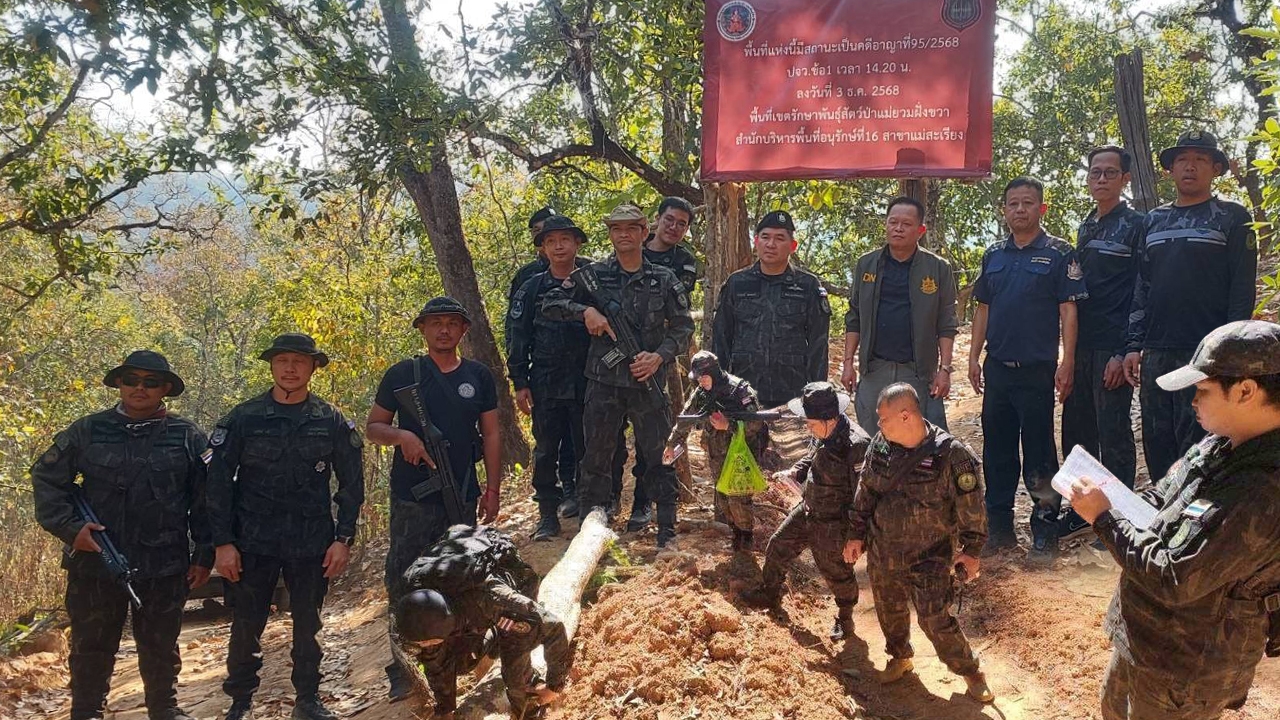
Suspicious new road construction through Mae Yuam forest linked to state officials prompts expanded investigation. The Seub Nakhasathien Foundation highlights three suspicious issues after discovering official involvement, leading to personnel transfers and inquiry committees. The Department of National Parks acknowledges awareness of the problem since last year.
The illegal road cutting and logging within Mae Yuam Right Bank Wildlife Sanctuary in Mae La Noi District and Salawin Wildlife Sanctuary in Mae Sariang District, Mae Hong Son Province, has become a major case triggering internal investigations within government agencies. The newly opened route in the conservation area involves several state officials, resulting in their transfer, the establishment of investigation committees, and both disciplinary and criminal proceedings.

The Protected Areas Regional Office 16, Mae Sariang Branch, reported the case began in December 2025 when officials detected land clearing and a new road opening in Mae Yuam Right Bank Wildlife Sanctuary. Additional encroachment of 2 rai 1 ngan 58 square wah was found in Salawin Wildlife Sanctuary. Legal actions were accelerated, including transferring the Mae Yuam Right Bank Sanctuary chief due to suspected collusion with offenders. This expanded to criminal charges and further investigations of involved parties in February 2026.
Atthapol Charoenchansa, Director-General of the Department of National Parks, Wildlife and Plant Conservation, explained that the department received reports of illegal road cutting in the area as early as September last year. A fact-finding committee was formed, later upgraded to a severe disciplinary inquiry against involved officials. By December, personnel transfers and legal actions followed.

Investigations revealed the illicit road is a forest trail divided into two sections: a 6.6-kilometer segment within Mae Yuam Right Bank Wildlife Sanctuary and a 1.7-kilometer segment inside Salawin Wildlife Sanctuary. Officials also confiscated 329 valuable timber logs along the route, totaling 156.9 cubic meters.
The Department of National Parks stated it has been continuously monitoring the case. After filing complaints, the case is now with investigators. However, the probe is challenging due to the remote, border-adjacent, and rugged terrain of the crime scene.
Recently, authorities seized tractors and backhoes used to open the road and summoned those involved with the machinery for questioning. Additional staff transfers occurred both in Mae Sariang and Mae Yuam Right Bank Sanctuary due to suspicions of wider involvement. Legal action was also ordered against the sanctuary chief involved.
The department reported progress to Suchat Chomklin, the supervising minister. Preliminary data indicates the road is about 5 kilometers from the border and may be planned to connect communities such as Ban Jokae, Ban Watu, and the Stone Pillar area.
Complaints from villagers indicate that the then-area chief encouraged community investment in the road project, claiming it was a government-backed initiative. When the promised funding did not materialize, locals submitted complaints, prompting authorities to expand investigations.
Currently, the Department of National Parks is conducting an in-depth investigation to determine the facts and true purpose behind the road construction, as multiple hypotheses exist regarding the goals of opening this route in the conservation area.

Phanudet Kerdmali, Chairman of the Seub Nakhasathien Foundation, outlined three key suspicious issues:
First, local residents had requested improvements to the existing Salawin field route to the main road for easier access, as some sections pass through streams that become impassable during floods. They did not demand a new road. The sanctuary administration explained that only partial improvements were possible, and flood-prone areas were beyond the chief’s authority, requiring the director-general’s approval—a limitation the community understood.
Second, the former area chief who was transferred had previous complaints about logging activities and was repeatedly investigated, but no clear action resulted.

Third, authorities have long been aware of such misconduct. Although procedures like transfers and inquiry committees were initiated, the issue remained unresolved and prolonged, with attempts to handle it internally before public exposure.
Additionally, villagers who filed complaints reported that during the road construction, the then-area chief told the community it was a government project, even though it was actually outside the Department of National Parks’ responsibility.
For solutions, Phanudet emphasized the need for transparent investigations and serious punishment for offenders. Meanwhile, spatial issues must be addressed by dismantling and restoring the illegally opened routes to their natural state. Continuous staff deployment and monitoring should prevent repeated encroachment. If security dimensions arise, coordination with relevant agencies and military forces should be arranged to manage the area.
Moreover, involved agencies should publicly clarify the facts to ensure transparency and alleviate public doubts about the case.