

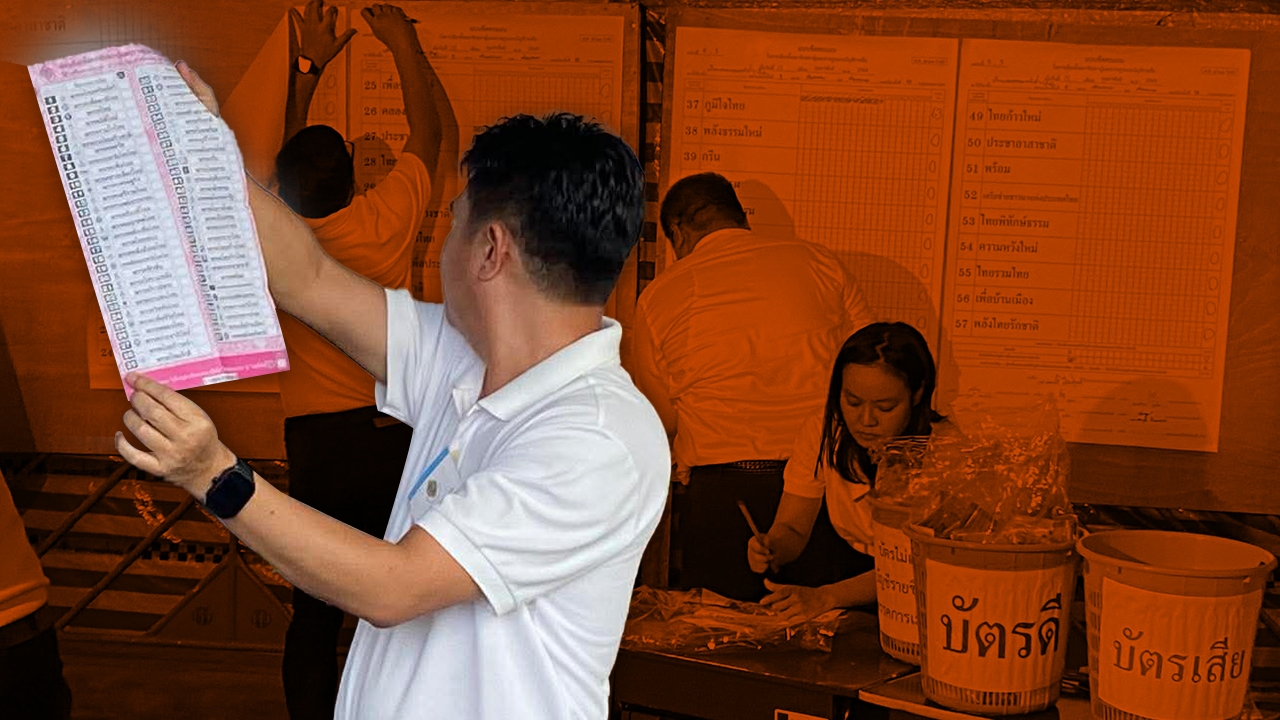
Concerns about missing stub numbers on election ballots have impacted voter confidence. The worrying features found on both ballots have led a Big Data expert to suggest these issues may be connected to identifying who cast their votes.
Dr. Tamthee Sukchotirat, also known as Dr. Airplane, a Big Data expert, said that in some by-election polling stations on 22 Feb 2026, the pink ballots lacked stub numbers. This contrasts with the general election on 8 Feb 2026, where the stub included the district number matching the barcode at the bottom of the ballot.
Meanwhile, the QR code on the green ballot, which previously scanned one-to-one, now scans as one code for 20 ballots (per booklet) in the new by-election ballot. This raises questions about why the Election Commission had to print new ballots and whether the old ballots had issues. The Election Commission needs to clarify this, because if there is an anomaly, it would relate back to the general election on 8 Feb 2026, where it must be proven whether the barcode or QR code can identify who cast the vote.

The stub number and barcode on the ballot from 8 Feb 2026 can be traced to determine who voted for whom. Even for the by-election on 22 Feb 2026, our team has conducted data collection experiments. We currently hypothesize that if the experiment is followed and the analysis continues, it will be possible to deduce which candidate each voter supported.
Since revealing these ballot irregularities, many people have sent information via social media. For example, there is a hypothesis that when voters queue, campaign agents go first and memorize the stub numbers on ballots, which are sequentially before the voters behind them. This could allow agents to bring vote buyers to queue and verify whether they voted as instructed. Memorizing the number may not require all eight digits; just four digits might suffice.
Regarding barcode scanning, even if ballots are stored in a different province, simply photographing and sending the image to a remote location allows scanning. Nowadays, applications can quickly read these codes, meaning offenders need not travel to the ballot storage site.

Asked to compare the concerns between the pink and green ballots, Dr. Tamthee said both ballots are equally worrisome.
From a political strategy perspective, if ballots can reveal who voted, this could enable political parties planning election strategies to know who supports whom in each household. For vote buyers, campaign agents could verify whether those paid actually marked their ballots accordingly.

The collected data is now being processed to identify possible vulnerabilities. Afterwards, we will consult legal experts on how this information can be disclosed. Our objective is to ensure compliance with the constitution, which mandates the secrecy of voting.