

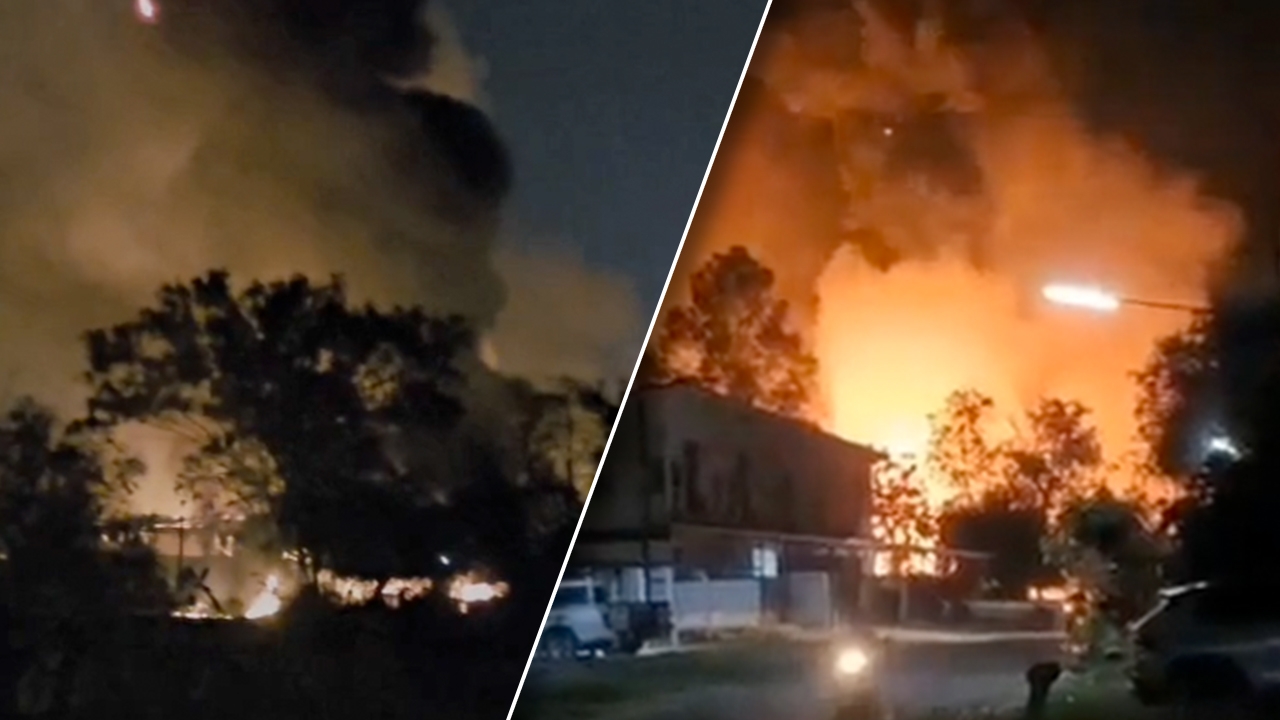
Authorities warn the public to stay at least 1 km away from the Border Patrol Police Regiment 21 armory in Surin following an explosion. Attention is focused on uncontrolled heavy weaponry, with recovery operations expected to take time.
At approximately 19:30 on 24 Feb 2026 GMT+7, reports confirmed an explosion at the Border Patrol Police Regiment 21 armory in Surin province. The blast caused shockwaves affecting nearby buildings and was followed by continuous detonations. The closest building, Surindra Rajabhat University, is located 3 kilometers away.
Chatchai Thaikla, advisor to the National Disaster Prevention Committee and director of the Advanced Fire and Rescue Training Institute Tafta, told Thairath Online's special reporting team that in the case of the Border Patrol Police 21 armory fire, the blaze must be allowed to burn out completely.

He emphasized the importance of evacuating residents from the area since it is still unknown whether the weapons involved include artillery shells or other heavy arms. Normally, people should be evacuated at least 1 kilometer from the site, but if evacuation is not possible, they should shelter behind solid walls.
Typically, in armories containing weapons like artillery, if a fire occurs, shells can be propelled unpredictably. However, ordinary bombs without barrels tend to explode in place and pose less danger, with a hazard radius of about 500 meters. For weapons or bombs with barrels capable of projecting, a safe distance of approximately 1 kilometer is required to protect civilians.
In this case, the fire at the Border Patrol Police armory is considered less severe because their weapons are not as heavy as those of the military. While some explosives may be present, they are not equivalent to the army's armory.

For recovery, once the fire is extinguished, an Explosive Ordnance Disposal (EOD) team or robots will need to inspect the area first. Rescue personnel are currently advised not to enter the site as it is hazardous and outside their responsibilities. Explosive disposal may follow later. Typically, Chinese-manufactured weapons tend to detonate more easily due to thinner casing materials compared to sturdier American-made arms, so if the weapons are Chinese or have thin, less durable casings, the fire may subside more quickly.
