

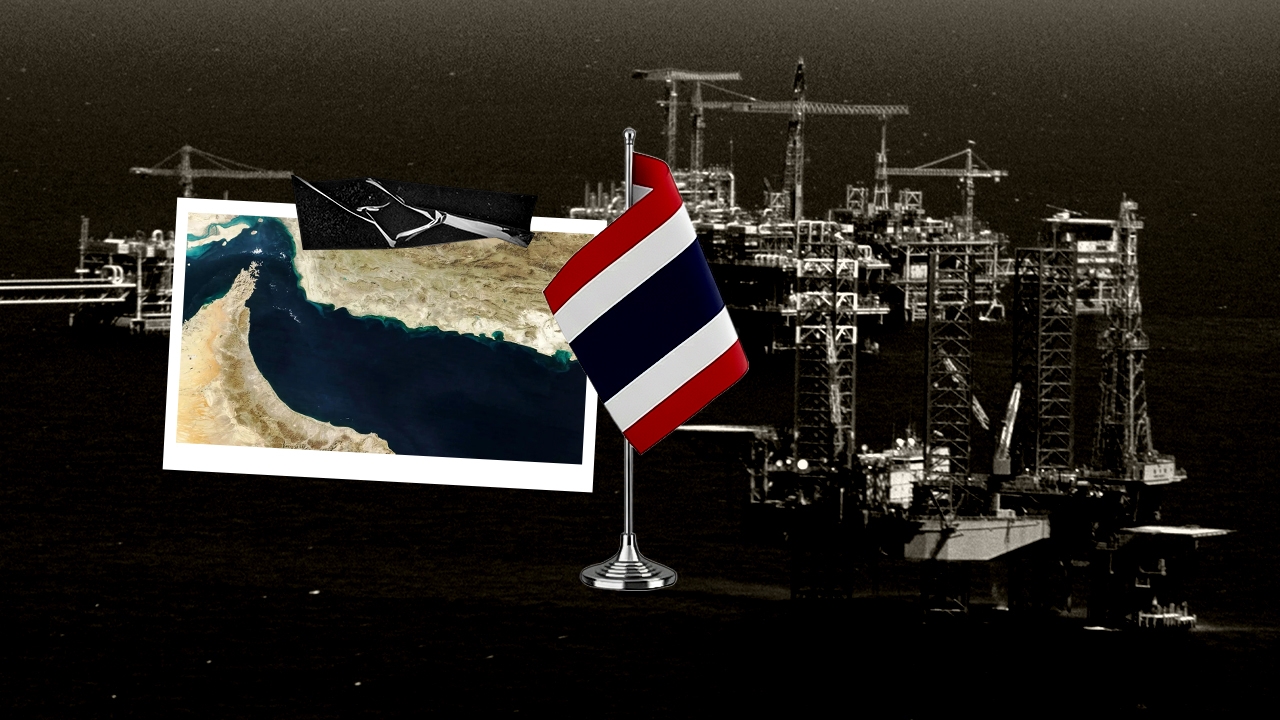
Check Thailand's oil reserves and how they would be affected if the "Strait of Hormuz" a vital global oil transport route, were closed. The Ministry of Energy has recently introduced response measures.
Following rising tensions in the Middle East since 28 Feb 2024 GMT+7, when the US and Israel launched an attack that killed Iran's supreme leader, reports emerged of Iran retaliating against US-allied countries in the region, including strikes in Dubai, UAE, and Doha, Qatar, targeting airports and oil rigs. Tehran also broadcast a warning to ships in the area: "Do not pass through the Strait of Hormuz." However, there has been no official announcement of a complete closure of this shipping lane.
This conflictthreatens global energy security since it occurs in the OPEC region. If Iran closes the Strait of Hormuz, a crucial maritime route for oil transport, it would immediately disrupt the global supply chain.

The Strait of Hormuz lies between Oman and Iran, connecting the Persian Gulf with the Gulf of Oman and the Arabian Sea in the Indian Ocean. At its narrowest, it is only 33 km wide, with a shipping channel just 3 km wide. Iran controls the northern side, while Oman and the United Arab Emirates (UAE) control the southern side.
This strait is known as one of the "most critical bottlenecks" for global oil transport. OPEC countries (Saudi Arabia, Iran, UAE, Kuwait, and Iraq) export most of their crude oil through this passage. About 20-21 million barrels per day—or roughly one-fifth of the world's oil—pass through here. It also handles liquefied natural gas (LNG) and fertilizers, accounting for nearly one-third of global trade.
However, Saudi Arabia and the UAE have oil pipelines that can serve as alternative export routes to bypass the Strait of Hormuz, but their combined capacity is limited to 2.6 to 4.2 million barrels per day.
The U.S. Energy Information Administration (EIA) estimated that in 2025, 84% of crude oil and petroleum products and 83% of LNG passing through the strait are exported to Asia, mainly to China, Japan, South Korea, and India, which account for over 75% of the oil and 59% of the LNG volume.
Physically closingthe Strait of Hormuz would be difficult due to the heavy presence of U.S. naval forces. Iran could, however, deploy naval mines in the shipping lanes or, if tensions escalate, shipping companies might suspend transit voluntarily.
Although there has been no official complete closure, reports indicate that Iran's Islamic Revolutionary Guard Corps (IRGC) recently launched missile attacks on three U.S. and UK oil tankers in the Persian Gulf and Strait of Hormuz, causing fires. This has led countries to avoid or partially halt navigation through the strait. Major shipping companies such as Hapag-Lloyd and CMA CGM have suspended passage and ordered ships to seek shelter, effectively resulting in a de facto closure.
Analysts predict that closing the Strait of Hormuz would drive global oil prices up sharply, potentially exceeding 100 U.S. dollars per barrel. However, Iran would also suffer, as it uses this route to export oil. Iran is OPEC's third-largest oil producer, with a daily output of about 3.3 million barrels and exports of 1.5 to 1.8 million barrels daily, 90% of which go to China. This has traditionally made a closure unlikely. Yet, given that the U.S. and Israel's objectives are seen as regime change, the current situation remains unpredictable.

One-third of Thailand’s energy comes from oil transported via the Strait of Hormuz, so the country is also affected by the unrest.However, the Thai governmentconfirms that the country's oil reserves meet required standards. As of 1 March 2024 GMT+7, Thailand's oil reserves were as follows:
Energy Minister Attapon Rerkpiboon revealed that he has urgently ordered a suspension of oil exports and the opening of an emergency energy monitoring center to track developments and have all agencies assess impacts and prepare plans covering reserves and price management. He also announced plans to use the oil fund to compensate for price increases and mitigate effects on goods prices and citizens’ living costs due to rising global oil prices.
Additionally, he directed the Department of Mineral Fuels to increase natural gas production in the Gulf of Thailand and postpone maintenance of gas production facilities to reduce impacts. For electricity, he ordered coal-fired plants to operate at full capacity alongside hydropower plants.
"The Ministry of Energy confirms that the recent unrest as of last Saturday has not affected Thailand’s oil reserves or prices. Nonetheless, urgent measures to suspend oil exports have been implemented, and an emergency energy monitoring center opened to closely track the situation with all related agencies,
developing both short- and long-term plans should the situation prolong. The oil fund will be used to offset price hikes if global prices rise. For natural gas, production from the Gulf of Thailand will be increased and maintenance delayed during this period. The Ministry assures sufficient oil reserves for domestic needs and urges the public not to panic, requesting cooperation in energy conservation to reduce imports and overall energy costs," Minister Attapon said.
He added, "We emphasize that Thailand has enough oil reserves to meet domestic demand. We ask the public to remain calm and conserve energy, which will help lower import volumes and reduce overall energy costs."
