

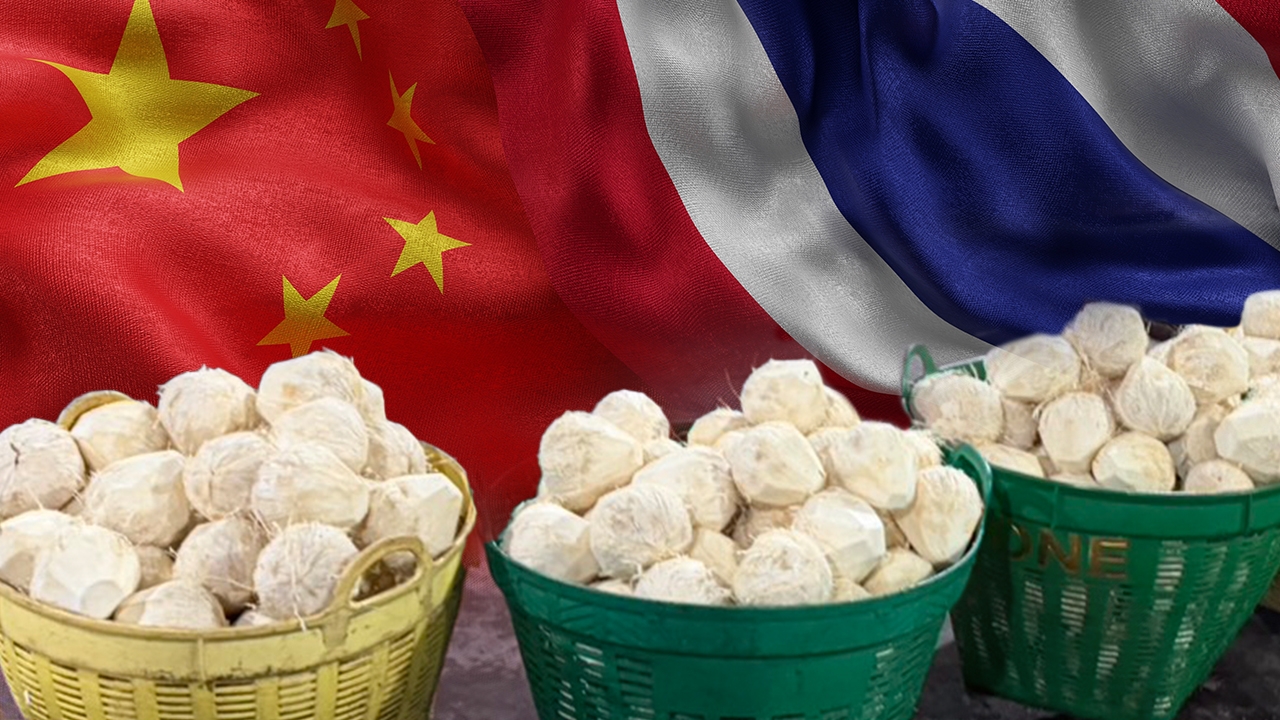
Chinese investors have seized control of the aromatic coconut market, suppressing prices and profiting by reselling to third countries. Local farmers complain that government officials in the area have not seriously cracked down on the issue.
Thai aromatic coconut farmers in Ratchaburi, Samut Songkhram, Samut Sakhon, and parts of Phetchaburi provinces have been severely affected by falling prices. The main cause is Chinese capital entering the area and using Thai nominees to control the market. Worse still, they fraudulently rebrand Thai coconut products to export them to third countries.
Thairath Online's special reporting team spoke with Jettajirat Jankimha, an aromatic coconut farmer and entrepreneur in Ratchaburi. He said prices began falling in June 2025, dropping to as low as 1 to 3 baht per coconut. Prices remained low for about eight months, prompting calls for action. Currently, prices have risen slightly to 4 to 5 baht per coconut, but it is expected that factories will soon collectively stop buying coconuts from farmers, causing prices to drop again.
Currently, Chinese capital owns about 80 to 90 percent of coconut export factories in Ratchaburi. The rapid expansion is due to local government officials neglecting to inspect and regulate illegal Chinese-run factories in the area.
Previously, about 700 aromatic coconut farmers gathered at the Ratchaburi provincial hall to protest, but local government agencies have been unable to resolve the problem, which is too large to handle at the provincial level.
Chinese investors operating aromatic coconut businesses in Ratchaburi, Samut Sakhon, and Samut Songkhram lease farms from local farmers, mostly using Thai nominees to acquire land. They particularly buy land through Thai community leaders who act as nominees, roaming to purchase land on behalf of Chinese investors.
Some Thais also protect these interests; farmers call them "Thais with Chinese hearts." When problems arise, they claim Chinese buyers will stop purchasing Thai coconuts. These Thais receive lump-sum payments from Chinese capital and disregard whether Thai farmers can survive.
Data shows that aromatic coconuts imported into Shanghai from neighboring countries like Vietnam have almost no market or presence since October 2025. In contrast, Thai coconuts are still imported into China and retain value.

Market checks in major Chinese cities revealed that Thai aromatic coconuts imported to China are not only consumed there but are re-exported to third countries by fraudulently using Chinese branding. For example, Thai restaurants in the U.S. purchase aromatic coconuts labeled as products from China in supermarkets; however, removing the sticker reveals they are actually imported from Thailand. This clearly shows China is fraudulently branding Thai aromatic coconuts and distributing them to third countries.
Another tactic called "boiled chicken factory" involves packaging nine coconuts per box, mixing 4–5 Vietnamese coconuts with 4–5 Thai coconuts, but labeling the box as a Thai product. Chinese operators then export these to third countries.
Currently, whenever Thai aromatic coconut farmers take action, major operators who are Chinese nominees hold meetings. In their LINE group, they agree to buy coconuts at no more than 10 baht per coconut throughout 2026. This is not price insurance but a deliberate process to suppress Thai coconut prices at the farm gate. Chinese investors have succeeded, as since June 2025, prices have never exceeded 10 baht per coconut, even though production costs are 3 to 4 baht each. Yet, when sold in China, the price reaches 150 baht per coconut.
Recently, farmers toured Shanghai’s fruit markets to verify if Thai aromatic coconuts were truly in short supply. While Thailand continues to export to China, the farmers found only one store selling Thai aromatic coconuts. Upon inquiry, they learned most Thai coconuts imported into China are re-exported to third countries to generate extra profits.

Chinese factories have been present in Ratchaburi, Samut Sakhon, Samut Songkhram, and Phetchaburi for a long time. They enter on tourist visas, claiming to inspect coconut farms. They gradually infiltrate by providing funds to Thai entrepreneurs to invest in machinery, with the condition that coconuts must be sent to China exclusively. Initially, conditions were lenient, but farmers receiving Chinese capital must sell only to that Chinese investor. Some companies register with 30% Chinese ownership and 70% Thai ownership, but in reality, Thai shareholders have no control or decision-making power.
Farmers want constitutional reforms on foreign land ownership and leasing, which threaten many Thai farmers and citizens. Even though foreign ownership is limited to one rai, this creates opportunities for Thai nominees to build large holdings.
Farmers urge the government to seriously investigate Chinese factories from central authorities and crack down on Chinese capital exporting coconuts to third countries. Simultaneously, new markets should be found to export Thai farmers' coconuts directly to final destinations.
Thailand should be the original exporter directly to end consumers, not allow China to exploit Thai aromatic coconuts by reselling them and taking large profit margins as currently happens.

The cost to produce one aromatic coconut includes farmer expenses for care, fertilizer, medicine, land rent, and labor. Farmers need prices between 8 and 10 baht per coconut to survive. When sold to factories, additional costs for labor, chemicals, shipping containers, and overseas shipping charges increase the final price.
Local farmers feel that government agencies helping and inspecting mainly approach wealthy factories, not the farmers. Since farmers are poor, officials avoid them because they bring only work and problems to solve. This is the farmers' complaint about local government agencies.
