

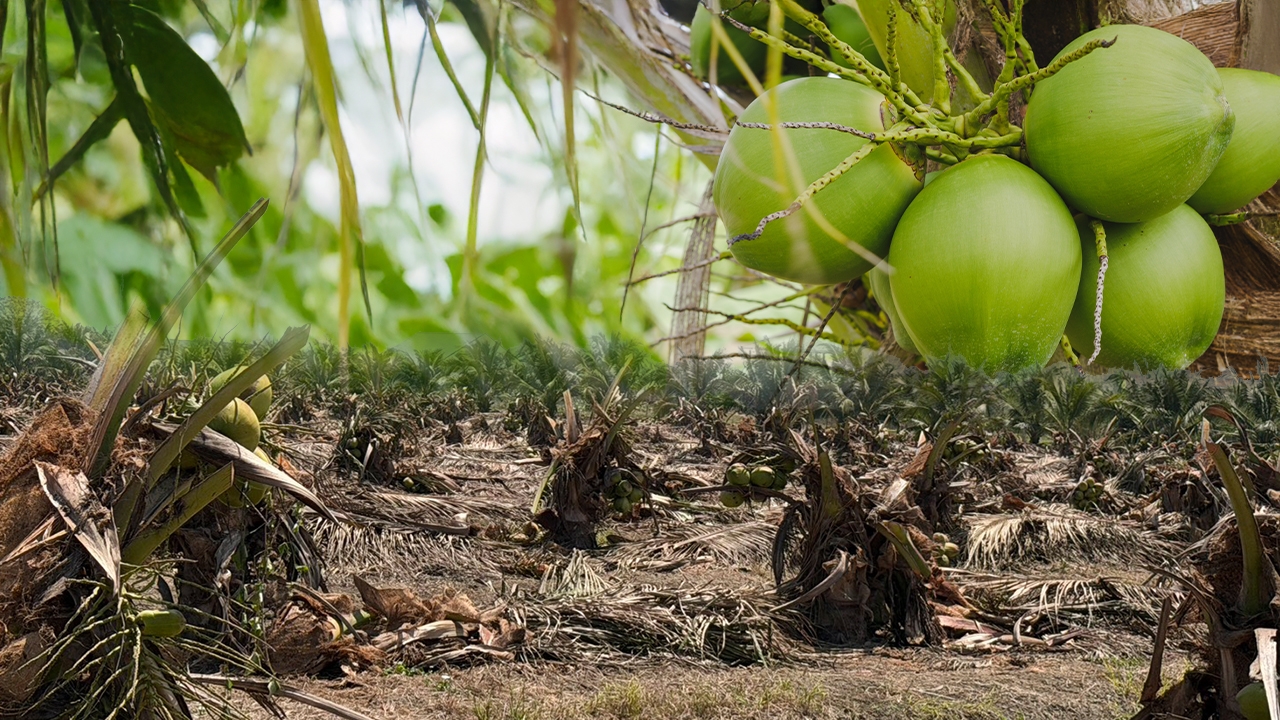
Aromatic coconut prices have been continuously low for over eight months, with Chinese capital overtaking Thai livelihoods by partnering with Thai nominees to monopolize everything from farms to exports. The president of the Thai Aromatic Coconut Association noted that the government is mentoring the establishment of a 'central hub' aiming to restructure the entire coconut market system.
The prolonged price slump of aromatic coconuts for over eight months has caused farmers to bear rising costs. At the same time, Chinese nationals have set up coconut hubs using Thai nominees to control prices and exports throughout the supply chain.
This situation led Ms. Suphajee Suthampun, Minister of Commerce, to seek solutions by preparing to discuss with the Thai Aromatic Coconut Association to hear from farmers and jointly develop strategies to resolve the price decline, including plans for managing production going forward. One key measure is promoting a 'central hub run by farmers.'

Typically, a 'coconut hub' functions as a center for sorting, packing, and managing produce before distribution to domestic and international markets. It also plays a crucial role as a price-setting intermediary in the market.
The proposed 'central hub' concept will transform operations so that farmer groups or community enterprises collect coconuts from Thai farmers’ orchards, then process sorting and distribution. The government will support marketing, logistics, and distribution both domestically and abroad to help farmers’ products reach more buyers.
This approach also aims to ensure that income from sales goes directly to farmers more than through multiple intermediaries in the traditional trade system, which reduces farmers’ bargaining power and price-setting ability.
The Thairath Online special news team interviewed "Charan Charoensap," president of the Thai Aromatic Coconut Association, who revealed that having a farmer-run central hub would help farmers better determine how to market their produce.
“Without a farmer central hub, money still flows through general hubs often dominated by large capital. But with a central hub, farmers can gather products and sell through a system they manage, allowing more income to reach them directly.”
This central hub concept would be operated by farmer groups, community enterprises, and those experienced in running coconut hubs or processing. The government’s role would be as a mentor supporting funding, inputs, and marketing, while farmers retain primary management control.
Additionally, the central hub could become a key base for developing new coconut products and expanding markets to other countries or regions in the future.

Aromatic coconut prices are currently in crisis. Charan noted that farm-gate prices in many areas, especially Ratchaburi, Samut Songkhram, Samut Sakhon, and parts of Phetchaburi provinces, have fallen far below production costs.
Currently, small coconuts sell for about 2 baht each, while large export-quality coconuts fetch only 4 to 5 baht each. Averaging all sizes, farmers receive only 3 to 4 baht per coconut, which is below their production costs.
“The fair price for farmers should not be less than 5 baht per coconut, but many orchards have been suffering losses for about 7 to 8 months now.”
The prolonged price slump has caused many farmers to face liquidity problems, with some lacking funds to buy fertilizer or maintain their orchards, potentially affecting future product quality.
“If farmers cannot invest in their coconut trees, product quality will decline, with smaller or inferior coconuts, creating ongoing problems,” Charan said.
Although some farmers have started uprooting coconut trees to plant other crops like lime, guava, or rose apple, this remains limited since most want to preserve coconut orchards as their main livelihood.

On another front, the falling coconut prices link to a market structure increasingly influenced by foreign capital, especially Chinese, as Thai aromatic coconuts have strong export demand, with China being a key market.
Charan explained that Chinese operators originally entered as buyers, but as demand and export prices rose, foreign capital began playing a greater role in production.
Some operators have leased coconut orchard land or partnered with farmers, and run buying hubs, allowing control over the trade system from upstream to downstream.
“Chinese capital controls the entire supply chain, preventing farmers from expanding to other markets because they buy up everything at low prices,” he said.
Investigations found some foreign capital disguises ownership by using Thai nominees to run buying hubs and control coconut price mechanisms, causing farmers to receive lower prices than they should.
This business model covers the whole production chain: upstream with long-term leased coconut orchards to control output; midstream using Thai shareholders as fronts in buying companies, while decisions and pricing come from abroad; and downstream including wholesale, retail, and exports.

Recently, the Central Investigation Bureau (CIB) under the Economic Crime Suppression Division raided eight transnational Chinese nominee coconut hubs in Ratchaburi province after uncovering foreign capital illegally using Thai names to control agricultural businesses reserved for Thai nationals.
The raids of eight coconut buying companies and processing factories revealed five companies suspected of violating the Alien Business Act of 1999.
Initially, five legal entities and a group of offenders including eight Thai nationals and six foreigners were identified, with authorities pursuing legal action against them.
Acting as a nominee or allowing others to register a company on a foreigner's behalf is illegal, punishable by up to three years in prison and fines ranging from 100,000 to 1,000,000 baht, or both.
These actions form part of efforts to reorganize the aromatic coconut market structure alongside government measures to promote a central hub, aiming to support prices and stabilize farmers in the long term.

Charan emphasized that without their own market or additional sales channels, the price problem could recur because farmers remain trapped in a market dominated by external control.
“As long as investors and nominees dominate, farmers cannot set prices, and the future of Thai aromatic coconuts remains uncertain,” he said.
Ultimately, the Thai Aromatic Coconut Association president stated that solving this issue requires cooperation among all sectors—farmers, government, and private sector—to establish a quality, transparent central hub that directs market income directly to farmers.
If this system develops and grows, it could lead to innovations and new coconut products, as well as market expansion to other regions, helping ensure the long-term sustainability of Thailand's aromatic coconut industry.