

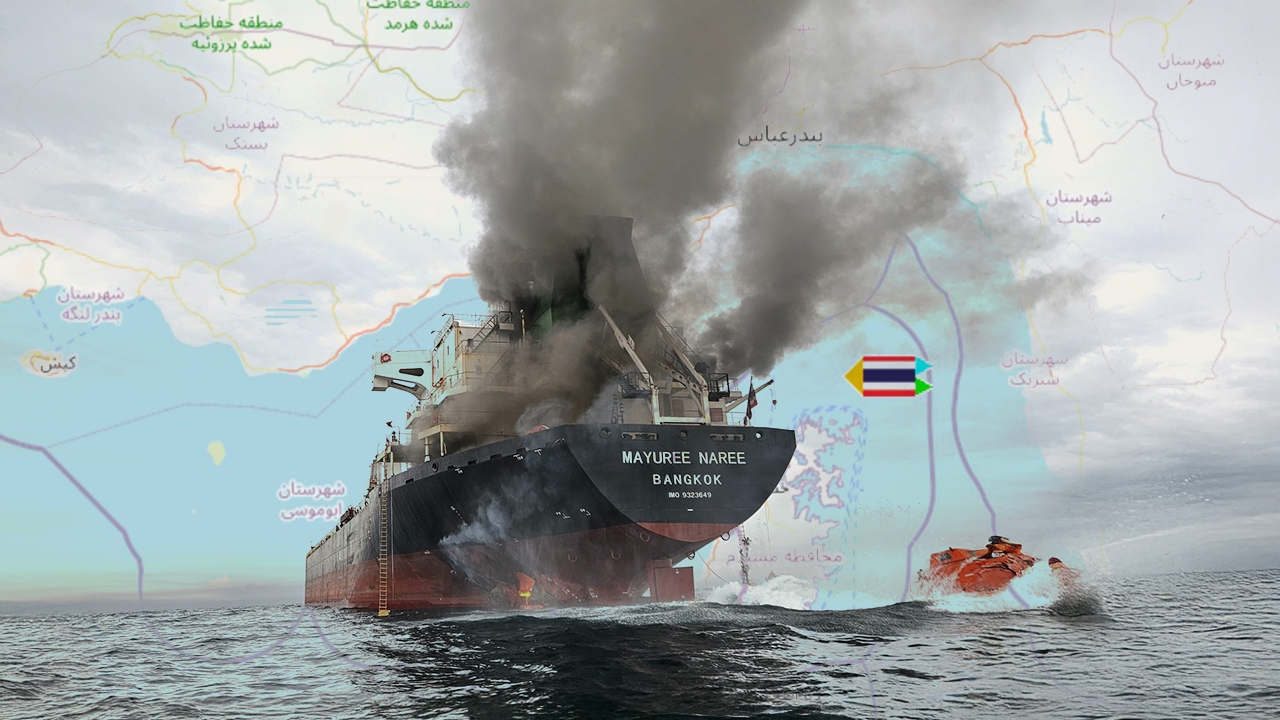
Tensions in the Middle East have extended to a Thai commercial vessel when Iran’s Islamic Revolutionary Guard Corps (IRGC) admitted to attacking the Thai-flagged cargo ship “Mayuri Naree” as it sailed through the Strait of Hormuz, claiming the ship ignored warnings and attempted to pass illegally.
The IRGC statement said the “Mayuri Naree” was fired upon after failing to heed warnings from the Iranian navy. On the same day, another cargo ship, the Liberian-flagged “Express Rome,” was also attacked after allegedly ignoring Iranian warnings.
According to United Kingdom Maritime Trade Operations (UKMTO), since the US and Israel launched attacks on Iran and Iran retaliated on 28 Feb 2026, there have been at least 14 attacks on commercial vessels in the Persian Gulf, Strait of Hormuz, and Gulf of Oman, including three incidents on 11 Mar alone.

Iran’s strategic use of the Strait of Hormuz is not new. Back in June 2025, after the US attacked three Iranian nuclear facilities, Iran threatened to close the strait, though tensions eased following a ceasefire announcement.
Precious Shipping, the vessel’s owner, told the Stock Exchange of Thailand that “Mayuri Naree” is covered by war risk insurance under the policy terms, so this incident is not expected to significantly affect the company’s financial standing or operations.
At the time of the attack, the ship was sailing empty without cargo, so no cargo damage occurred. However, reports indicate three people were trapped on board, though the Royal Thai Navy has yet to officially confirm these details.
The Strait of Hormuz is one of the world’s most strategic maritime routes, as it is the only sea passage connecting the Persian Gulf to the Arabian Sea and serves as the gateway to the Indian Ocean. This narrow channel is a critical node in the global energy system.
Energy data show that about 20% of global oil consumption passes through this strait, and in 2025 alone, around 34% of the world's seaborne oil trade transited the Strait of Hormuz, earning it the reputation as the world’s most important oil transport bottleneck.
Although regional countries have sought alternative pipelines to bypass this route, countries like Kuwait, Qatar, Bahrain, and Israel still heavily rely on the strait for energy exports.
Geographically, the narrowest part of the Strait of Hormuz is approximately 20–21 nautical miles wide, with territorial waters divided between Iran and Oman, making this area a strategic zone jointly overseen by both nations.
To ensure navigation safety, the International Maritime Organization (IMO) established a Traffic Separation Scheme (TSS) here in 1973, updated in 1979, defining two main shipping lanes—one for inbound and one for outbound vessels—each about 2 nautical miles wide, organizing traffic in one of the world's busiest sea routes.

The United Nations Convention on the Law of the Sea (UNCLOS) is an international treaty that governs the use of the world's seas and oceans, aiming to ensure fair conservation and use of marine resources and environments, including protection of marine life. UNCLOS also addresses sovereignty, maritime rights, and navigation rights.
An international strait is defined as a natural sea passage used for international navigation between two large bodies of water.
The Strait of Hormuz fits this definition because part of it overlaps the territorial waters of Iran and Oman, thus legally qualifying as an international strait under maritime law.
Under UNCLOS, this strait is subject to “transit passage,” guaranteeing the right of all ships and aircraft to navigate continuously and expeditiously through the strait.
Article 38 of UNCLOS states this transit right is freedom of navigation and overflight between high seas or exclusive economic zones, while Article 44 requires coastal states not to impede or suspend this right, meaning all vessels—including warships and military aircraft—may exercise transit passage through international straits.
Meanwhile, within a coastal state's territorial sea, extending up to 12 nautical miles, foreign ships have the “right of innocent passage,” meaning navigation that is not prejudicial to the coastal state's security, such as refraining from military threats, exercises, or espionage.
However, the United States, Israel, and Iran are not parties to UNCLOS, leading to practical legal disputes over the extent of navigation rights exercised by their vessels and aircraft.
Many maritime legal experts agree that even in armed conflict, the right of transit passage through international straits remains in effect, referencing the San Remo Manual on International Law Applicable to Armed Conflicts at Sea, which stipulates that navigation through straits used for international navigation should not be suspended even during war.
This principle means all types of vessels retain the right to transit straits under certain conditions, including warships and military aircraft, while commercial and civilian ships not engaged in military roles should receive special protection under maritime war law.
In the case of the Thai commercial vessel, if it did not threaten the coastal state’s security or engage in military operations, the attack’s legitimacy under international law could be questioned.

Part 15 of UNCLOS sets rules for resolving disputes among parties arising from interpretation or application of UNCLOS. Under Article 287(1), when signing, ratifying, or acceding to UNCLOS, states may declare their chosen dispute settlement method from the following options:
International Tribunal for the Law of the Sea (ITLOS) in Hamburg, Germany;
International Court of Justice (ICJ) in The Hague, Netherlands;
Special arbitration under Annex VII of UNCLOS; or
A special arbitral tribunal established for certain disputes under Annex VIII of UNCLOS.
Since Iran is not a party to UNCLOS, recent attacks on commercial vessels in the Strait of Hormuz are often analyzed under maritime war law, especially the law of targeting and naval blockade, to assess whether such attacks during armed conflict are lawful under international law.