

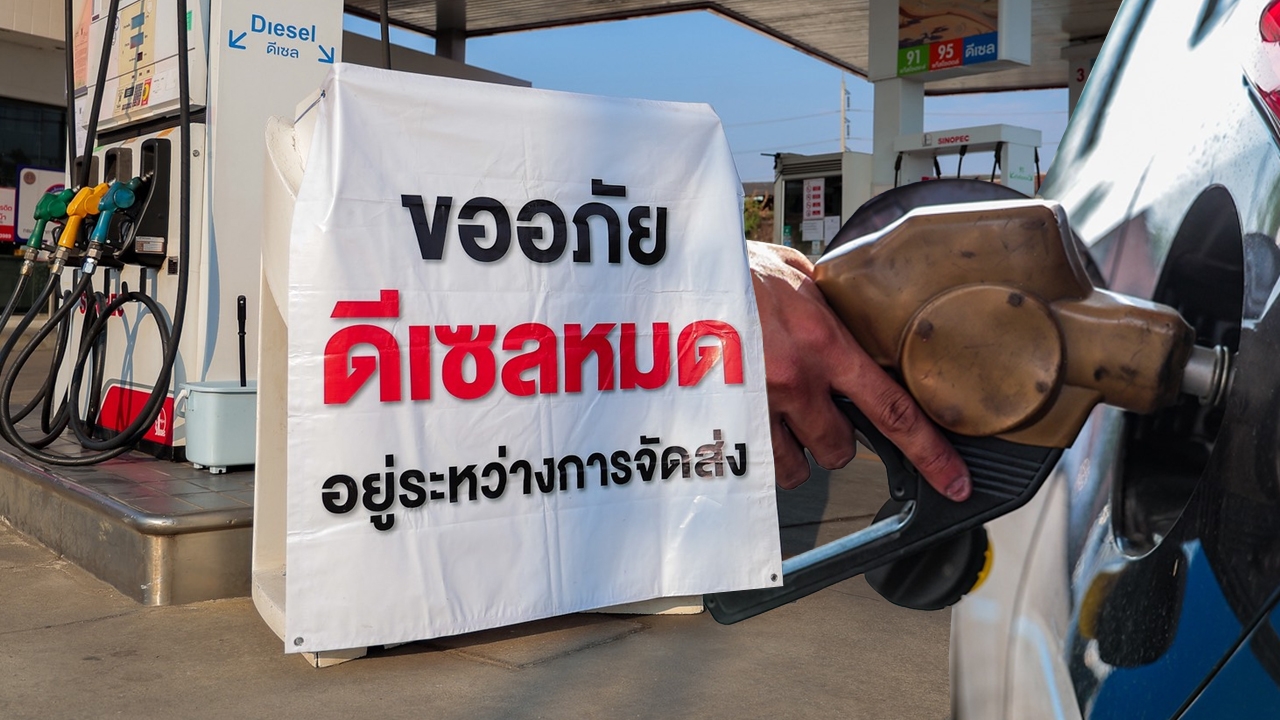
The mystery of fuel shortages at gas stations—whether due to hoarding or soaring prices—is analyzed alongside solutions like government tax reductions, inspections of old fuel stocks, and creating fair pricing.
Recently, many areas shared on social media about the problem of insufficient fuel supply at numerous gas stations nationwide, especially diesel used for transporting goods and agriculture, which may cause product prices to rise. Meanwhile, relevant government agencies stated that fuel is not lacking; rather, increased hoarding has made the normally supplied fuel volume insufficient for sale.

On social media, questions arose about why fuel is sufficient overall but runs out at stations. To clarify this mystery, Thairath Online's special team interviewed Rosana Tositrakul, Chair of the Public Service, Energy, and Environment Subcommittee of the Consumer Council. She analyzed that the shortage at gas stations might result from deliberate withholding to gain profits. Although ministers claim Thailand has a 60-day fuel reserve with another incoming batch adding 30 days, totaling 90 days, the government has fixed prices for 30 days before allowing prices to float, which is unfair. Normally, refineries contract to buy fuel about six months in advance. Before the attack on Iran, the refinery's gasoline 95 stock—unblended with ethanol—was priced at 15.88 baht per liter on 20 Feb 2026, representing old, cheaper stock. But by 13 Mar 2026, the price was 28.22 baht, despite being from old stock.
Since 1 Mar 2026, after the war began, refining costs jumped abnormally from the usual 2 baht per liter to 6 baht per liter, representing a price increase despite using the same raw materials. Europe has implemented windfall taxes because of such sudden fuel price spikes.

Therefore, refining costs should not rise within 60 days when Thailand’s refined fuel is 100% domestic, yet prices are pegged to Singapore’s oil market, providing opportunities for profiteering. When Thailand references the Singapore market, crude oil refined into finished fuel causes prices to soar from 15.66 baht per liter to 28 baht. To address this, similar to Europe, a price ceiling should be set, and any excess above this ceiling should be taxed as windfall profits to compensate the oil fund.
Regarding excise tax on fuel, the government should reduce taxes to stabilize fuel prices. Currently, diesel is taxed at 6.92 baht per liter. Thus, money from the oil fund used to subsidize prices ends up paying taxes to the government, which should instead reduce taxes to maintain price stability.

Concerning oil reserves for energy security, the public currently bears these costs, whereas operators should pay. During an energy security crisis, the public’s advance payments are not discussed, even though the government should distribute that reserved fuel to citizens to stabilize prices, as Japan has done during times of global oil price surges.
The government’s explanation that fuel shortages at stations are due to ongoing deliveries is questionable since transportation remains normal. This raises suspicions of deliberate hoarding by operators to sell fuel later at higher prices, causing public distress as people want to fill up at stable prices without fearing shortages.