

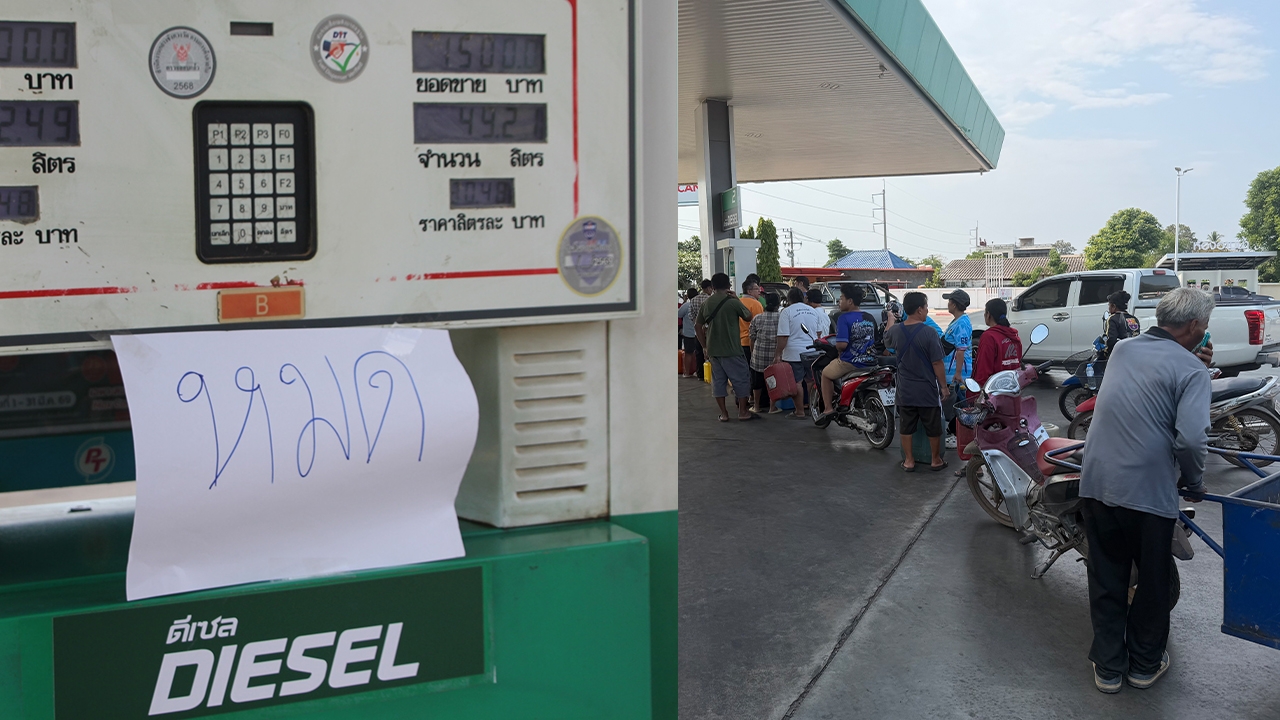
A nationwide survey of gas stations reveals quotas limiting fuel purchases to between 300 and 1,000 baht, with some stations closing before official hours after consumers rushed to buy all available fuel. Government and fuel retailers confirm sufficient oil supplies but note transport cannot keep pace with demand.
Regarding reports that "gas stations" at many locations have completely run out of fuel, and that fuel purchase quotas have been imposed, raising public concern about potential energy shortages,
a survey by Thairath Online's news team found that fuel purchase limits are indeed being applied. However, this is not a nationwide directive but depends on each station's management. Currently, many stations are out of fuel or experiencing supply delays during transport. As of 16 Mar 2026 GMT+7, some issues and obstacles have been reported as follows:
Many gas stations nationwide have introduced measures limiting fuel purchase quotas, ranging from about 300 to 1,000 baht, depending on the station and vehicle size. Some stations have even prohibited customers from bringing fuel containers to prevent hoarding.
For example, in Khlong Khlung District, Kamphaeng Phet Province, some stations have customers waiting to refuel as early as 4 a.m., requiring queue cards to manage demand. One station allows customers to fill containers up to 700 baht for vehicles and agricultural use.
Similarly, in Kalasin Province, several gas stations have posted signs stating
"Sharing measures to ensure fair distribution. The station limits refueling as follows:
- Small cars and pickup trucks: 500 baht per vehicle
- Trucks and buses: 1,000 baht per vehicle
- Containers for farmers: 500 baht
Due to the fuel shortage situation, please conserve energy together."

In Pathum Thani Province, the governor and officials visited Khlong Luang District, confirming no fuel shortage yet but higher-than-usual customer demand depletes supplies faster than expected. Delivery trucks cannot replenish stations quickly enough. Some stations limit small cars to 500 baht and pickups to 1,000 baht.
In Chiang Mai Province, reporters observed at Saraphi District that many private and large trucks fueled up, causing some stations to run out of fuel and resulting in minor traffic congestion. Some stations nearing depletion limit trucks to 1,000 baht per fill.
In Kabin Buri District, Prachinburi Province, several stations posted signs indicating diesel is sold out, with mostly only Benzene 91 and E20 remaining. A truck driver traveling from Chachoengsao to Khon Kaen had to stop at 3-4 stations due to a 700 baht limit per station.

Similarly, in Krabi Province, many stations have sold out fuel, with those still open limiting purchases to 700 baht. Some small private stations have increased prices, such as diesel at 38.99 baht per liter.
Meanwhile, some stations in Satun Province limit car refueling to 300-500 baht, motorcycles to 50 baht, and restrict container filling to no more than 500 baht. Some places allow unlimited vehicle refueling but limit container fills to 500 baht or impose a 500 baht per vehicle quota.
Several gas stations, without imposing fuel purchase limits, have had to close early due to running out of fuel after large crowds.
In Mukdahan Province, reporters surveyed stations near the Second Friendship Bridge border checkpoint (Mukdahan–Savannakhet) and found many vehicles queued to refuel, especially those from Laos preparing to return home.

Thai citizens were also observed bringing containers for staff to fill. Some even transported motorcycles on pickups to fill their tanks. A pump attendant said diesel had run out at many stations; the station he worked at ordered 6,000 liters, which sold out within two hours.
Around Mukdahan city, some stations close early at 6:00 p.m. because opening later is pointless without fuel to sell.
In Roi Et Province, the deputy governor inspected Phon Thong and Pho Chai Districts, finding four stations temporarily out of fuel and suspending service while waiting for deliveries, as consumer demand has been unusually high over the past week.

At a press briefing of the Center for Management and Monitoring of the Middle East Conflict Situation (CMMC) on 15 Mar 2026 GMT+7, Deputy Prime Minister and Finance Minister Ekniti Nitithanprapas said that the government reviewed domestic fuel prices and invited executives from PTT Public Company Limited and fuel traders under Section 7 to exchange updates.
Energy Business Department Director-General Sarawut Kaewtatip disclosed that inspections of 53 oil depots nationwide found commercial oil reserves of about 1.4 billion liters and statutory reserves of 3.4 billion liters, totaling 39 days of supply. Additionally, there are 27 days of fuel in transit and 30 days under supply contracts, totaling 90 days of fuel availability, confirming sufficient fuel for domestic use. Regarding increased consumer refueling causing transport delays and supply gaps, the Prime Minister has ordered measures to address these issues.
Fuel company executives affirmed adequate reserves, with
PTT Public Company Limited CEO Kongkraphan Injaeng confirming a global network and crisis preparedness plans, including sourcing oil from ports bypassing the Strait of Hormuz or from countries like the U.S. and Latin America. He assured that PTT's refineries, responsible for 60% of the country's oil production, continue full operations with sufficient fuel production for national consumption. M.L. Peekthong Thongyai, OR executive,
stated that PTT gas station operations remain normal with sufficient fuel, and continuous efforts are underway to transport fuel to stations. However, long distances and sharply increased demand mean some stations run out temporarily at times. Ms. Orauthai Na Chiangmai, Shell Thailand executive,
noted a similar situation with fuel sourced domestically and internationally, assuring sufficient supply. Some 2-3% of stations have experienced shortages due to transport issues, which are being addressed to minimize shortages. Mr. Pitak Ratchakitprakan, PT executive,
confirmed support for government guidelines and efforts to ensure fuel availability to the public. Deputy Prime Minister Ekniti concluded that fuel producers, in consultation with the Energy Business Department and nationwide chambers of commerce, consistently assure no fuel shortages, emphasizing ample crude oil supplies. However, public concern has led to hoarding, causing lower-than-normal deliveries to stations.

The Energy Ministry, through the Director-General of the Energy Business Department, will engage traders to assure the public that fuel at stations is sufficient to meet demand, urging calm and confidence in the fuel supply situation.