

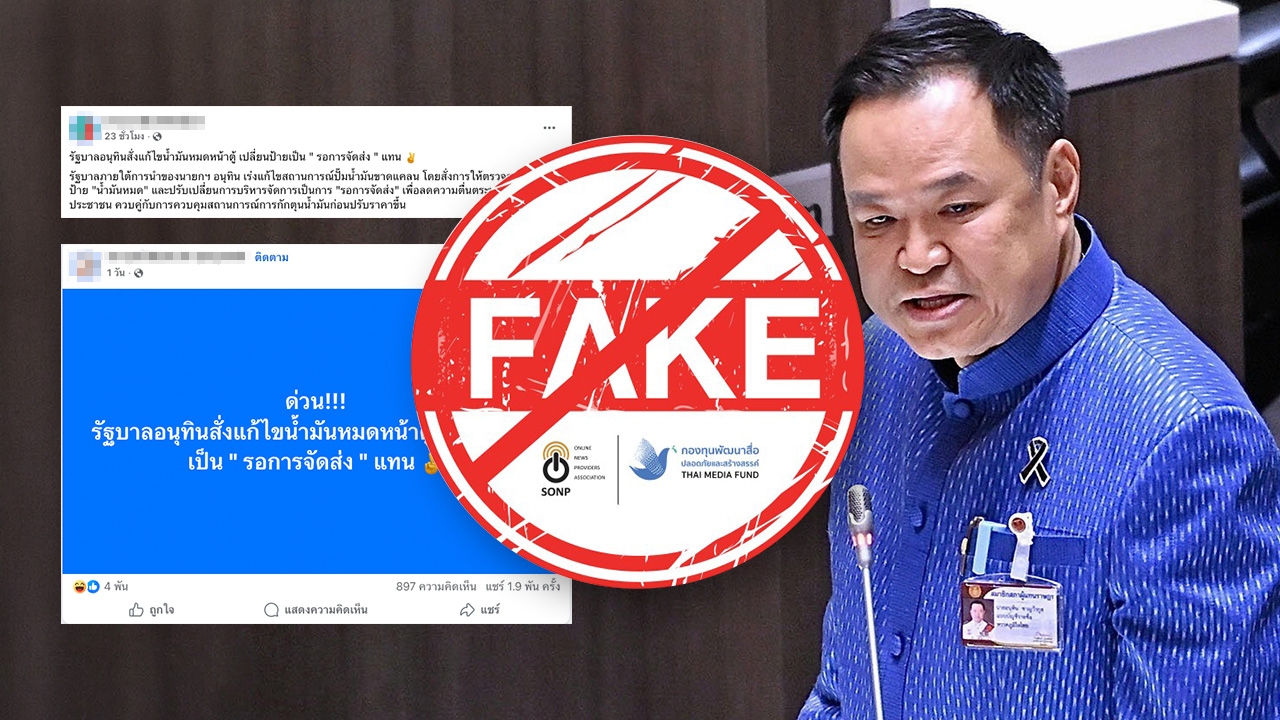
No evidence was found that the 'Anutin Government' ordered changing 'Out of Fuel' signs at fuel pumps to 'Awaiting Delivery.' The Energy Ministry revealed solutions to the fuel shortage at stations, coordinating with dealers to increase oil transport vehicles and allowing 24-hour delivery operations.
Regarding the case where a message was shared stating that "Anutin Government" Mr. Anutin Charnvirakul, the Prime Minister, was said to have ordered solving the fuel shortage problem at service stations by changing the "Out of Fuel" signs at pumps to signs reading "Awaiting Delivery" instead, to reduce public panic.
This message was shared on social media between 17 and 19 March 2026. Upon investigation, the news team found that no such information appeared from interviews with the Prime Minister during that period.
Most recently, on 19 March 2026, Mr. Anutin chaired a meeting of the Center for Management and Monitoring of the Middle East Conflict Situation (CM3E), together with ministries, agencies, the private sector, and related civil society groups, stating that the government is implementing measures aligned with the current situation, such as setting new fuel price caps, promoting bioenergy, and extending fuel transport hours.
However, he acknowledged ongoing practical issues, with many people in various areas reporting difficulties accessing fuel smoothly and concerns about insufficient fuel volumes. He reassured that there are no problems with fuel reserves or crude oil supplies, emphasizing that Thailand can still purchase and import crude oil from multiple global regions. There are no signs or indicators that Thailand's oil supply will decrease. He urged all relevant sectors to help build public confidence.
He explained that the current problem arises because public concern persists despite unchanged supply. He gave an example comparing the situation to an ATM holding 3 million baht but with withdrawals totaling 10 million baht; it will inevitably run out. Similarly, fuel pumps cannot always be fully stocked due to delivery cycles. Therefore, methods must be found to maintain public confidence and address problems like queues forming at stations as before (read more: "Anutin urges transporters and jobbers to show oil purchase contracts after significant volume drops")
Regarding solutions to fuel shortages at stations caused by insufficient tanker deliveries, on 19 March 2026 during a CM3E press conference, Mr. Wutit Tantiwess, Deputy Director-General of the Department of Energy Business, Ministry of Energy, revealed that from inspections of 2,649 service stations nationwide between 15-17 March, it was found that
- 241 stations (9.1%) were closed due to being out of fuel,
- 1,912 stations (72.2%) were open but some fuel types were out or nearly out,
- 496 stations (18.7%) were open and had sufficient fuel available.
The survey found that fuel demand has risen significantly above normal, causing tanker deliveries from depots to lag behind demand, resulting in fuel shortages at stations. The solutions are as follows:
1. Allow 24-hour fuel transport operations.
Cooperation has been requested from four related agencies: the Royal Thai Police, Ministry of Interior, Ministry of Transport, and Bangkok Metropolitan Administration to allow 24-hour fuel deliveries to speed up distribution to stations. Previously, fuel transport was restricted during rush hours from 05:00-10:00 and 15:00-21:00.
2. Increase the number of fuel transport vehicles.
Coordination with fuel dealers to increase the number and trips of transport vehicles, with each dealer able to increase trips from 10% up to double.
On 18 March, dealers under Section 10, or "small-scale dealers" with annual trade volumes above 30,000 metric tons but not exceeding 100,000 metric tons, were invited to monitor the situation and discuss problems. It was found that these dealers receive fuel allocations as usual but no additional supply to meet the increased demand. Some dealers even experienced reduced allocations. Therefore, the Department of Energy Business was asked to coordinate with major dealers to allocate more fuel to supply the industrial and agricultural sectors. They were also asked to oversee pricing and control fuel transfers between points.
Currently, the Energy Ministry is expediting an announcement under Section 8 of the Fuel Trade Act B.E. 2543 (2000) to strengthen oversight. Oil depots will be required to display selling prices at the depot and report daily sales data and contract sale prices.
Regarding rumors that Thailand is exporting oil to Cambodia, Mr. Wutit stated that the Department of Energy Business confirms there is no export of any type of oil to Cambodia, and there are no reports of illegal oil transport into Cambodia.
As for the national oil reserve situation as of 19 March 2026, it stands at 5,060 million liters, sufficient for 41 days of use. Additionally, 7,396 million liters, or 59 days' worth, are in transit or confirmed for import, giving Thailand a total oil reserve supply of approximately 100 days.