

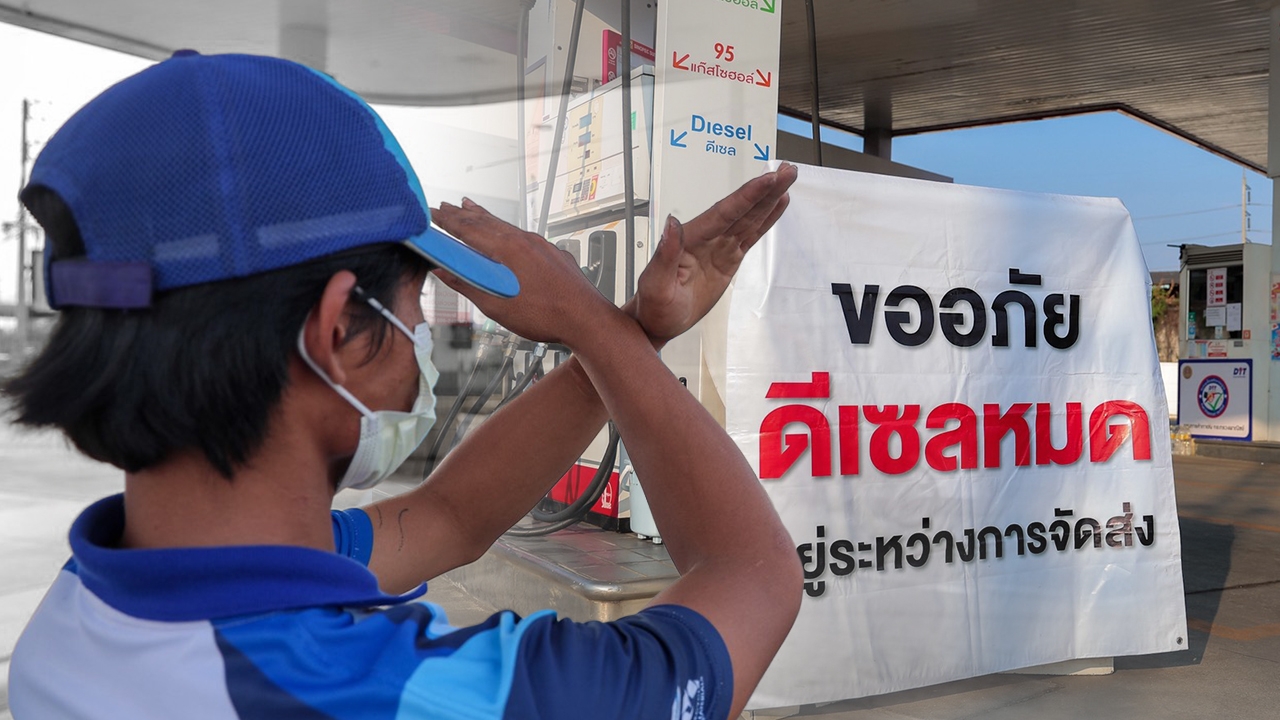
The unrest and significant events around the "Strait of Hormuz" in early March 2026 directly impacted the global oil market, causing continuous volatility in retail oil prices in Thailand throughout the first three weeks of the month.
(Comparison of current prices with those at the start of the month)
Diesel: Cumulative increase of 1.2 baht per liter
Gasohol 91: Cumulative increase of 2.5 baht per liter
Gasohol 95: Cumulative increase of 2.5 baht per liter
E20: Cumulative decrease of 0.29 baht per liter
E85: Cumulative decrease of 1.5 baht per liter
Observation: Users of Gasohol 91 and 95 were most affected by sharp price hikes up to 2.5 baht per liter, while alternative fuels with higher ethanol content like E20 and E85, despite a late-month increase, remained overall cheaper than at the start of the month.
Diesel surpasses 30 baht: During the first 10 days, diesel prices held steady at 29.94 baht, but from 18 March onward, diesel exceeded the 30-baht mark and continued rising, now at 31.14 baht.
Gasoline group surges continuously: Gasohol 91 and 95 consistently rose in each of the three pricing announcements, increasing by 0.5 to 1.0 baht per round.
E20 / E85 fall then rebound: These two types were the only fuels to see continuous price drops mid-month (10 and 18 March) before all fuel types increased by 1 baht together in the latest announcement on 21 March.
The tensions in the "Strait of Hormuz" (Strait of Hormuz) in early March 2026 were no longer distant foreign news, as their effects crossed oceans to reflect in fuel prices at stations throughout Thailand. Since this strait is one of the world's most important oil transport routes (accounting for over one-fifth of global crude oil consumption), even minor disruptions create a "Risk Premium" in the global oil market, inevitably pushing up energy costs for oil-importing countries like Thailand.
Throughout the first three weeks of March 2026 (1–21 March), we witnessed a clear reflection of price battles, market adjustments, and tangible impacts on consumers.
Price changes over the past 21 days have not only affected fuel pumps but have sent ripple effects through the economy in three main dimensions:
1. Transport sector and inflation (Logistics & Inflation)
Diesel rising from 29.94 to over 31.14 baht (an increase of 1.2 baht) signals danger for businesses, as diesel is a primary cost for nationwide goods transport. Prolonged high prices may force operators to pass costs onto consumers, causing inflation to rise.
2. Cost of living burden (Cost of Living)
Private vehicle owners using Gasohol 91 and 95 face the heaviest burden from a 2.5 baht per liter rise. Filling a full tank (about 40 liters) means paying 100 baht more per fill-up, directly impacting savings and spending power in other economic sectors.
3. Opportunity for alternative energy (The Ethanol Buffer)
Although E20 and E85 prices rose late in the month with global market trends, overall monthly prices remained down (-0.29 and -1.5 baht respectively). This proves that policies supporting alternative energy from domestic agricultural materials (ethanol) can serve as a "shock absorber" during global geopolitical crises.
The crisis of the "Strait of Hormuz" in March 2026 tested the resilience of Thailand's energy structure again. As long as Thailand remains a net energy importer, global geopolitical volatility will continue to impact Thai consumers' wallets.
What businesses and consumers must closely watch going forward is the duration of the Middle East tensions and the financial status of the "Fuel Oil Fund," which will determine how long diesel prices can be kept from rising further. This will decisively influence the economy and cost of living in Thailand for the second quarter of 2026.