

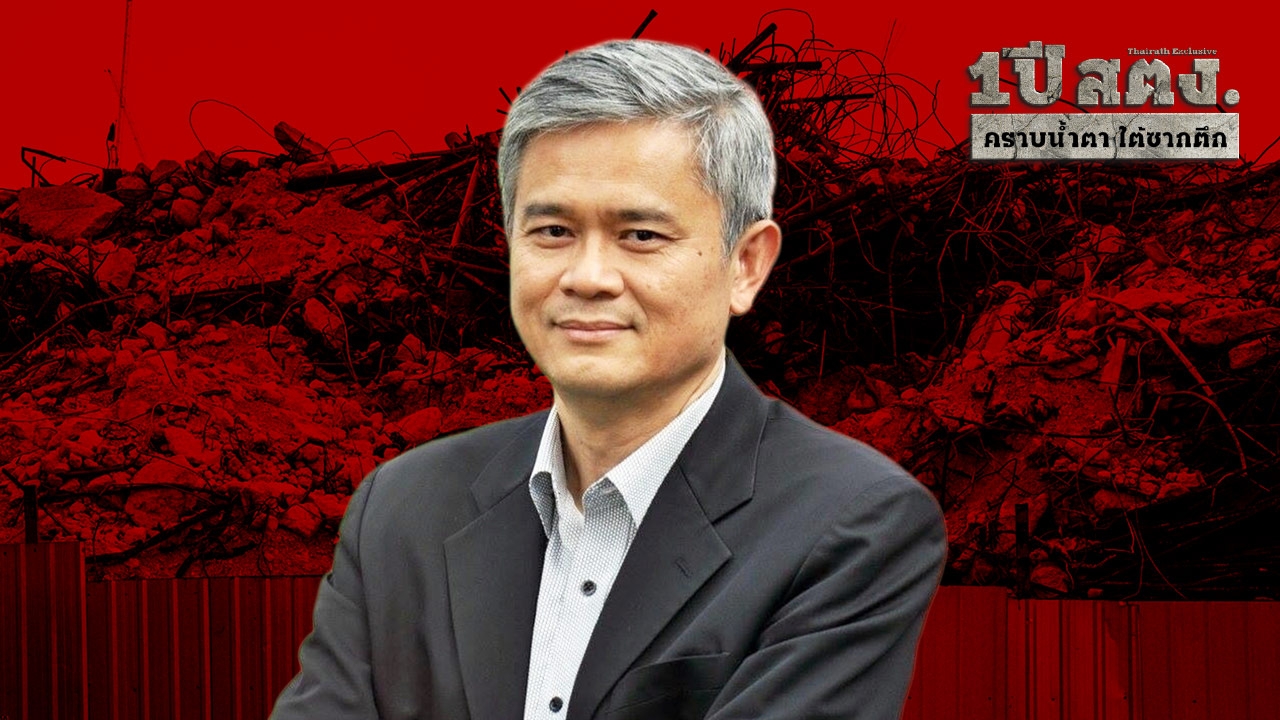
Justice in Question One Year After the Comptroller General's Department Building Collapse: Unanswered Questions from a Systemic Tragedy That Exposes the Entire System
One year has passed since the collapse of the Comptroller General's Department building. Although the damaged structure has been demolished and removed from its original site, the questions raised by the incident remain unanswered and silent.
For Dr. Mana Nimitmongkol, this event is not merely a tragedy caused by technical failure but a reflection of the Thai state's structural collapse.

“This is an incident that has angered Thai people deeply due to the loss and the shame it brings.”
Dr. Mana Nimitmongkol, chairman of the Anti-Corruption Organization (Thailand), said firmly that the Comptroller General's Department is responsible for auditing transparency across all government agencies nationwide. Therefore, its building should meet the highest standards in design, strength, and safety.
However, what happened was the complete opposite: the building of the very auditors collapsed. The damage extends beyond the physical structure, shaking confidence in the entire system and prompting society to question whether the Thai bureaucracy has failed to such an extent.

What worries him is not only the cause of the collapse but “the lack of answers.” Even after a full year, “to this day, the complete investigation report has never been made public.” When the government withholds information, the public cannot learn the facts, and without knowledge, trust cannot be established.
For Dr. Mana, disclosure is not just about transparency but a prerequisite for resolving the problem. “If the data were released, professionals—engineers, architects, academics—could assist in analyzing it.” This prolonged ambiguity not only erodes societal trust but also burdens those who may not be involved.

Following the event, legal proceedings have been divided into three main groups: nominee cases, design and construction violations, and bid-rigging involving numerous government officials. The critical question is whether these processes are rigorous enough or merely a "blanket" prosecution.
Here, “blanket” does not only refer to the number of defendants but expresses concern that the charges may not sufficiently differentiate individual responsibilities.
“If that is the case, the cases may not be strong enough to punish the guilty effectively,” and at the same time, innocent people might lose both reputation and freedom.
Regarding the bid-rigging case, he noted the involvement of 72 government officials and questioned how plausible that number is. He also pointed out that although the list covers executives of the Comptroller General's Department, it remains unclear whether it includes the entire Audit Committee.
While he acknowledges that such cases take time, especially under the National Anti-Corruption Commission’s process, which may drag on 3-5 years, society expects a swift process that does not sacrifice fairness.

For Dr. Mana, the greatest concern is not just the legal cases but what the incident reveals. “People are angry because they feel their lives are at risk.” The first risk questioned by society is the standards of Thailand's construction industry—from the professional standards of engineers and architects to the practical oversight system. Issues like signature trading, document forgery, and lax supervision all indicate that state monitoring may never have functioned seriously. He sees this not as isolated but as a long-accumulated structural problem.
Looking deeper, the construction industry's structure is full of interconnected pressures forming a chain.
“We have heard about nominee issues for a long time. They relate to capital, competition, and foreign investment.”
At the same time, fierce price competition in government procurement leads to sharp price-cutting.
When prices fall, main contractors subcontract further, and ultimately, the cost cuts come at the expense of safety.
He explained that when the cost structure is squeezed, budgets for safety systems or supervisory personnel are usually the first to be reduced.

The end of this chain is the workers, especially migrant workers. “With multiple layers of subcontracting, workers are at the bottom of the system.”
These workers often labor under insecure conditions and may not receive adequate protection according to proper standards. This is not only a safety issue but also a human rights concern.

Though the justice process is lengthy, he emphasized that society still plays a vital role. “At minimum, we must help raise questions” about procurement systems, tax money use, and government accountability.
Ultimately, Dr. Mana sees this event as a catalyst for change. “We must think together about how to stop corruption,” “how to address specification rigging, bid-rigging, or negligence.”
Without clear answers, this tragedy may not be the last, and the same questions may return when it is too late to ask them.