

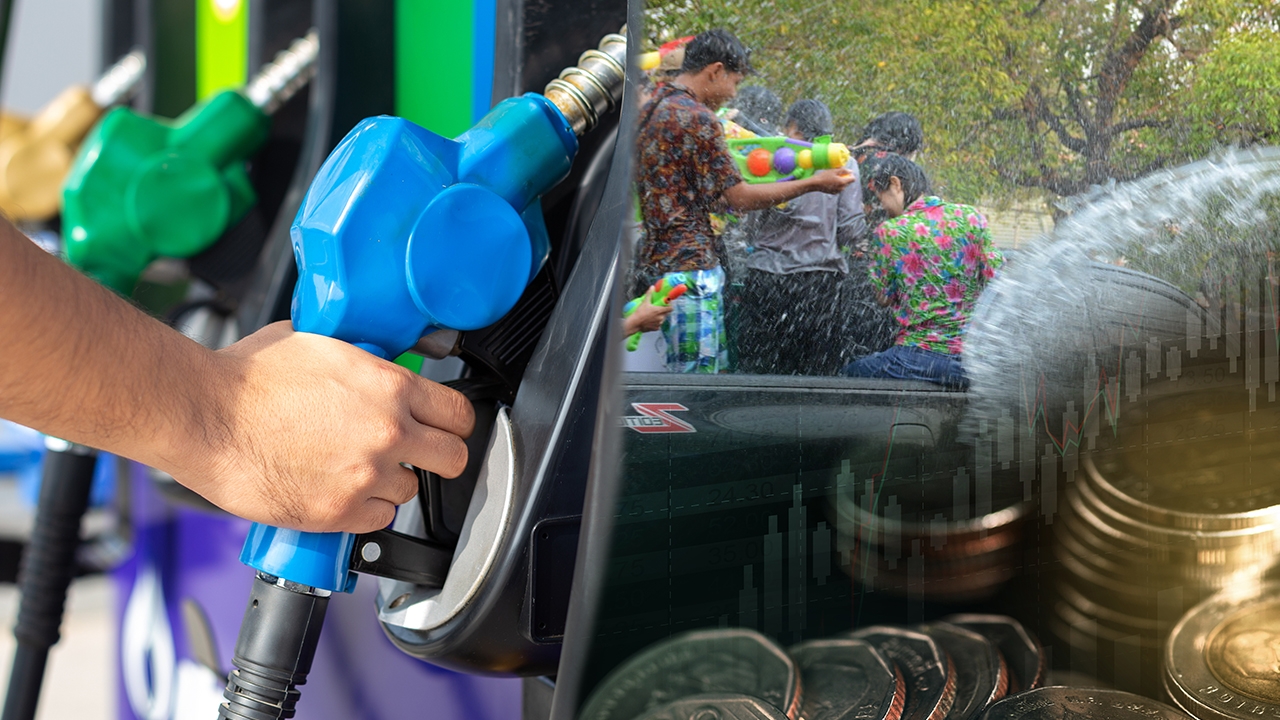
Monitoring new oil price record The Energy Ministry does not guarantee that Songkran prices will stay below 70 baht per liter, as the government implements excise tax reduction measures An academic expert criticizes the sudden price hike for causing panic and recommends urgent support for heavily impacted groups
Today (26 Mar 2026), at a press conference by the Center for Middle East Conflict Situation Management (CMEC) Mr. Pornchai Jirakulpaisan, Director of the Policy and Planning Office at the Fuel Oil Fund Office (FOF), said the ongoing unrest in the Middle East shows no signs of ending, causing global fuel prices to rise sharply, which affects retail prices in all countries.
The rising oil prices have caused the Fuel Oil Fund to face increasing liquidity shortages, currently at a deficit of 35 billion baht, with daily outflows of 2 billion baht. This has forced subsidy reductions; for example, the diesel fuel subsidy for regular fast-moving diesel dropped to 19.12 baht per liter from 26.99 baht per liter on 24 March. However, subsidies still assist certain fuel groups like diesel and gasohol.
Thailand is not the only country with rising oil prices. Last night, neighboring Malaysia increased diesel prices by as much as 7 baht per liter. Overall, Thai oil prices remain comparable to or even lower than those of neighboring countries.

At the press conference,CMEC, reportersasked if the ongoing situation could push prices to 70 baht per liter during Songkran. Mr. Pornchai said Thailand's oil prices depend on global market prices. Whether prices reach 70 baht depends on the fund's capacity to maintain liquidity. If it can, oil prices can be stabilized.
"Reducing the subsidy rate will improve the fund's status. We remain confident we can continue operations, but we cannot guarantee how much global prices will rise. We need to keep monitoring the situation."
When asked about the current subsidy of 19.12 baht per liter and the likelihood that consumers might have to pay that amount themselves, Mr. Pornchai said the conflict shows signs of negotiation, leading to lower global oil prices. However, there is no guarantee prices won't rise again. If global prices remain stable or decrease, the fund may maintain current retail prices this week. If prices rise, further consideration will be needed.
Regarding the midnight price increase and allegations that oil shortages at stations were due to hoarding in anticipation of price hikes, Mr. Pornchai explained the midnight adjustment was because Singapore's refined oil market closes at 7 p.m., after which prices for each fuel type are released in U.S. dollars. The fund then converts this data into the price structure in baht, completing the process around9 p.m., after whichthe committee meets and decides on price adjustments, confirming no one had prior knowledge of the price change.

Dr. Areeporn Asawinphongphan, energy policy researcher at the Thailand Development Research Institute (TDRI), said it is difficult to predict how high oil prices will go. If market forces were fully in play, diesel prices in Thailand would be about 58 baht per liter now. However, she personally does not want prices to float that high due to the impact on living costs, so government mechanisms like the Fuel Oil Fund should continue subsidizing to reduce oil costs.
Dr. Areeporn agreed that price increases are necessary since the fund cannot bear the full burden but noted that a 6 baht per liter increase is too steep and sudden, causing public panic. She believes that holding prices at 30 baht per liter for an extended period was a mistake; prices should have been raised gradually rather than jumping 6 baht overnight.
Going forward, the government might gradually raise prices for general consumers while increasing subsidies specifically for the most affected sectors, such as transportation, agriculture, or vulnerable households.
"The government should design mechanisms like issuing coupons to those needing special assistance or allocating quotas,"

Dr. Areeporn said the reduction of the diesel subsidy from 26.99 baht to 19.12 baht per liter will improve the fund’s liquidity.
However, currently, the government seems to rely solely on the Fuel Oil Fund to manage this crisis. Other measures like reducing excise tax and value-added tax (VAT), which is charged twice, should also be used to lessen the fund's burden and oil prices. This would reduce government revenue, so discussions with the Ministry of Finance are needed to find suitable rates.
Dr. Areeporn said the severity of this oil crisis lies in public concern and confidence, not just the rising prices but also shortages at gas stations.
"Suddenly increasing prices by 6 baht affects public confidence greatly, raising suspicions about transparency and worries about future impacts on living costs. Although the government claims oil reserves are sufficient for 100 days, is the supply truly adequate?"

This afternoon (29 Mar 2026), Mr. Lawan Sunthanit, Permanent Secretary of the Ministry of Finance, announced after a special Cabinet meeting on the energy crisis that the Cabinet approved seven urgent relief measures to reduce living costs and production expenses for citizens and businesses, as follows:
1. The Ministry of Finance will review the adjustment of excise tax rates, considering how much and for how long to reduce them.
2. Support vulnerable groups by adding 100 baht to state welfare cards for one month, with situation reassessment thereafter.
3. Measures for groups affected by rising oil prices such as transport, truck drivers, and motorcycle taxi drivers. The Permanent Secretary of the Ministry of Energy will provide details.
4. Agricultural sector support, initially through the Green Flag project to subsidize fertilizer costs and promote alternative fertilizers to reduce import dependence.
5. Fishery sector relief by promoting use of B20 fuel, which costs about 5-6 baht less per liter than regular fuel.
6. For government contractors and construction industry operators facing delays, the Ministry of Finance will consider extending acceptance periods appropriately, with penalties remaining but adjusted case by case.
7. For affected SMEs, the Government Savings Bank will prepare a soft loan fund of 10 billion baht to improve liquidity. Specific target groups have not yet been selected.