

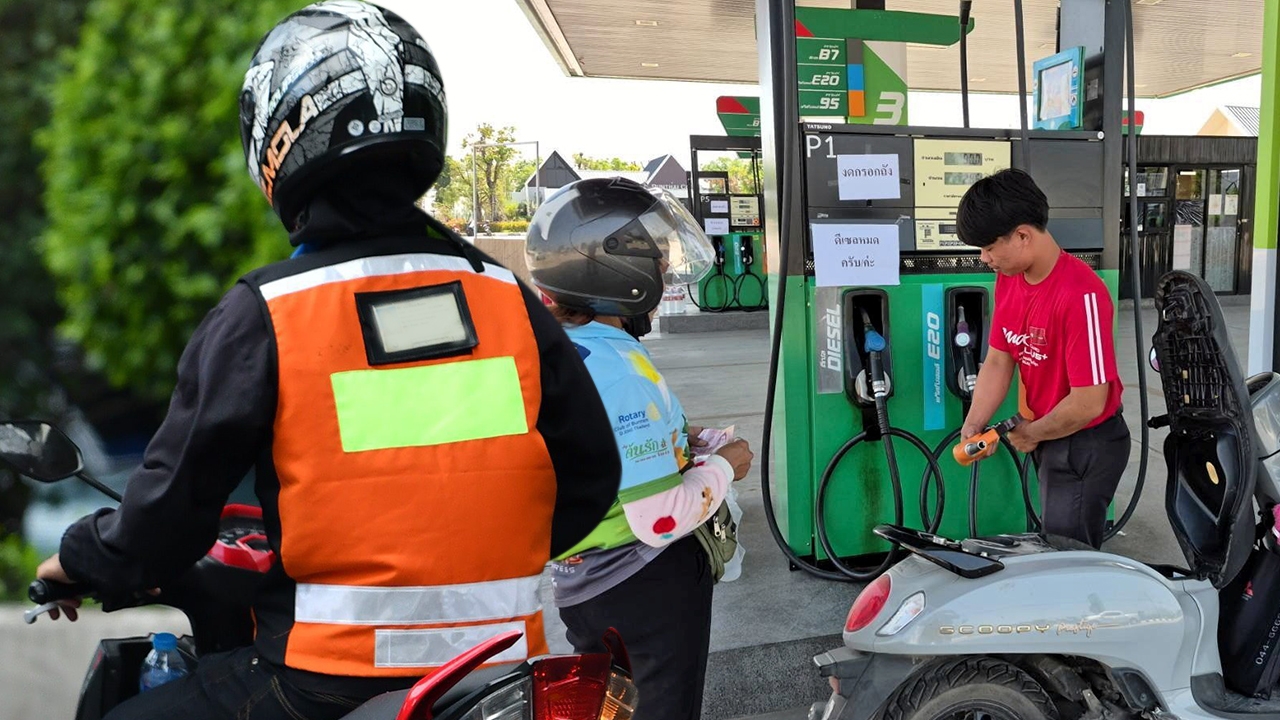
Motorbike taxi drivers are overwhelmed by rising fuel costs and urge the government for urgent support. With incomes shrinking, they propose government backing for electric motorcycles and deregulation of registration, viewing this as a long-term lifeline to survive.
Amid soaring fuel prices compounded by shortages in some areas, many motorbike taxi drivers struggle to find fuel, causing their costs to surge while their working hours shrink.
Thairath Online's special team interviewed Chalerm Changthongmadan, President of the Motorbike Taxi Drivers Association of Thailand, about the heavy impact that high fuel prices are having on those working on the streets.
The issue is not only rising fuel prices but also difficulty finding fuel. Gas stations once used regularly, especially those in alleys, now often lack fuel, forcing drivers to search around instead of spending time transporting passengers. This both raises costs and lowers income.

Time that should be spent earning money is now spent hunting for gas stations, causing income to drop. Meanwhile, fares remain unchanged because most drivers don’t want to pass costs onto passengers amid rising living expenses. For example, fuel that previously cost 100–120 baht lasted all day, earning about 500 baht. Now, fuel costs have risen to 150 baht, but income has fallen to 300–400 baht due to time lost searching for fuel and fewer passengers.
This situation forces drivers to adapt. Instead of refueling in the morning, they now look for fuel in the evening before going home, sharing information within their groups about which stations have fuel to manage the immediate problem. At the same time, passenger numbers have clearly dropped from 20–30 per day to around 25 or fewer, as people tighten spending and travel only when necessary.

Opportunities for longer-distance jobs have declined due to ride-hailing apps, leaving most motorbike taxi drivers to take only short rides earning about 15–20 baht per trip. Their main customers are those traveling daily in and out of alleys.
Chalerm expressed drivers’ frustration, saying that while high fuel prices are tolerable, the greater problem is the lack of fuel availability, which disrupts work and adds unnecessary burdens. Among drivers there is concern over raising fares due to fear of passenger backlash, while current incomes are barely sufficient to survive.
Chalerm suggested the government should urgently support the adoption of electric motorcycles (EVs) among drivers to reduce energy costs and help address environmental issues such as PM 2.5 dust pollution.
However, significant current limitations include insufficient travel range, inadequate charging stations, and living conditions unsuitable for charging—such as drivers residing in multi-story buildings. He proposed that if the government could promote widespread EV use among this group—on the order of 100,000 vehicles—it would significantly reduce oil dependence and offer a more sustainable solution than short-term fixes.

Regarding relief measures like fuel cards, Chalerm noted practical limitations since they cannot be used at all stations and some areas lack participating stations, so having a card does not truly solve the problem.
Structural problems are also reflected in the motorbike taxi registration system. Currently, there are about 200,000 active drivers, but only around 50,000 are properly registered because the government has not allowed legal registration for over two years. This prevents many drivers from accessing government benefits or support measures. Similarly, many drivers fail to qualify for the State Welfare Card because their income is assessed as too high, despite bearing heavy costs.
He concluded that short-term fixes like price caps or distributing cards are not sustainable solutions. If the government has clear policies promoting alternative energy, especially for public transport, drivers will no longer worry about fuel and can work with greater stability in the future.