

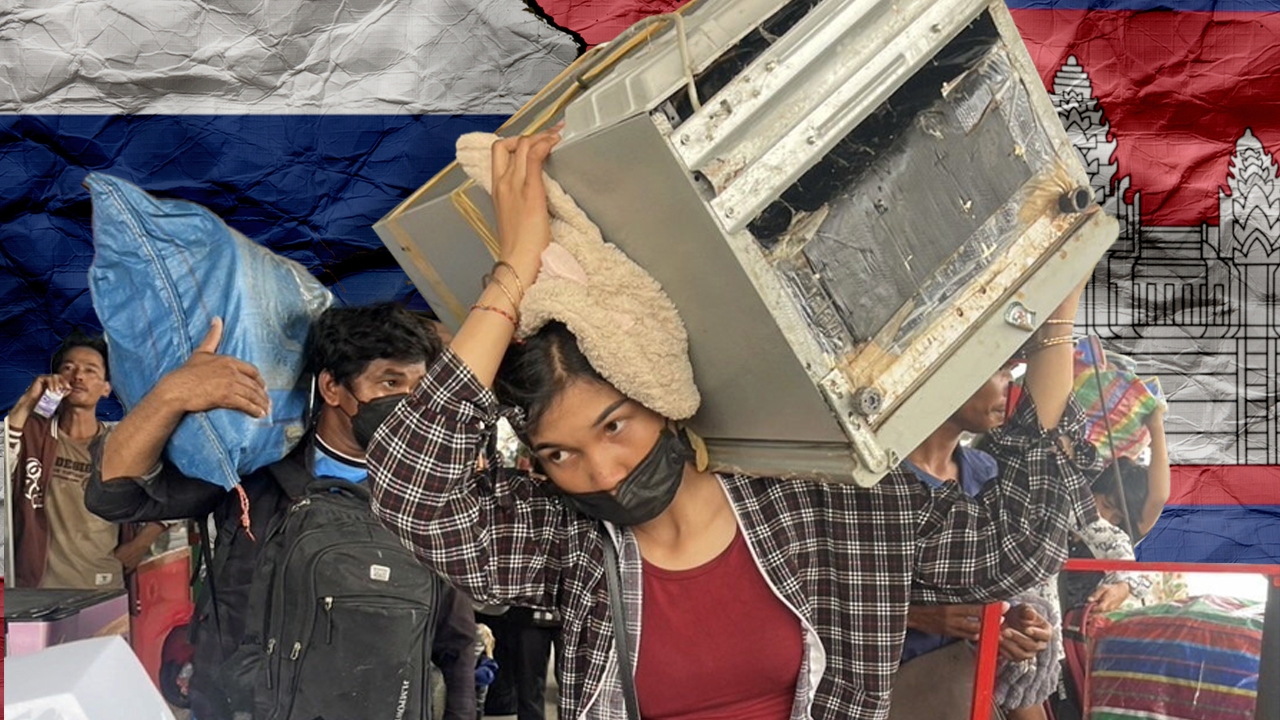
The abandonment of Cambodian workers who fail to renew visas impacts Thai employers, putting hundreds of thousands of employees at risk of falling out of the system. Small business operators bear heavy costs and must pay extortion fees within the system, with long-term effects shaking the overall economy.
The situation of Cambodian workers in Thailand is reaching a crisis point. By the deadline of 31 Mar 2026, as per the Cabinet resolution on 2 Dec, 103,598 workers will lose their work rights immediately if they cannot renew their visas in time. Combined with over 4,000 border-hired workers and cross-border commuters whose status expires in the same month, the number of workers falling out of the system continues to rise. Some already lost status as early as January due to inability to process renewals on time.
Regarding Cambodian workers returning home, Thairath Online's special report consulted Nilubon Pongpayom, a representative of the White Employer Group, who stated that Cambodian workers are a crucial part of Thailand's labor market, ranking second only to Myanmar. The loss of over a hundred thousand workers is therefore not just a group issue but is affecting the broader economic structure.

Adisorn Kerdmongkol, coordinator of the Migrant Population Network, noted that the loss of Cambodian workers from the system immediately impacts the economy, including fisheries, construction, agriculture, industry, and services. Labor shortages occur suddenly, especially in agriculture sectors like sugarcane and sugar, which risk missing quota systems. Many construction projects are stalled, and service sectors such as restaurants in shopping malls must rapidly adjust their workforce. Employers face shortages in jobs that Thais refuse to do and try to find replacements from other countries but encounter many limitations. Myanmar labor is declining due to internal conflicts and conscription policies, Lao labor is limited and not promoted for overseas work, Vietnamese labor imports have nearly ceased recently, and Sri Lankan workers face cost, language, and job suitability challenges, especially in agriculture.
Although some businesses attempt to use technology to replace labor, cost limitations prevent this approach from being widely adopted, especially among small and medium-sized enterprises.

When workers fall out of the system, illegal labor increases. The recent Thai-Cambodian relations have led to border closures and restricted services at the Cambodian embassy in Thailand, preventing workers from renewing passports through the usual channels, such as crossing borders or direct embassy processing.
With these channels closed, many workers cannot maintain legal status and gradually fall out of the system, becoming illegal workers by default. This increases their risk of arrest, while immigration detention centers face overcrowding beyond capacity and cannot accommodate all detained workers. Meanwhile, the government struggles with insufficient budgets for care and repatriation.
At the same time, inefficiencies in the system create opportunities for unofficial extortion, lack of transparency in discretionary decisions, and exploitation of vulnerable workers, worsening the crisis beyond legal status issues alone.
Nilubon explained that the root causes of workers falling out of the system are not only visa renewal delays but multiple layered constraints: failure to renew on time, inability to change employers, passport renewal issues due to border restrictions, and problems with the unstable e-Work Permit system, which has data losses and does not support the practical needs of many workers.
How long can Cambodian workers stay in Thailand? The process requires workers to register via email and undergo biometric scanning before employers submit their data into the system, which becomes a major obstacle since many workers lack smartphones or cannot access the system. Service centers are overwhelmed with queues, causing delays that lead many workers to become illegal immediately, even while still working at their original workplaces.
Nilubon added that beyond legal status problems and system inadequacies, hidden risks are emerging, notably the use of fake medical certificates in labor documentation, exposing vulnerabilities due to insufficiently strict verification processes.
This issue affects not only documentation but also the overall public health system, as fake documents can undermine disease screening effectiveness and increase the risk of infectious disease outbreaks in workplaces and communities.

Adisorn observed that the government's past approach has been short-term fixes: when workers disappear, new registrations are allowed without addressing the root causes, causing the cycle of falling out and re-registering to repeat continuously.
An urgent proposal is to extend the grace period by six months to prevent more workers from falling out of the system, alongside specific control measures such as periodic check-ins and work area restrictions if the government remains concerned about security.
The policy decision remains caught in political pressure, including nationalist sentiment and social conflicts, making the government hesitant to move on sensitive issues despite many affected people.
The current critical issue for Cambodian workers in Thailand is not just visa renewals or temporary extensions but establishing a long-term strategy for managing migrant labor that retains workers in the system and reduces dropouts. When the system expels workers more easily than it retains them, the impact extends beyond the workers to affect the entire economy inevitably.