

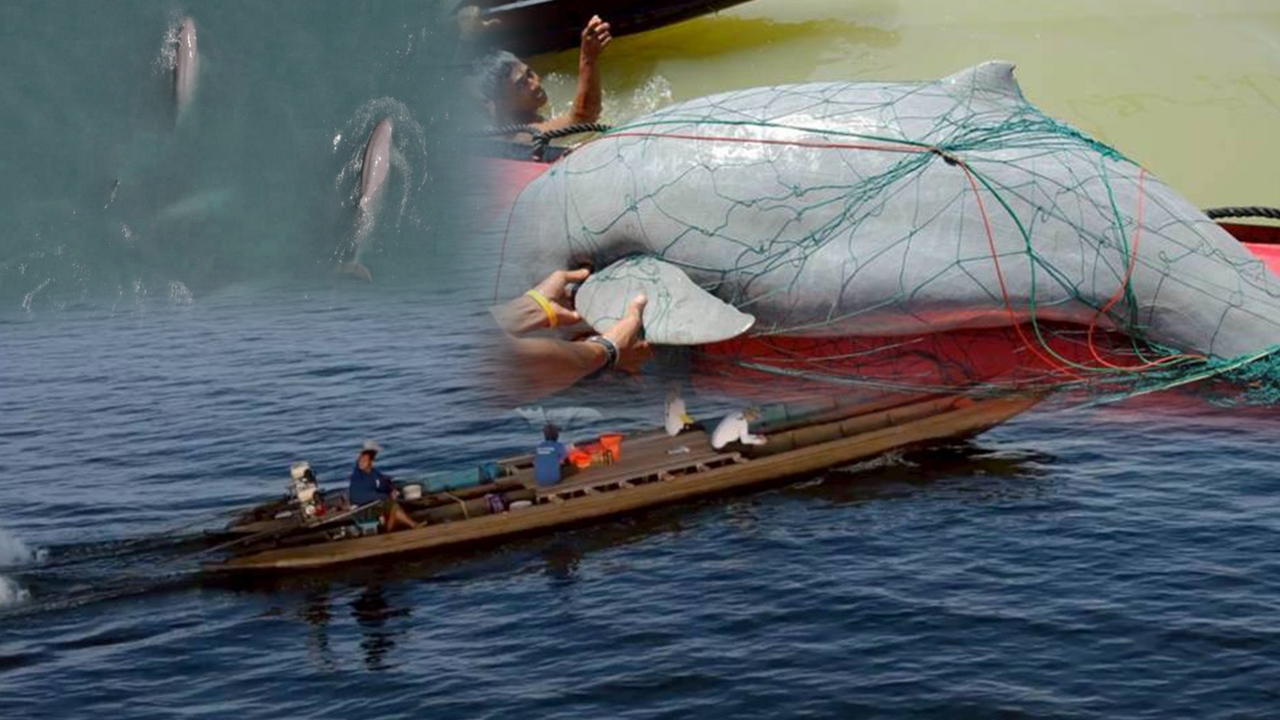
The rescue mission for the last 14 Irrawaddy dolphins in Thailand, the lifeblood of Songkhla Lake. The NSTDA and World Bank, in collaboration with multiple agencies, have developed a 5-year roadmap with a budget of 402 million baht to conserve and breed the dolphins and promote their sustainable coexistence with local communities.
"Irrawaddy dolphin" A species named after the Irrawaddy River in Myanmar, Thailand's neighboring country. This mammal lives in both freshwater and brackish environments, found along coastlines from the Bay of Bengal in South Asia to Indonesia. Freshwater Irrawaddy dolphins are rarer and currently found in only five locations worldwide: the Irrawaddy River in Myanmar, the Mekong River in Laos and Cambodia, the Mahakam River in Indonesia, Chilika Lake in India, and Songkhla Lake in Thailand.
In these freshwater habitats, dolphin populations range between 70 to 100 individuals per site. However, Songkhla Lake’s population is critically different, with only 14 dolphins remaining, placing them at extreme risk of extinction and potentially disappearing from the lake forever without timely intervention.

Mr. Piti Sakumpong A former fisherman turned shrimp bank operator and currently vice chairman of Ban Khlong Khut community, he recounted that he has seen Irrawaddy dolphins in Songkhla Lake throughout his life. In his childhood, he often encountered both live dolphins and stranded carcasses along the shore every year.
Mr. Piti continued that during his fishing days around 1982-1987, dolphins appeared in groups of more than ten, estimating about 50 individuals. But as fishing gear became more widespread, dolphins got caught in nets, their habitats shrank, and food sources declined. Today, only a dozen or so remain, occasionally seen, much fewer than before.
Mr. Santi Nilwat Director of the Andaman Coastal and Marine Resources Research Center, Department of Marine and Coastal Resources (DMCR), revealed that Irrawaddy dolphins have likely inhabited this area since Songkhla Lake formed about 1,500 years ago, originally living along the coast before the lake's creation. "Sathing Phra Sandbar" This natural barrier blocked saltwater from the Gulf of Thailand, turning it into a freshwater lake. It is believed that the dolphin population became trapped within the lake at this time.
In the past, the Irrawaddy dolphin population was substantial before the arrival of "fishing gear" which increased in number and efficiency, reducing the dolphins' food supply and causing many to become entangled, especially in "giant catfish nets" There is also a rising problem of water pollution linked to the growth of surrounding communities and lake shallowing.

Over the past 30 years, 144 Irrawaddy dolphins have died—averaging more than eight annually—with over 60% dying from net entanglement. This led to a program to collect and buy back giant catfish nets from fishermen, which has clearly reduced dolphin strandings and eliminated net entanglement incidents.
However, the reduced death rate may partly reflect the declining population. The latest 2022 survey found only 14 Irrawaddy dolphins remaining in Songkhla Lake. Dolphins are reproductively fragile, with an average lifespan of 30-50 years, reaching maturity at 8 years or older, and giving birth to one calf every 2-3 years. A dolphin's gestation lasts 12 months, followed by 18 months of close nursing. If a mother dies during this period, her calf also likely perishes.
. Mr. Kitipong Songnui Head of the Thale Luang Wildlife Sanctuary, Protected Area Regional Office 6 (Songkhla), Department of National Parks, Wildlife and Plant Conservation, explained that fishing gear zones have been established to conserve dolphins in the upper Songkhla Lake area, known as "Thale Luang" This area is divided into three zones: "Zone A" The innermost 'egg yolk' area in the lake, covering about 47,000 rai, where fishing gear is strictly prohibited.
Next is "Zone B" The intermediate outer zone, about 56,000 rai, where fishing gear is permitted but nets with mesh larger than 13 cm are banned. Lastly, "Zone C" The outermost zone, covering 268,000 rai, where nets with mesh larger than 20 cm are prohibited.
Zoning affects fishing activities of over 61 villages around Thale Luang. Officials spent more than 3-4 years engaging with communities to build understanding and jointly establish "fish traps" along shorelines as alternative fishing grounds to compensate for restricted lake fishing and reduce disturbance to dolphins.
Although the latest survey found 14 dolphins, this is preliminary data; precise numbers, gender distribution, and ages remain unknown, complicating conservation planning and leading to the "Songkhla Lake Irrawaddy Dolphin Conservation Action Plan" developed through multi-sector collaboration.

On 24 Mar 2026 GMT+7, at the opening ceremony for the Songkhla Lake Irrawaddy Dolphin Conservation Action Plan orientation, Prof. Dr. Sompong Klai Nongsuang, Director of the National Science and Technology Development Agency (NSTDA), stated that the dolphin conservation plan is a flagship project under the national research and innovation strategy, important to the Thai government for conservation, climate change, and sustainable development.
This initiative involves collaboration among at least three ministries, driven by the Science, Research and Innovation Fund (SRIF) through the National Research Office (NRCT) and the Office to Accelerate Research and Innovation for Competitiveness and Regional Development (Public Organization) (ARIC). It also partners with functional agencies such as the Department of Fisheries, Department of Marine and Coastal Resources, and the World Bank.
The project budget totals 402.8 million baht, divided into 181 million baht from government functional budgets, 89 million baht from the SRIF, and 132 million baht from the World Bank’s PROBLUE Fund, which supports integrated and sustainable economic activities under healthy ocean ecosystems, equivalent to 4 million USD. Prof. Dr. Sompong added that the research and innovation approach includes four main components: restoring Songkhla Lake and its aquatic life, conserving and breeding Irrawaddy dolphins, and fostering community engagement around the lake to achieve sustainable growth.

Mr. Santi, Director of the Andaman Coastal and Marine Resources Research Center, revealed that initial funding will enable installation of 64 Acoustic Survey (PAM) devices across the lake to monitor dolphin movements in real time. This data will support dynamic fishing zoning to protect dolphin habitats while allowing fishermen more flexible access than current fixed zones.
Expecting 3 new dolphin calves within 3 years Prof. Dr. Sompong said the research plan aims for at least three years of continuous collaboration on dolphin conservation and breeding in the wild. “If within these three years we thoroughly understand the life of Irrawaddy dolphins, it is highly possible to ensure their survival and reproduction, leveraging knowledge from wild dolphin populations and World Bank studies of similar models abroad.”

Sustainable coexistence with communities
Prof. Dr. Sompong explained that local communities will receive compensation, possibly through provision of suitable fishing gear. If research identifies areas with dense dolphin populations that impact fishing, alternative aquatic species might be introduced as new products, enabling communities around the lake to improve incomes and quality of life while enhancing the environment. With thorough biological studies and successful breeding, economic and tourism development opportunities may arise, though long-term investments remain necessary.
Meanwhile, Prof. Dr. Phedimsak Jaryapan, Director of the Blue Economy Research and Innovation Coordination Center at NRCT, noted community friction varies, with some fully supportive and others less engaged, possibly due to unclear project benefits. However, conserving the Irrawaddy dolphin will serve as an indicator of critical natural resource health and support sustainable resource use benefiting local people. He believes eventual cooperation and recognition of the project's value by communities are achievable.
