

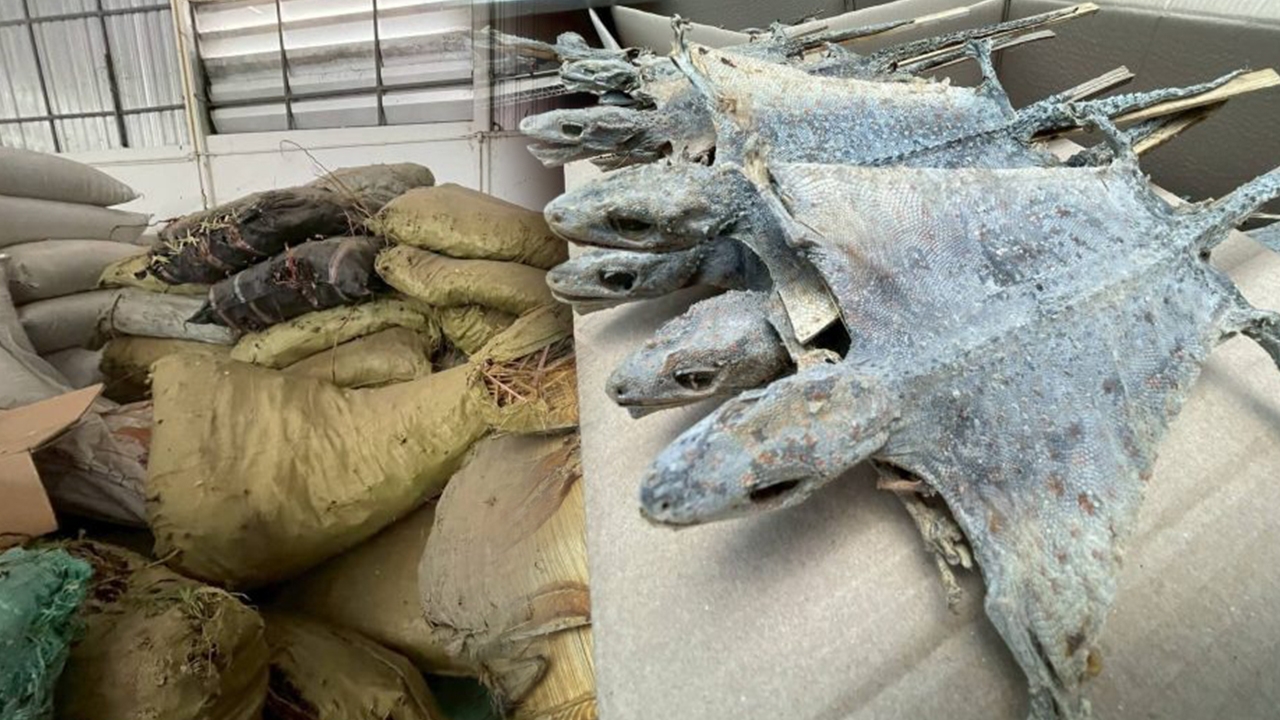
Chinese investors are exploiting export quotas on Thai dried geckos by smuggling them in from Indonesia. They highlight the quality difference of Thai geckos, which are well-regarded in the Chinese market at higher prices. The Department of National Parks is imposing stricter export inspections.

There has been an ongoing smuggling operation importing dried geckos through Thailand's borders to claim export quotas to China. Recently, Thai authorities discovered a systematic operation by Chinese investors smuggling dried geckos along the southern border. Most dried geckos are brought in from Indonesia, which has limited export quotas. These investors then claim them as Thai geckos to export and mark up prices at the destination.
On 6 March 2026, the Central Phaya Suea task force and the Natural Resources and Environmental Crime Suppression Division (Division 5, Crime Suppression Police) raided a suspicious warehouse in Lam Luk Ka Subdistrict, Lam Luk Ka District, Pathum Thani Province, under a Thanyaburi Provincial Court warrant. They seized 124,000 dried gecko carcasses illegally imported, packed in cardboard boxes ready for export, along with other agricultural and natural resource products such as sacks of dried orchids, buffalo horns, wood chips, and wood powder. These items were confiscated for detailed source verification.

Previously, on 27 August 2025, authorities seized 15,000 smuggled dried gecko carcasses. Continued investigations revealed this warehouse was used as a large storage site to gather goods before export abroad.
Thairath Online special news team interviewed Sadudi Punpakdee, Director of the Wildlife and Plant Protection Division under the Department of National Parks, Wildlife and Plant Conservation. He stated that most seized dried geckos involved Chinese investors behind the scenes, with the geckos originally smuggled from Indonesia into southern Thailand.
The reason for smuggling dried geckos into Thailand is that Indonesia has limited export quotas but produces large quantities. Therefore, geckos are illegally brought into Thailand to claim export rights, since Thailand has not yet established clear export quota limits.

Regarding differences between Thai and Indonesian geckos, there are slight scientific physical differences, but the most obvious is the "drying technique".
Thai villagers, especially in Na Wa District, Nakhon Phanom Province, are skilled at "stretching" geckos to dry them into well-shaped and standardized sizes, superior to those from Indonesia.
The dried gecko business and exports from Thailand primarily target the Chinese market. Previously, about 6 to 10 major Thai operators had been active for 7-8 years. Recently, "gray Chinese capital" has entered, buying geckos from villagers at high prices for export, with some involved in smuggling to claim export rights.
About 90% of Thailand's dried gecko production for export comes from Na Wa District, where villagers catch geckos near their homes to earn supplemental income.

Government measures to address quota exploitation include listing geckos under CITES (the Convention on International Trade in Endangered Species), requiring Thailand to establish new export quotas and prioritize rights for existing traders.
The Department of National Parks is currently setting up quota systems that consider the natural population sizes.
Enforcement efforts over the past 4-5 months have slowed exports to verify documentation, with stricter scrutiny on exporters’ sourcing, ensuring purchases come from genuine communities with legitimate origins.