

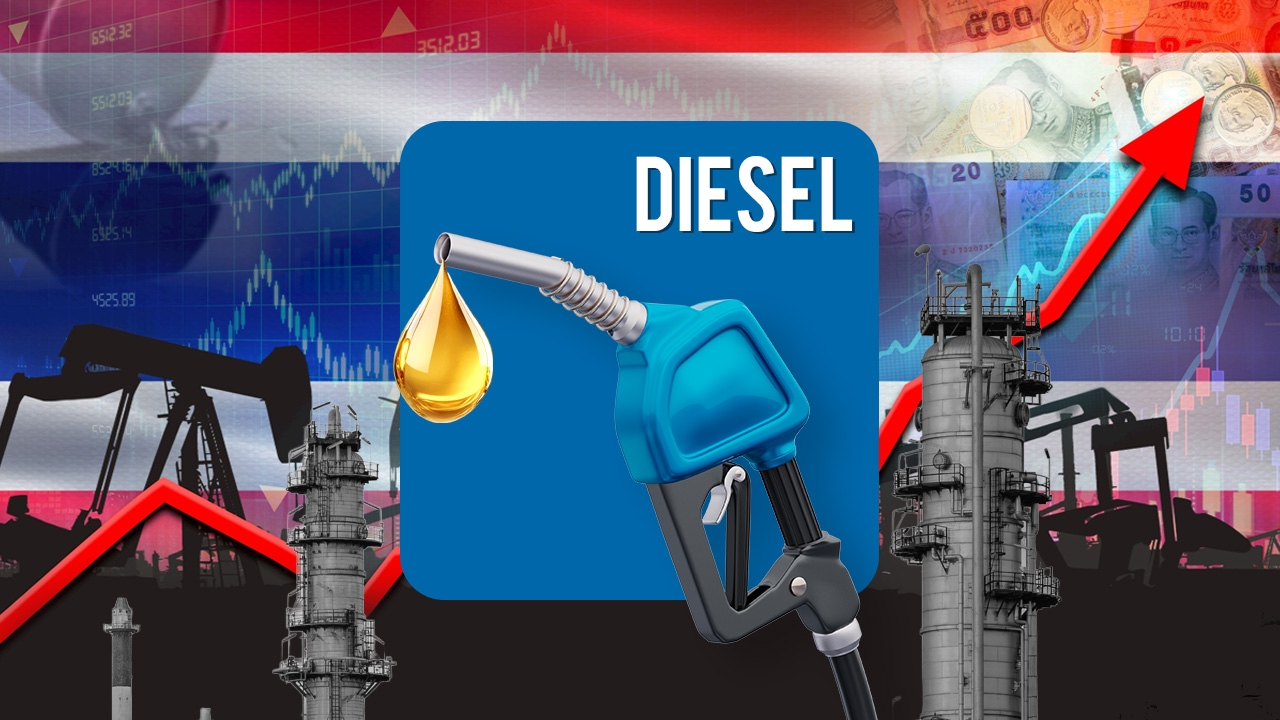
Pressure mounts on refineries to release profit margins and reduce fuel prices, with diesel expected to surge to 60 baht per liter. Thailand's GDP faces a sharp contraction amid rising inflation, high layoffs, and a collapsing economy.
The energy crisis caused by the Iran war has led to a continuous surge in oil prices in Thailand, especially diesel, which has now risen over 20 baht per liter. The government, led by Anutin, has begun measures to reduce refining fees. As of 7 Apr 2026 GMT+7, the Ministry of Energy announced a refining fee of 17.50 baht per liter—nearly double last year's rate—contrasting with the oil fund's deficit exceeding 56 billion baht. The government may consider borrowing to compensate the fund again.

At today's (7 Apr 2026 GMT+7) Energy Policy and Planning Office (EPPO) meeting, Minister Eknat Phrompan announced that the Energy Policy Committee (EPC) has approved measures to reduce refinery prices. For March 2026, refinery prices will be cut by 2 baht per liter. It remains to be seen if this 2 baht reduction at the refinery level will translate into lower pump prices.
The refining fee is a key variable the government is pushing refineries to lower prices on, despite refineries citing increased transportation costs and nearly doubled crude oil purchase prices. Refining fees rose from 2.14 baht per liter in January 2026 to 7.23 baht per liter in March 2026, and now have surged to 17.50 baht per liter.

The Thairath Online special news team interviewed Associate Professor Dr. At Phisanwanich, an expert in international and ASEAN economics, who analyzed refining fees. He noted that government measures to reduce refining fees will lower fuel prices, but the reductions should primarily support the public. Currently, refining fees are linked to refinery gate prices, having risen to 17.50 baht per liter—significantly higher than the previous average of 2 baht per liter.
Diesel prices have increased by 68.8%, while refinery gate prices have risen nearly 200%. Implementing mechanisms to reduce refining fees effectively would help alleviate the public's burden.
The oil fund has effectively become a large public fund supporting fuel prices, akin to citizens helping themselves since the fund comes from the public. Meanwhile, the government has not reduced fuel taxes, and oil companies have not contributed to cost relief. Therefore, besides cutting refining fees, the government must also consider reducing fuel taxes to aid the public.

Refineries claim that the war has increased crude oil purchase and transportation costs, but previously, oil companies did not bear these expenses and have already reaped significant profits.
Thailand's refining fee should not exceed 5 baht per liter, but it has surged to 17.50 baht per liter, an excessive increase. This contrasts with Vietnam, where the government sets fuel prices instead of private companies, and Indonesia, where refineries are government-owned.
Proposals for free competition among refineries in Thailand might help in the future. However, currently, foreign investors can enter the Thai refinery market, but private companies set fuel prices, causing pump prices to spike. Hence, the ideal solution is free trade with government price controls, as in Vietnam, where investment is open but price formulas are government-determined.

Refining fees represent gross profits, not net profits. Previously, the average refining fee was just over 2 baht per liter. Adding other costs of about 3 baht would bring total fees to no more than 5 baht per liter, a reasonable price under current conditions. A permanent ceiling on refining fees should be established.
The current fuel pricing formula requires structural revision, including redefining refinery gate prices and refining fees. Thailand’s pricing method differs from Vietnam, Malaysia, and Indonesia. While these countries reference Singapore’s fuel prices, they only use them as a base and adjust prices to suit their own populations’ needs.

Fuel taxes raise questions during this energy crisis, as the government has yet to reduce them. Associate Professor Dr. At notes that throughout the surge in oil prices, citizens have essentially been self-supporting, while the government has refused to cut fuel taxes. In contrast, Vietnam has reduced fuel taxes to zero baht per liter until June.
“Over the past month, citizens have been solving the high fuel price problem largely on their own, with little government assistance. The response has been very slow, especially for farmers facing rising agricultural costs, such as rice, sugarcane, and coffee growers,” he said.
Regarding borrowing to support the oil fund, it is still seen as necessary since the fund is over 56 billion baht in deficit. However, the government must consider cost-effectiveness: whether borrowing to support the fund or reducing fuel taxes would be more beneficial. Borrowing could mean a double burden on citizens—both fuel taxes and future loan repayments.

Associate Professor Dr. At believes that if diesel, critical to industry and transport, rises to 50.54 baht per liter, Thailand’s GDP will shrink to 1% annually. If diesel hits 60 baht per liter, GDP could fall to 0.5% or become negative in some quarters. Originally, the National Economic and Social Development Council projected 2% growth this year, but rising energy prices will reduce GDP. Analysis suggests diesel at 60 baht per liter would lead to GDP contraction and the onset of a major economic crisis.
Thailand will face very high inflation of 5–6%, leaving citizens with little spending power and triggering mass layoffs, leading to economic stagnation. People should prepare for the coming challenges.
Although the war may end, global oil prices will take about two years to normalize due to damage to major regional oil and gas facilities requiring lengthy repairs.