

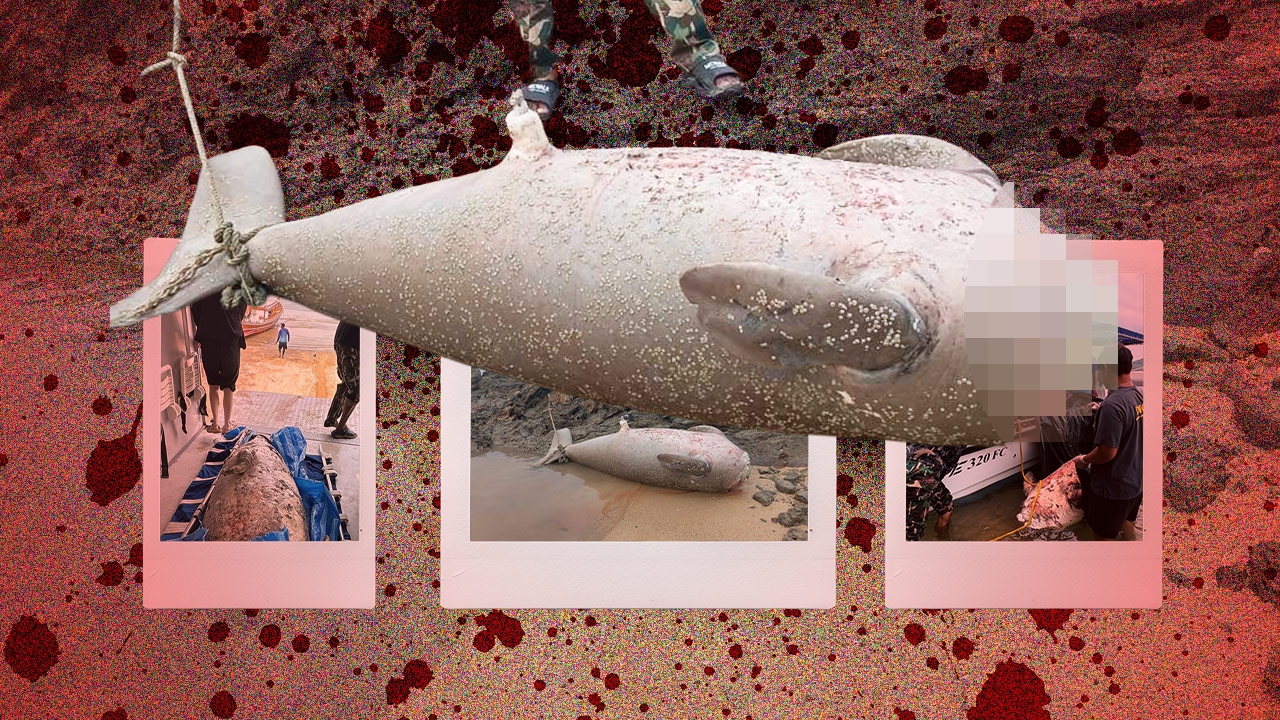
An adult dugong carcass was found beheaded on Koh Yao Noi, Phang Nga, revealing clear evidence of human involvement. The tail was tied with rope and anchored to an underwater rock to mislead authorities. Researchers stressed the need to identify and punish those responsible.
Today (9 Apr 2026), Dr. Kongkiat Kittiwattanawong, a specialist in marine and coastal ecosystem resource and environmental research affiliated with the Department of Marine and Coastal Resources (DMCR), who has long worked on dugong conservation, posted on Facebook about the latest dugong death caused by human actions, saying, "I hope that in some cases the perpetrators can be found."

The Upper Andaman Sea Marine and Coastal Resources Research Center inspected the carcass and reported that on 9 Apr 2026, their officers received a report from volunteers on Koh Yao Noi Subdistrict, Koh Yao District, Phang Nga, about a dugong carcass found there. The center’s researchers, together with citizen scientist Mr. Theerasak Saksritavi, went to investigate.

They found the dugong carcass missing its head, male, fully grown, about 2.20 meters long (excluding the head) and weighing approximately 120 kilograms. Barnacles covered its body. There were cut marks from a sharp object on the right side of the chest, and its tail was tied with a coiled rope knotted to an underwater rock. The center's staff collected the rope as evidence and, with help from Paradise Koh Yao Resort, transported the carcass from Koh Yao Noi to Ao Por Pier in Phuket.

The carcass was handed over to center staff for autopsy to determine the cause of death. Regarding the legal case, officers from the Marine and Coastal Resources Office Region 6 filed a report with Koh Yao Police Station, Phang Nga Provincial Police Region 8, to investigate and gather evidence leading to the arrest of the offender.
Between fiscal years 2023 and 2025, 112 dugong strandings were recorded, including eight cases of illegal tusk or head removal. In fiscal year 2026, two strandings were found, one involving illegal tusk or head removal. All removals occurred post-mortem. The department continues to campaign among fishing networks, dugong volunteer groups, and the public to raise awareness of dugongs' value and dispel the false belief that dugong tusks have mystical powers. They have also been enhancing capacity-building efforts.
Officials organize workshops on forensic diagnosis and data collection, habitat restoration, seagrass cultivation in abandoned shrimp ponds, fencing for seagrass recovery, and rehabilitation of degraded seagrass beds to restore dugong habitats. The public is encouraged to report any relevant information or sightings of injured or stranded rare marine animals to local authorities or the Forest and Marine Protection Hotline at 1362, available 24 hours.