

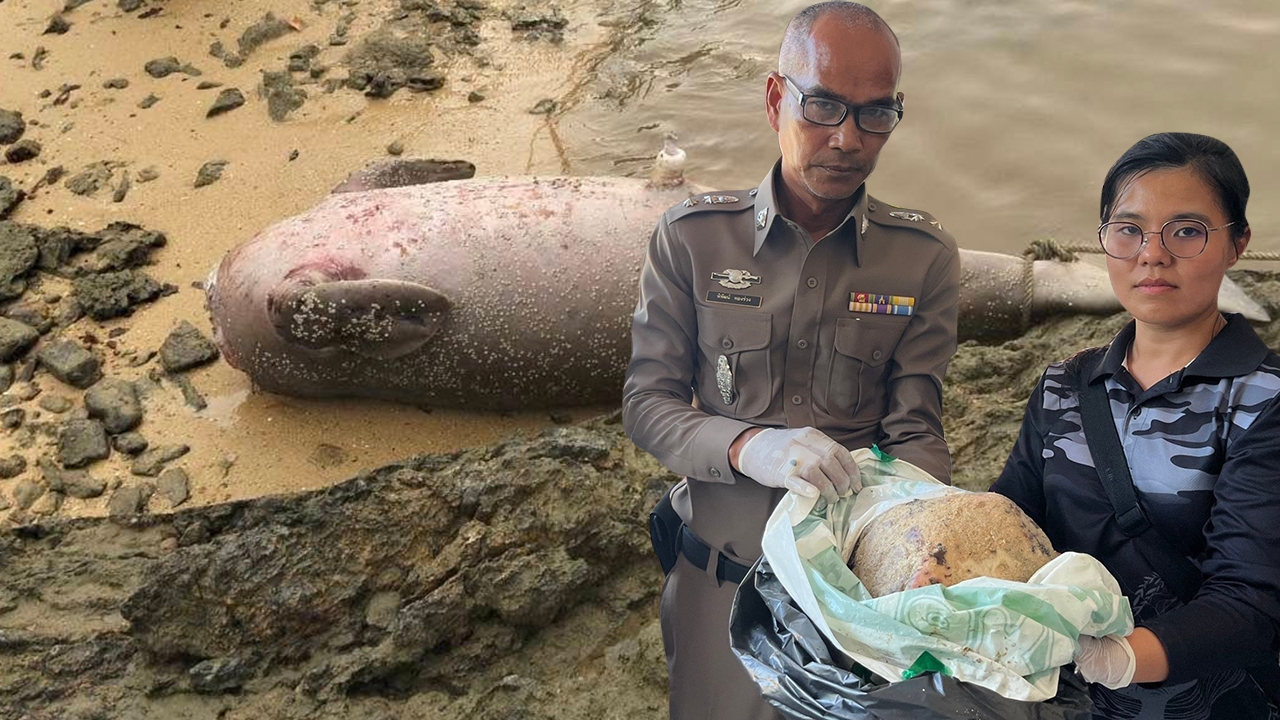
Tragic“Headless Dugong”At Ko Yao Noi, a dugong’s nose fragment was found abandoned in the sea. It is suspected that the perpetrator decapitated the dugong after it died from illness. Evidence indicates the cutter was skilled, knowing the bone joint precisely. There are tight lock marks on the body’s side from the cutting process. Evidence has been sent to police to track the suspect and compare DNA.

The Thairath Online special news team continues to follow the case of a full-grown dugong found at Ko Yao Noi, Phang Nga province, on 9 April 2026. The dugong carcass was missing its head, male, fully mature, about 2.20 meters long (excluding the head), weighing approximately 120 kilograms. Autopsy showed the dugong suffered from intestinal illness and was unable to eat, leading to death. Tragically, the missing head had sharp cut wounds, indicating human action in decapitating the dugong.
Recently, investigators found the dugong’s nose fragment discarded in the sea, regarded as crucial evidence to identify the perpetrator.

On 11 April 2026, the Upper Andaman Marine and Coastal Resources Research Center reported that Mr. Phaedet Laitong, Deputy Permanent Secretary of the Ministry of Natural Resources and Environment, traveled to follow up on the situation of the dugong’s death and decapitation.
He was welcomed by the directors of the Upper Andaman Marine and Coastal Resources Research Center, Marine and Coastal Resources Office Region 6, Mangrove Conservation Center Region 10, Phang Nga Provincial Natural Resources and Environment Office, and other officials.

A veterinarian from the Sirithan Rare Marine Animal Rescue Center summarized the forensic autopsy results. It is believed the dugong stranded and died before decapitation, as there were no bruises or blood congestion in the tissues. The decapitation likely occurred more than 2 hours but less than 24 hours after death, as the cut edges remained sharp and not decomposed. This was not a hunting act for decapitation since there was no muscle breakdown or water in the respiratory tract, indicating the animal did not drown before dying.

It is presumed the decapitator was highly skilled, as the head was cut precisely between cervical bone joints with sharp wounds. The cutting tool must have been long enough to sever a large head. There were also marks on both sides of the chest, indicating the use of a solid object to lock the body tightly for easier cutting. To clarify the case, an investigation is underway to find the offender, including site inspection with Phang Nga National Park officials and district officers.
The team then went to Ko Yao Police Station to receive additional nose fragment evidence from the police for DNA testing. Marine and Coastal Resources Office Region 6 also filed a complaint under Section 17 of the Wildlife Preservation and Protection Act. Field investigations revealed from the district chief that the rope found tied to the carcass was only to prevent loss of the remains.

According to the Department of Marine and Coastal Resources, from fiscal years 2023 to 2025, there were 112 recorded dugong strandings, with 8 cases involving illegal tusk or head removal. In fiscal year 2026, there were 2 strandings, with 1 case involving illegal tusk or head removal. All decapitations occurred after the animals had died.
Decapitating a dugong is a criminal offense under the Wildlife Preservation and Protection Act B.E. 2562 (2019). Section 12 prohibits hunting protected wildlife, punishable by imprisonment from 3 to 15 years, fines from 300,000 to 1,500,000 baht, or both. Section 17 prohibits possession of protected wildlife or remains, punishable by up to 5 years imprisonment or a fine up to 500,000 baht, or both. Section 29 prohibits trading protected wildlife or their remains, punishable by 3 to 15 years imprisonment or fines from 300,000 to 1,500,000 baht.

. The Thairath Online special news teamcontinues to track down the perpetrator in this case, as head removals of dugongs have continued to be carried out to create amulets based on false beliefs. Meanwhile, past perpetrators have often evaded capture, while Thailand’s dugong population steadily declines.